Ghosts, monsters, strange cars and other Halloween creatures haunt Frankensteiners Ball

Cross a Halloween party with a car show and you get the annual Frankensteiners Ball. (See lots of photos at end of article.)Add rain, some snowflakes, temperatures around 40, a costume contest, and 507 hot rods, rat rods, classic cars, created one-of-a kind vehicles, and you get the eighth annual Frankensteiners Ball held October 20, 2013, at the Anoka County Fairgrounds.The annual event includes contests for best Halloween costumes for adults and children, the best flame-throwing car, the car with loudest pipes, and a limbo contest for the car that can go the lowest.Last year on a sunny day, the show attracted 1,156 cars and perhaps hundreds of children who walked from car to car picking up trick-or-treat candy from buckets club members displayed with their the cars.On October 20, the number of children was noticeably smaller but no less enthusiastic about picking up candy from car owners offering it.Within a day, the Frankensteiners Car Club had posted an event picture of club members at the event with a note thanking “the brave spectators,” vendors, and participants who helped make “another great show, smaller but no less great.”The Frankensteiners Ball started in 2006 in the parking lot of a Coon Rapids bar and moved in 2009 to the Anoka County Fairgrounds and in 2012 the club began talking about looking for an even larger venue.Ed Reinke, whose project is restoring a 1939 Plymouth sedan, said he was not worried about getting his car wet. “I’m quite certain it’s seen rain before,” he said about the car he purchased from someone who had stored it on a farm.Reinke was more concerned about making sure that children got the Tootsie Pops he was handing out without getting the candy wet.Walt LaRoche used his classic 1955 Ford Crown Victoria as a place to keep warm with the engine idling and the heater running.LaRoche said he’s a member of the Minnesota Street Rod Association, a much larger and older group than Frankensteiners. Although this was his first Ball, he has regularly attended MSRA’s Back to the 50s, which held its 40th annual show in June at the Minnesota State Fairgrounds.Many participants see the Frankensteiners Ball and Back to the ‘50s as Minnesota’s two biggest car events of the year.[FULL DISCLOSURE: The writer’s adult son is a member of Frankensteiners.] Well-preserved old cars and creations made from car, truck and tractor parts shared the field at the Frankensteiners Ball at the Anoka County Fairgrounds. Some vehicles at the Ball are hard to classify: Is this a tractor, pickup or hot rod car?  “I’m quite certain it’s seen rain before,” said Ed Reinke about his decision to take his 1936 Plymouth to the Frankensteiners Ball in the drizzly morning. Reinke has restored this car himself. Continue Reading

Neighbors say farewell to Joyce Anderson

Nearly 100 neighbors, relatives and friends gathered on the Minneapolis riverfront Sunday, October 13, to bid farewell to long-time Marcy-Holmes resident Joyce M. Anderson, 90, who died October 1.Anderson had created and maintained a garden at the east end of the Stone Arch Bridge in memory of her late partner Joan Leigh, who helped convert the bridge to a pedestrian and bicycle path after the railroad abandoned it.“If she were here today, Joyce wouldn’t be sitting here; she’d be over there weeding and tending the garden,” said Mugs Enstad, a crew leader for the Minneapolis Park and Recreation Board.Anderson recruited park staff to think of the park as their own as well as hers, Enstad said. She and Rochelle Rau shared memories from the park staff.The garden surrounds a bench purchased by the Marcy-Holmes Neighborhood Association to honor Leigh’s role in getting the state to purchase the bridge and convert it into a pedestrian and bicycle trail.The converted bridge opened in 1994 and the Joan Leigh bench was dedicated in 2002. Leigh had been MHNA president for several terms at different times.Anderson possessively guarded the garden during riverfront festivities, including fireworks displays, when people would trample the plants. On some occasions, she put up signs and yellow crime-scene tape in her effort to keep people off the plants.Jean Olson, a ministerial intern at the First Unitarian Society of Minneapolis, conducted the service, which included shared memories and a “hootenanny for Joyce Anderson” with the group singing “This Land Is Your Land,” “The Happy Wanderer,” and “Vive L’Amour.”An eagle soared overhead during the sunny mid-day service that celebrated Anderson’s love of nature, travel, teaching and walking – fast walking.Afterward, friends gathered at the bench where Anderson’s niece Sarah Rodeberg and great niece Nikki Wald shared additional memories and family pictures.Wald had come from her home in Ramsey on weekends to help Anderson tend the garden.“I will keep up the garden as you’ve asked me,” Wald pledged on the Legacy site, adding, “such an amazing woman who cared for so many.”Some proposed that Anderson’s name be added to Leigh’s on the bench.Enstad said the Father Hennepin Park where the service was held was largely undeveloped when she began working with Anderson.Anderson was born June 7, 1923, in Becker, Minnesota. She taught at the Marcy Open School in the early 1970s and later at the school associated with the Children’s Theater Company in Minneapolis.In late September, she fell in her home and, after a time, lost consciousness and died a couple of days later in Regions Hospital in St. Continue Reading

Leather pro, Vietnam vet, Girl Scout leader, friend: Remembering Tom the Tailor

Leather biker jackets far outnumbered suits and ties while motorcycles—ranging from scooters to rare classics—crowded cars out of the chapel parking lot as about 150 people gathered Saturday, September 28, to remember the life of Thomas E. Dale.Known as Tom the Tailor around Dinkytown, Mr. Dale died of an apparent heart attack in his sleep Tuesday night, September 24, 2013. He was 63.“It’s way too early for someone so vital to go,” said Michael Trittipo, a neighbor and friend. “It’s just such a big loss for the community. Tom knew everybody, and he was always helping out, like helping out with the Girl Scouts when they needed a leader.”Local residents remember Dale as a businessman, a leather artist, and motorcycle rider and would not necessarily think of him as a Girl Scout leader, Trittipo said.At his memorial, though, several tearful young women in their late 20s mourned the passing of Dale, whom they described as a “second father.”One of them, Lindsay Moody, whose mother was a scout leader with Tom, recalled selling Girl Scout cookies. “I remember that Tom always sold ten times as many cookies as anybody else because he knew so many people,” Moody said.Tom Dale’s daughter, Kaycie Dale, spoke at the visitation and recalled activities and road trips they did together.Tom Dale worked as Tom the Tailor for 34 years and six months, from April 1979 until his death. Continue Reading

Emerald ash borer threatening to make Minneapolis streets look “like parking lots”

50 University of Minnesota students joined park officials and neighborhood residents on Sunday, September 22, to raise awareness of the emerald ash borer (EAB) that threatens to kill as many as 20 percent of the trees in Minneapolis.Students tied green ribbons around ash trees on boulevards and in other public areas to call attention to the problem and to identify trees that may have to be removed if the emerald ash borer infests trees in the Marcy-Holmes neighborhood.Green ribbons had already been attached to ash trees in other parts of the city, including Northeast Minneapolis.The ribbons will raise awareness and direct residents to the city’s website for more information on how to handle trees in their own yards, said Mary O’Neill, a seasonal forestry worker for the Minneapolis Park and Recreation Board. (Information is also available from the Marcy-Holmes Neighborhood Association, Minnesota’s Department of Natural Resources, and Michigan State University.)O’Neill and members of Marcy-Holmes Neighborhood Association briefed the students on how to identify ash trees and passed out a map showing the location of neighborhood ash trees on city property.Although the city replaced elm trees with a more a diverse “urban forest” during the Dutch elm infestation several years ago, the diversity was citywide rather than on each block, said Craig Pinkalla, an arborist for the Minneapolis Park and Recreation Board.Some blocks may all have ash trees and some others may have all maple trees—another susceptible species—he said.“In some areas, streets and boulevards with a canopy of green trees today could end up looking like parking lots without their ash trees,” Pinkalla said.“This crisis could provide an opportunity to plant a greater diversity of trees in each area,” he said. “When trees are taken out because of EAB, they will be replaced with a more diverse canopy.”The green ribbons demonstrate a concentration of ash trees along Main Street and University Avenue, but Pinkalla and O’Neill said the city will replace the ash trees gradually so they are not all removed at once—unless an infestation creates a crisis.To protect their trees, residents can have their trees inoculated to discourage the emerald ash beetle—just as some people get flu shots. Like flu shots, these inoculations may have to be administered annually.Kelly Phillips, who lives at Second Avenue and Sixth Street Southeast, treated several of his trees.“I didn’t want to lose them,” said Phillips, a Marcy-Holmes board member. “Losing them would dramatically change the appearance of our street.”Pinkala said what homeowners do with their trees is a matter of individual conscience. Continue Reading

Marcy-Holmes residents block proposed sound walls along I-35W in Minneapolis

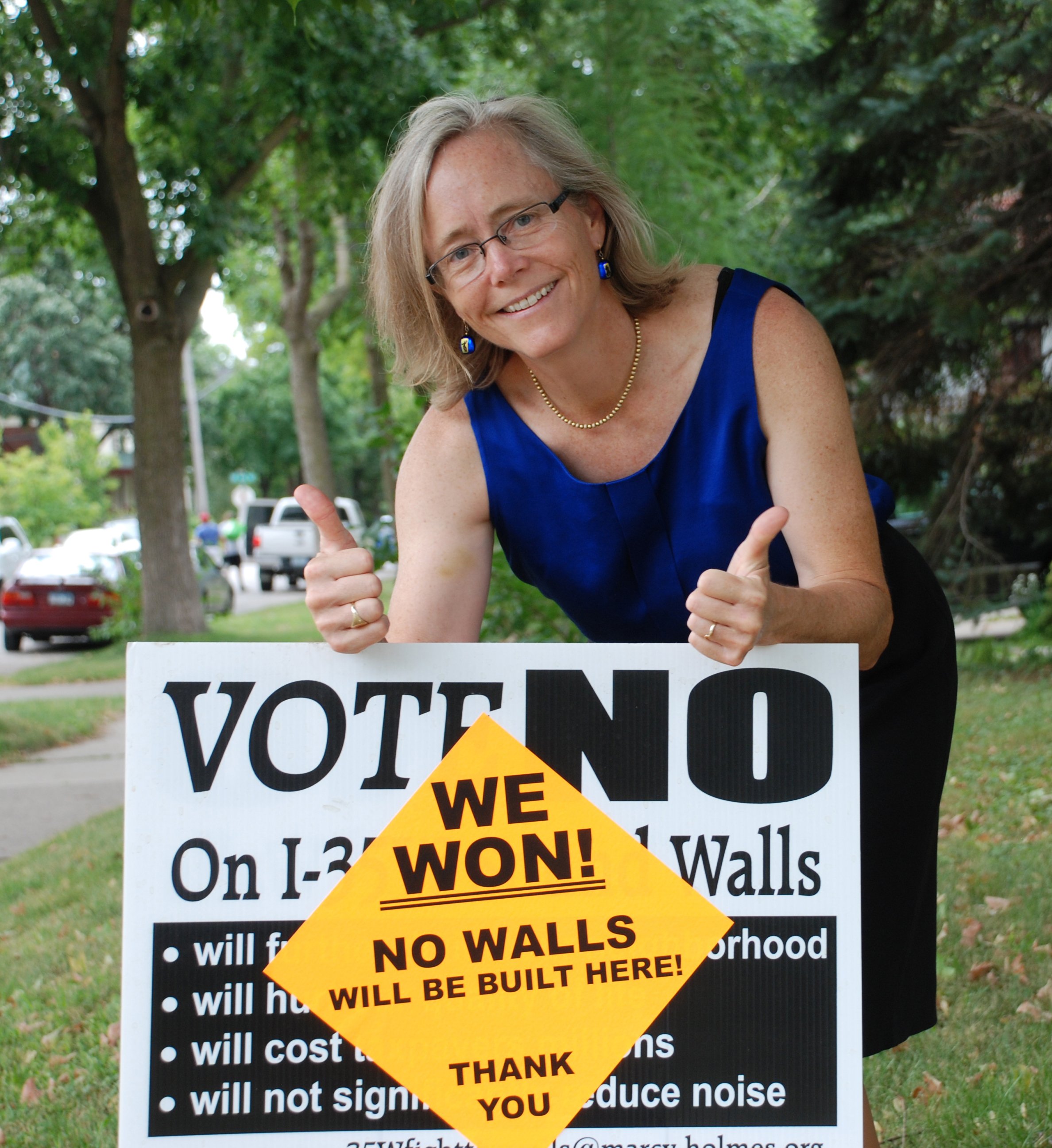
Controversial sound barrier walls will not be built along I-35W in the Southeast Como and Marcy-Holmes neighborhoods—after an election process that would make Rube Goldberg cringe.The 20-foot sound walls had been proposed as part of a construction project that will add two lanes to I-35W from Fourth Street South across the Mississippi River to Johnson Street Northeast, passing through sections of the Marcy-Holmes, Southeast Como, and Beltrami neighborhoods.State and federal rules require sound walls for projects of this magnitude but allow the state to create a voting process for neighbors to reject or approve them.Neighborhood leaders say the system was weighted in favor of building sound walls, making it difficult to reject them.Cordelia Pierson, newly elected president of the Marcy-Holmes Neighborhood Association (MHNA), said the campaign required strategic planning. She and MHNA staff Melissa Bean distributed lawn signs throughout the neighborhood asking residents to vote against the walls.They encouraged word-of-mouth contacts because only certain residents and landlords could vote and votes were weighted by occupancy and a transportation department projection of how much the property would benefit from a sound reduction.Vacant properties that did not return the mail ballots would count as “yes” votes. “That must be a bureaucratic mistake that needs to be corrected,” Pierson said.Pierson said she’d like to build on the momentum that MHNA has gained from organizing to oppose the sound walls.“It’s always easier to get people out to oppose something, but building on something positive is more difficult,” she said.She suggested that an additional bridge across the interstate at Fifth Street or Sixth Street Southeast would reconnect the neighborhood divided by the interstate highway in the late 1960s.The sound walls would have visually re-enforced that division, Pierson said.Marcy-Holmes had distributed black-and-white lawn signs that were seen throughout the neighborhood saying: “VOTE NO/ on I-35W Sound Walls/ will further divide our neighborhood/ will hurt our quality of life/ will cost taxpayers millions/ will not significantly reduce noise.”They began putting bright yellow diamonds over the signs proclaiming victory: “WE WON! No walls will be built here/ Thank you.”The highway expansion is designed to reduce congestion created by people leaving downtown to drive north on I-35W from Washington Avenue. The addition of a lane from Fourth Street downtown near the Metrodome would reduce traffic turning from Washington Avenue during games and rush hour.         The project will also reconfigure the Johnson Street, New Brighton, and Stinson Boulevard exits on the north end of the expansion.Both Hennepin County Commissioner Peter McLaughlin and Minneapolis City Council Member Diane Hofstede said they were “blind-sided” when informed of the required $3 million wall after they had already approved a $13.4 million highway project involving the city, county, and state governments.“We had committed to keep that vote open until we receive 50 percent one way or other,” said Scott Pedersen, project manager for MnDOT. Continue Reading

Minneapolis City Council rejects moratorium on Dinkytown development

The Minneapolis City Council, with a tie vote of 6-6 on August 30, rejected a proposed moratorium on the four-block core of the Dinkytown business district adjacent to the University of Minnesota.Council Member Diane Hofstede had proposed the six-month moratorium to allow time for the Dinkytown Business Association and Marcy-Holmes Neighborhood Association to complete small-area plans before new development projects begin. Both associations had endorsed the moratorium.The moratorium’s failure allows a developer to proceed with plans for an apartment building in the traditionally small-scale business area.Kelly Doran, who was at the City Council meeting, will continue with a proposal to build a six-story mixed-use building that would replace two buildings that currently house Mesa Pizza by the Slice, Camdi Vietnamese restaurant, and other small businesses. The Doran development would require rezoning from C1 commercial to C3A mixed use.The plan, which he presented to a committee of the whole of the City Planning Commission Aug. 29, shows commercial space and parking on the ground level and 70 dwelling units, including 130 bedrooms, on the upper floors.“Dinkytown needs development,” Doran said after his presentation. “If we don’t do this development, Dinkytown will continue on a downward spiral.”An objective look at the buildings, including the rear of the buildings, would reveal the need for improvements, Doran said.He admitted that his plan might not displace the most needy buildings, but refused to comment on which buildings might be worse.Doran told the planning commission that none of the Dinkytown buildings has a historic designation, but he said he favors preserving Al’s Breakfast, the Varsity Theater, and the former drug store building that houses Loring Café.Ted Tucker, president of the planning commission, said he invited Doran to present his proposal, but he’d prefer a more informal conversation about the nature of Dinkytown and what his project would contribute to it.“This is a very complicated area,” Tucker said. Continue Reading

More development in Dinkytown? Public forum will address long-term plans

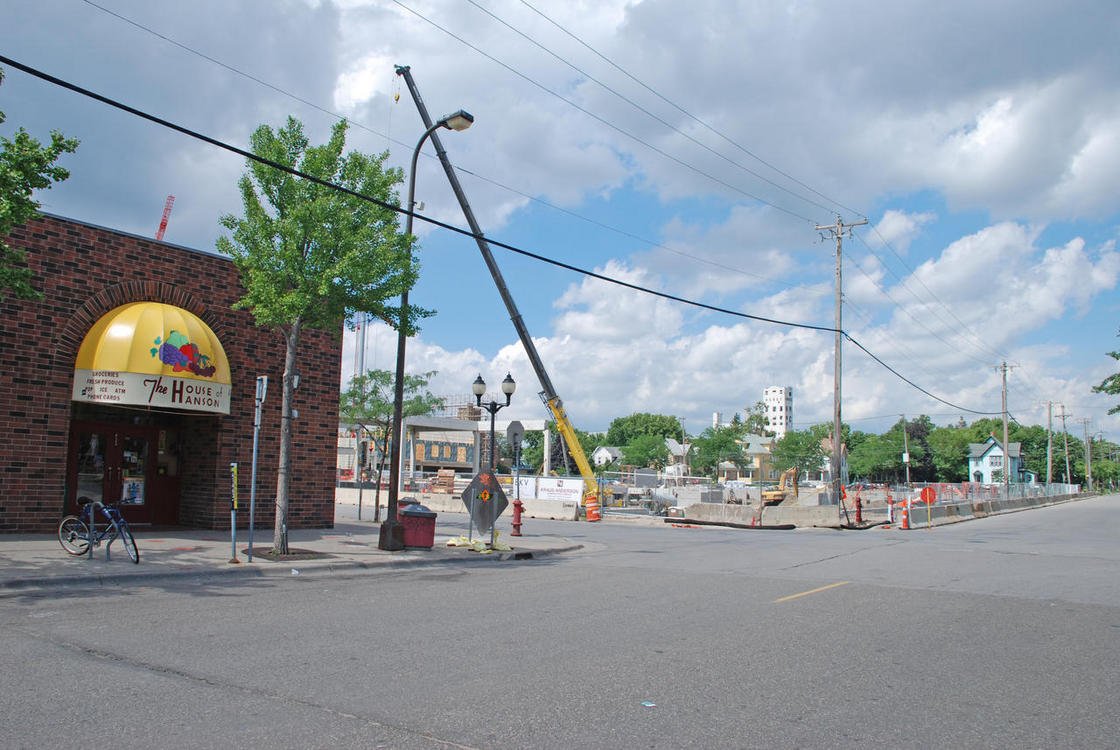
The future of Dinkytown will be the subject of a public forum on September 9, a meeting convened by those creating a small-area plan for the unique four-block business district adjacent to the University of Minnesota.Minneapolis city planner Haila R. Maze announced the meeting in an email to the community just days after a developer proposed a new mixed-use building on Fourth Street Southeast, Dinkytown’s main street.The meeting will begin with a 6 p.m. reception followed by a 6:30 p.m. presentation and open house in the Varsity Theater. The Dinkytown Business Association will host the meeting featuring Maze and City Council Member Diane Hofstede.Doran Companies has proposed a six-story, 70-unit apartment building with ground-level retail on Fourth Street between 13th and 14th Avenues, the Star Tribune reports.This project would fit on the south half of the block on which Opus Development has begun construction of a larger six-story mixed-use development along Fifth Street, taking land that housed the House of Hanson, Duffy’s Pizza, and parking lots.Some community and business leaders have proposed a moratorium on development in Dinkytown at least until the plan is completed.“The Dinkytown area has been experiencing a great deal of change and transition,” Maze said. “This has raised a number of important questions regarding the future of the area, and how important issues are being handled—including everything from community character to parking availability.”The meeting will provide an update on the planning process and seek public input on land use and development; parking and transportation; market conditions and trends; and preservation, design, and community character, Maze said.Hofstede, who is in a close re-election race, had proposed a delay of the Opus Development until the small-area plan is completed.Read our complete coverage of development in Dinkytown.Coverage of issues and events affecting Central Corridor communities is funded in part by a grant from the Central Corridor Funders Collaborative. Continue Reading

“A lovely development”: Minneapolis City Council clears the way for Opus development in Dinkytown

The Minneapolis City Council on August 2 rezoned a portion of Dinkytown to pave the way for a mixed-use apartment and commercial building that displaces the House of Hanson and other long-time businesses on Fifth Street Southeast between 13th and 14th avenues.After the council meeting, a teary-eyed Laurel Hanson Bauer said her 82-year-old business, the House of Hanson grocery store, would close after this weekend—assuming her negotiations with Opus Development go as planned.Her nemesis on the issue, Kristen Eide-Tollefson, owner of the Book House, which has moved after eviction from Hanson’s building, was philosophical about the loss, saying her opposition Save Dinkytown movement stimulated an important discussion among City Council members on development, density, and planning in the city.The victor, Opus Development, could begin construction on its six-story 140-unit apartment building as early as next month and complete it a year later, the Star Tribune reported.Pat Duffy, who owns Duffy’s Pizza and manages the adjacent parking lots, says he’s closed the pizza business but he will keep the parking lot open.“We’ll keep it open just as long as we can, probably until the bulldozers show up,” he said. Appearing enthusiastic about the sale, he said, he has begun discussing the possibility of opening his pizza business in the new Opus building when “Dinkytown will be a vibrant business district again.”“With customers,” added his wife, Susan Duffy. She originally bought their property, which includes five rental units in two old Victorian homes, in 1996.“It was zoned R5 when I purchased it in October 1996,” she said, adding that category allowed much higher density than the current C1 business zoning that the City Council changed to C3A for mixed residential and commercial use.“Dinkytown has been my life,” Susan Duffy said. “It’s the only place I’ve ever worked.”Bauer said she started working for her father 44 years ago when she was 12 years old. “I worked for free at first, but later he paid $1 an hour. Continue Reading

Dinkytown showdown: Pro- and anti-rezoning advocates brace for Minneapolis City Council vote on August 2

Save Dinkytown leaders will continue lobbying Minneapolis City Council members to block a proposed six-story mixed-use apartment and business development when the council takes up the plan on Friday, August 2.The council’s zoning and planning committee on July 25 rejected the rezoning from C1 commercial to C3A mixed-use that would have allowed Opus Development to replace three buildings and a surface parking lot with the new 140-unit apartment building on Fifth Street between 13th and 14th avenues southeast.The surprise 3-2 vote, which went against both the planning department and planning commission’s recommendations, gave Save Dinkytown a victory that organizers are not taking for granted until final City Council action on August 2.“We still have to fight the battle at the city council,” said Gordon Kepner, long-time resident who lives near Dinkytown. “Opus is now on full alert and they’re going to pressure in the many ways they can.”Opus developer Matt Rauenhorst, however, said on July 26 that he will continue to push for the development, but he said he was uncertain whether he would seek time to speak before the council.“We will ask the full city council for the rezone,” he said.“We’ve been though a really lengthy process for this project,” he said, listing meetings with the Marcy-Holmes land-use committee and addressing the conditions the neighborhood put on its support.Matt Hawbaker, a manager of the Book House and organizer of Save Dinkytown, said he plans to continue trying to reach more people to contact their council members to oppose the rezoning.“It’s a big step, definitely,” he said about the zoning and planning committee vote, “but a lot can happen in a week. We’re going to continue to ask people to tell their representatives how they feel. We will try to reach them through the media and online.”Although she is not on the committee, Third Ward Council Member Diane Hofstede, who represents Dinkytown, urged the committee to reject the rezoning proposal until the Dinkytown stakeholders complete a small-area plan for the four-block district.Nonetheless, Hofstede would not predict the council’s vote. “Nobody can say what will happen when you take something to the City Council,” she said.Council President Barbara Johnson can choose to open the agenda for discussion, just as chairman Gary Schiff did with the zoning and planning committee, even though the item was originally listed on the consent agenda, which wouldn’t have allowed discussion. Continue Reading

Minneapolis committee decision may halt Opus development in Dinkytown; House of Hanson in limbo

A Minneapolis City Council committee on Thursday, July 25, rejected a plan to rezone a portion of Dinkytown for a six-story mixed-use development to replace the House of Hanson and other businesses.After the meeting, the owner of the House of Hanson said she may not close on July 31 as she had announced earlier in the week.The zoning and planning committee voted 3-2 against the rezoning from C1 commercial to C3A that allows mixed-use developments like the Opus six-story proposal. The City Council may make the final decision on Friday, August 2.“I don’t know what’s next,” said Laurel Hanson Bauer, owner of the 80-year-old corner grocery store founded by her grandfather in 1932. “I have to figure out a way to stay in business until I know. If I’m in business, I make money. If my business is closed, I make nothing.”Before announcing her plans to close, she said, council members had indicated to her they supported the rezoning that would permit the Opus project that would displace her business.“Now they’re saying no. Continue Reading