I received an email this morning with an article about the University of Kansas professor who now sits at home with her foot—or perhaps both feet—in her mouth while her administrators make decisions about her future. Continue Reading
No sooner had the National Rifle Association and its congressional servants raised the call to place armed cops in every school, than videos began to surface of Black students thrown, dragged and beaten by “school resource officers” for such offenses as refusing to put down their phone or getting a drink of water during assembly. While not all schools have armed cops, the trend toward criminalizing childhood for dark children has been in motion for some time. Calling in the cops has become an accepted school response to temper tantrums, arguments and other minor forms of acting out. Continue Reading
The battle over history books is whether to show the warts, blemishes, and horrific tragedies of American History. Do they diminish its place on the world stage? Or are they an essential learning tool for moving forward. Continue Reading
In a recent City Pages article on the St. Paul Schools, the words used to describe students were deeply troubling. They were not described as children or the developing youth, but as violent delinquents. These were certainly not my scholars, nor was it an accurate depiction of my work climate in a North Minneapolis school. Continue Reading
A new science, technology, engineering and math (STEM) focus will be fully introduced this fall at both North Community High School and, a few blocks away, at the “new” Franklin Middle School. North Principal Shawn Harris-Berry and Franklin Principal Karon Cunningham are working collaboratively across the schools.There was a strong relationship back in the ‘80s and the ‘90s” between the two schools, recalls Harris-Berry, a 27-year Minneapolis Public Schools (MPS) veteran. Since then, however, both schools have undergone major changes. North now is a “small college-preparatory” high school with nearly 300 students.“[It] is not a big box school. Everybody knows you by name,” proclaims North’s principal. Continue Reading
t’s hardly news that less than half of the kids in Minneapolis and St. Paul public schools are proficient in reading and math. Education “experts” have weighed in on this topic, but we haven’t often heard the perspective of classroom teachers. What follows are eight ideas for improving urban education; they’re based on what I learned from 34 years of teaching in public and private schools:1. Provide one year of free preschool for all children from low-income families. Critics of urban public schools rarely acknowledge that many kids come to kindergarten already a year or more behind. Continue Reading
Educators and lawmakers are divided over a proposal that would cut funding for developmental courses at state-run colleges ST. PAUL, Minn. – College students in remedial classes at state colleges and universities may find themselves taking college-level courses under a proposal that would cut funding for remedial programs.The proposal would not require Minnesota State Colleges and Universities (MnSCU) to eliminate remedial courses, but courses that do not earn college credit would be ineligible for grants and financial aid starting in 2017. This has some administrators and legislators split.While lawmakers say the proposal would improve how many students finish their degree faster and improve enrollment retention, some educators and college administrators feel it could deter students from graduating by placing them in courses beyond their skill level.On average, students pay almost $1,000 for remedial courses and 28 percent of MnSCU students are currently taking remedial courses, according to the Office of Higher Education. Of these students, only 20 percent graduate in less than three years.“We don’t want to put [students] in a situation where they get so discouraged and drop out when a two-year degree takes three years to earn,” said Sen. Greg Clausen, DFL-Apple Valley, who is spearheading the proposal. Continue Reading
[Central high school on Marshall Avenue.]Saint Paul’s school board is often viewed as less contentious than its Minneapolis counterpart. Fewer families have left the city for charter schools and suburban options, and the School Board meetings have seemed more cooperative between administratos, teachers, and parents. But that might be changing, as the School Board race has become very heated this year. Issues like superintendent pay, the district’s new “mainstreaming” inititive (placing most students in the same classrooms), the (oft-maligned) iPad program, and contract requirements aimed at improving student-teacher ratios. On top of the close race, Superintendent Silva’s recent headlines about a job offer in Florida place added pressure on the election as a test of party support for different kinds of reform.Jess Banks is one of the candidates challenging the incumbent board members this year, and seeking the endorsement at this weekend’s City DFL Convention. Continue Reading
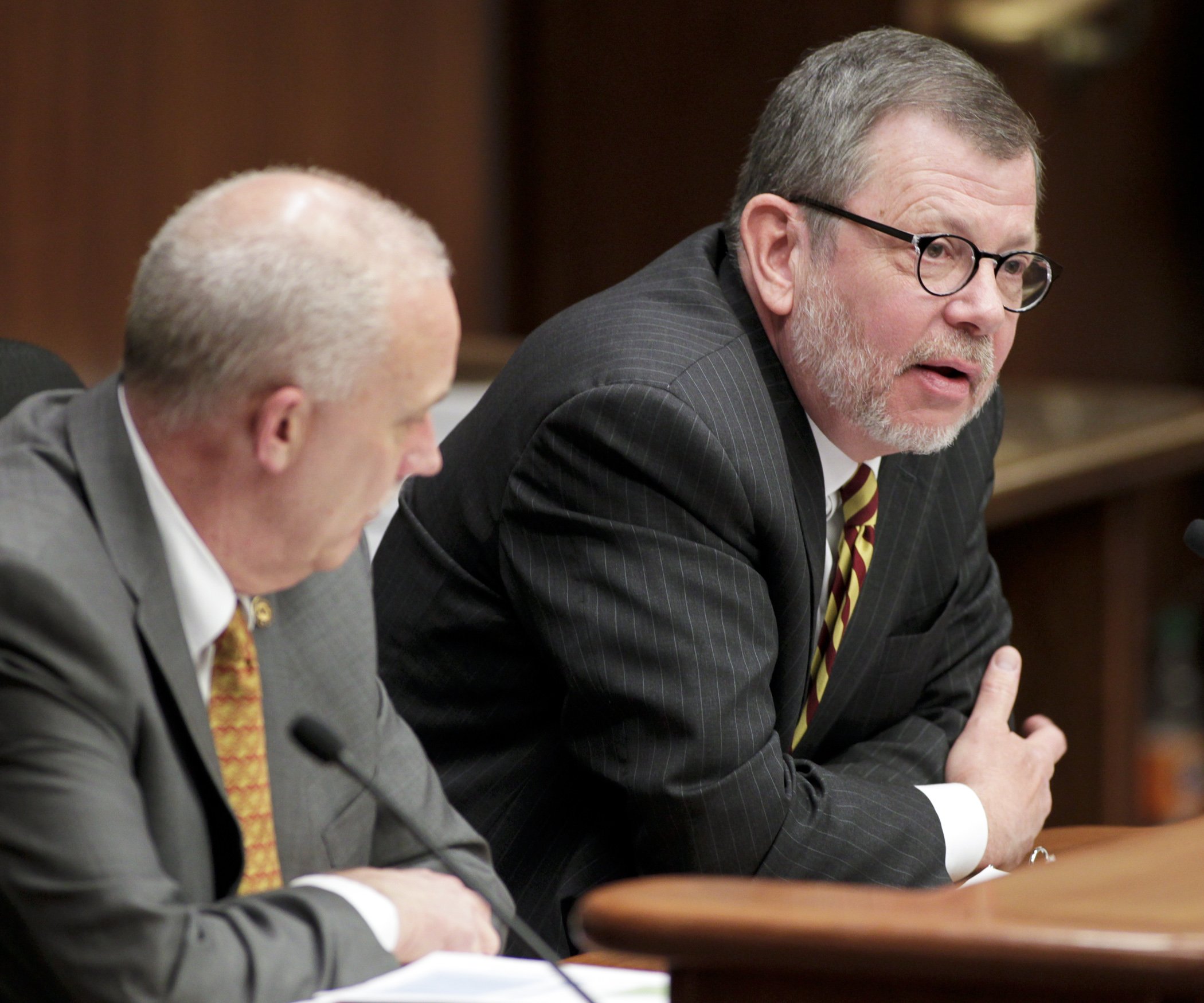
The House Higher Education Policy and Finance Committee approved an omnibus higher education bill Wednesday that would increase spending by $53.4 million —to $2.95 billion — over the next biennium.But absent from HF845 are funds that would have covered a tuition freeze for students at public four-year universities, much to the dismay of University of Minnesota President Eric Kaler.In light of a $1.9 billion budget surplus, “I believe a zero-percent increase is not an acceptable outcome,” Kaler told committee members Wednesday. The bill was referred to the House Ways and Means Committee.Kaler said that inflationary increases, much needed technology upgrades and the university’s commitment to recruiting and retaining a world-class roster of faculty and staff are major factors in its request for $148 million in increased funding over the next biennium.About $65 million of that requested increase would be allocated to freezing tuition for students at all five of its campuses through 2017. Instead, under provisions of the bill, undergraduate students at the U of M would see a 3 percent increase in tuition and graduate students can expect a 3.5 percent increase, Kaler said.While DFLers expressed disappointment in the bill’s failure cover a tuition freeze, several Republican legislators grilled the president about the university’s professed inability to find more funds anywhere else but in the form of tuition increases.Rep. Bob Barrett (R-Lindstrom) asked Kaler why the university hasn’t considered increasing the price of tuition for non-resident students, which was lowered in recent years in an effort to attract more out-of-state students..“If we just correct that situation there is millions of dollars available at your disposal,” Barrett said. “Would it cover (the) total amount (needed to offset a tuition freeze)? Probably not. Continue Reading