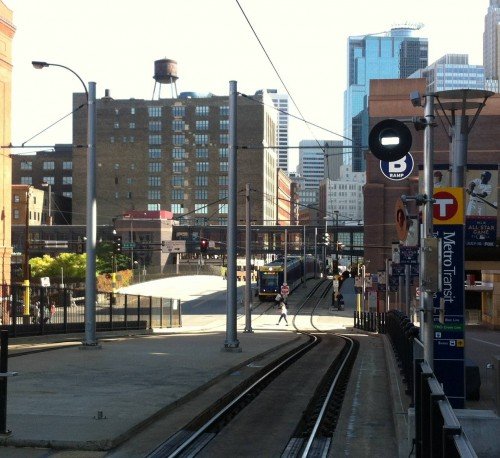
Improving LRT signal timing in Downtown Minneapolis

Although St. Paul’s traffic signals deserve most of the blame for slowing the Green Line, there’s room for improvement in Minneapolis as well. To be fair, Minneapolis deserves praise for its signal timing through the University of Minnesota campus, where trains are seldom delayed. They’ve also established a very good progression for westbound trains from the city limits to the Prospect Park Station, including the right turn from University Avenue onto 29th Avenue SE. Continue Reading

Dancing for safety at the street corner

The launch of the light rail Green Line has spurred an increase of 20 to 25 percent in pedestrian traffic at the downtown Minneapolis Nicollet Mall station where Blue Line trains have stopped for years, according to a new study. Unlike its predecessor, the new line traverses its entire route through the heart of the Twin Cities, an area particularly rich in vehicle, bicycle and walking traffic. Continue Reading

Infrastructure opportunists and the Kellogg Bridge

Earlier this week, news surfaced that the Kellogg Ave-3rd Street bridge connecting Lowertown and Dayton’s Bluff is structurally deficient. The bridge, built in 1982 by MnDOT, has four vehicle lanes, the outer two largely supported by concrete cantilevers with pier supports built in the middle. Continue Reading

Sharing like a capitalist

The sharing economy has received lots of media adoration over the last couple of years. A closer look reveals a more troubling truth. There are various types of companies in this new economy, but the ride-sharing companies like Uber and Lyft provide a useful example. In a recent article, Avi Asher-Schapiro details the effects of this model on the workers. Continue Reading

A better block indeed! PARKing Day rocks!

Last Saturday some neighbors, local business owners and I put on a Better Block event, and for one glorious day a pretty darn good commercial corner of Minneapolis (42nd Street and 28th Avenue) was made a much better place with trees, an on-street bike rack, a PARKlet, live music, a Ping-Pong table, and most of all, people enjoying themselves in our public space. There were even bubbles. Continue Reading

Transportation politics and the rhetoric of choice

We often hear from transit advocates that expanding public transportation is good because it increases the choices available to people. Framing the issue this way reveals something about the deeper commitments of the supporters, namely that it is a good in itself simply to expand available avenues for people to assert their will. The ability to choose, regardless of the kinds of choices people make, is good. It is then often suggested that what the city or state or governing authority needs to do is incentivize certain choices above others; or it is hoped that people acting in their own rational self-interest will choose well. To increase available options is believed to be an equitable move insofar as it levels the field for choosing agents, enabling people who were previously limited with respect to transportation to increase their power. Continue Reading

Unsafe and unseen—Minnesota’s ghost bikers

The Twin Cities are regarded as America’s litmus for bicycling. Minneapolis has been rated the number one bicycling city, while Bicycling Times lauded “the nation’s finest network of off street bicycle trails”. Former Mayor Rybak told visitors: “Biking has become a large part of what we are.”

Continue Reading