Opting out of MAP tests at Minneapolis South High

In early September, a group of teachers at South High School in Minneapolis let parents know that they have the right to opt their children out of the upcoming MAP (Measuring Academic Progress) test. The MAP is one of the standardized tests that most children in Minnesota are given in grades 1-9, and some view it as a way to measure students’ academic growth throughout the year.FULL DISCLOSURE: The author is a Minneapolis Public School parent, who has opted out of testing for her children.Melinda Bennett, Michelle Ockman, Stephanie Woldum and Rob Panning-Miller work as a team with the 135 ninth graders enrolled in South’s Open program, which they say is a diverse group of kids from many backgrounds. While the MAP has been given to ninth graders at South for several years now, this year the testing has changed. The district has decided to give the test in the fall and spring rather than once a year. Along with a growing concern about standardized testing in general, this led the South teachers to tell families about their right to refuse the tests.Emailed note to parents:The MAP test:As you know, standardized tests have become a defining feature of our schools. Continue Reading

Will more inclusion = more progress in school reform debates?

For those paying attention to education reform conversations in the Twin Cities, one thing might seem to be missing: the voices of the families, communities, and students reform movements say they are focused on. Yes, there are endless dictates and conclusions from every side about what families want, or what is good for students, but what do the families and students really think about all of this? Continue Reading

Parent vigilance works: Getting help for learning disorders in Minneapolis schools

For Samantha Pree-Stinson and her husband, Preston Stinson, making sure their oldest son is getting the help he needs at school has not been easy. Their son, who is now in eighth grade at Northeast Middle School (NEMS) in Minneapolis, has had an Individualized Education Plan (IEP) since fifth grade, and noticeable speech and spelling issues since before starting school.As Pree-Stinson describes it, she saw early on that her son had “trouble making certain sounds” and had difficulty with expressing himself on paper. This situation got more serious as he got older, and by the time he was in fifth grade, Pree-Stinson saw that it had become “harder for him to write reports and longer assignments.”Their elementary school at the time, Sheridan Arts Magnet in northeast Minneapolis, did not, in Pree-Stinson’s words, “come close to identifying the issue.” Instead, she says, she was told by the school “not to worry,” and that her son’s problems were all speech related. Pree-Stinson could see, however, that her son was struggling at school and that something more serious was going on.Using what she considers her significant resources as a parent with a good job and good health insurance, Pree-Stinson, along with her husband, sought help for their son outside of school. She was able to take him to a developmental psychologist who told the Pree-Stinson family that, while the boy tested above average for IQ and aptitude, he had a “written expression disorder.” This outside look at what was going on was important because it gave them a clearer picture of not only the boy’s trouble spots, but also his strengths.According to Pree-Stinson, this kind of advocacy by parents is essential. Continue Reading

Refugee parent finds sense of home in Minneapolis neighborhood school

For northeast Minneapolis resident Ilhan Omar, making sure her children get a “first class education in a supportive environment” is an important goal. Her two school age children, ten-year old Isra, and seven-year old Adnan, attend Pillsbury Elementary School in Minneapolis, and so far, Omar is confident that her children are getting a solid start to their school careers.After having started their daughter, Isra, in kindergarten in Minneapolis, Omar and her husband, Ahmed Hirsi, moved to North Dakota so that Omar could finish her bachelor’s degree in political science. Upon moving back to Minneapolis, they enrolled Isra in Whittier International School in south Minneapolis because of its International Baccalaureate programming and global education focus.After a year at Whittier, though, the family decided to put their oldest at Pillsbury Elementary School because it is their neighborhood school, and Omar wanted her children to “go to school with their neighbors.” Also, the school’s strong focus on science and math was a draw for the family.At Pillsbury, Omar and her husband have been pleased with their children’s experiences thus far. One important example that stands out to Omar is the way that her children’s progress is being “tracked by more than just test scores.” Her son, Adnan, is in second grade, and Omar says that the students in his class write in a journal at the end of every school day about what they have done in class.Her son then brings this writing home, and Omar says, through this, she can “see progress in his thinking and writing without waiting for test scores” to tell her how he is doing. She finds this empowering as a parent, because she can help track what he is learning and where he might need extra support at home.Another aspect of Pillsbury that is working well for Omar’s family comes from seeing how her daughter Isra has been “encouraged to work at her own level.” Known as “differentiation,” this approach to the classroom allows students to move more at their own pace than at a set level, and, for Isra, who Omar describes as being “very advanced at math,” this has been essential.Last year, in fact, Isra’s fourth grade teacher had the girl participate in a higher level math class so that her needs were being met. Continue Reading

Minneapolis family finds global learning opportunities at Windom Dual Immersion School

A new school year has just begun at Windom Dual Immersion School in south Minneapolis, and second grader Libby Bures and her sister Josie, who is starting kindergarten, will be there. The two girls will be learning Spanish along with the usual academic subjects, and this is ultimately a significant part of what led their parents, Bridgit Jordan and Frank Bures, to choose Windom for their children.The way Bridgit Jordan sees it, the Minneapolis public schools offer “great and diverse choices” to parents. Although she is appreciative of these choices, Jordan says that she and her husband Frank Bures also found the school choice process to be “overwhelming.”As they searched for a school for their oldest daughter, Libby, a few years ago, Jordan recalls touring schools and not being sure “what to pay attention to.” There was seemingly so much to factor in to the decision, such as “learning philosophies, principals, gut feelings,” and what parents and kids “had to say about the school.”Finally, what won Jordan and Bures over to Windom was the small size of the school, which made it seem accessible and welcoming, and the fact that it is a dual immersion school, meaning students at the school can become fluent in both Spanish and English. As Jordan put it, “Our children would leave the program fluent in another language, opening doors for their future.”Since becoming a Windom School family, Jordan and Bures have been impressed with what they’ve found. Jordan describes a school community where “all of the teachers have connected with us and our children in a very personal way” through hugs, emails, and visits outside of regular school hours. Continue Reading

Marching for jobs and justice in St. Paul, 50 years after March on Washington

Community leaders gathered in St. Paul on Wednesday, August 28, to commemorate the fiftieth anniversary of the March on Washington. Like the original march, a combination of organized labor, community leaders, and representatives of the faith community put this one on.At Frank Boyd Park just behind the St. Paul Cathedral, a small but enthusiastic group gathered in the mid-day heat. March organizer Harrison Bullard, of the Service Employees International Union (SEIU), invoked the memory of Frank Boyd, the namesake of the park, saying he was a porter and a “member of one of the first black unions,” as well as a member of the NAACP. Continue Reading

Winning the school lottery: Minneapolis family chooses Clara Barton

When it came time to choose a school for her two children, Minneapolis resident Jody King knew where she wanted them to be: Clara Barton Open School in southwest Minneapolis. For King, getting her kids into Barton felt like “winning the lottery.” That’s exactly what the school choice process for Minneapolis magnet schools uses for schools that, like Clara Barton, have more applicants than spaces.FULL DISCLOSURE: The author of this article is also a Barton parent.King wanted a K-8 school, and one that provided a “nurturing, safe place,” for her son, Anthony, and her daughter, Maya. What she found at Barton was a “supportive community of families and teachers.” Some unique aspects of Barton’s Open School focus were especially attractive. Students at Barton, for example, stay with their classroom teacher for two years in first-sixth grades, and King ended up seeing the benefits of this longer connection between teacher and child.Seventh and eighth grade students at Barton often pair up with early primary students in a “buddy” system. The older kids are matched with a younger child for the whole school year, and they spend time reading books together, getting to know one another, and doing some classroom work as a team. Continue Reading

Too hot to learn? Patrick Henry students speak out in Minneapolis

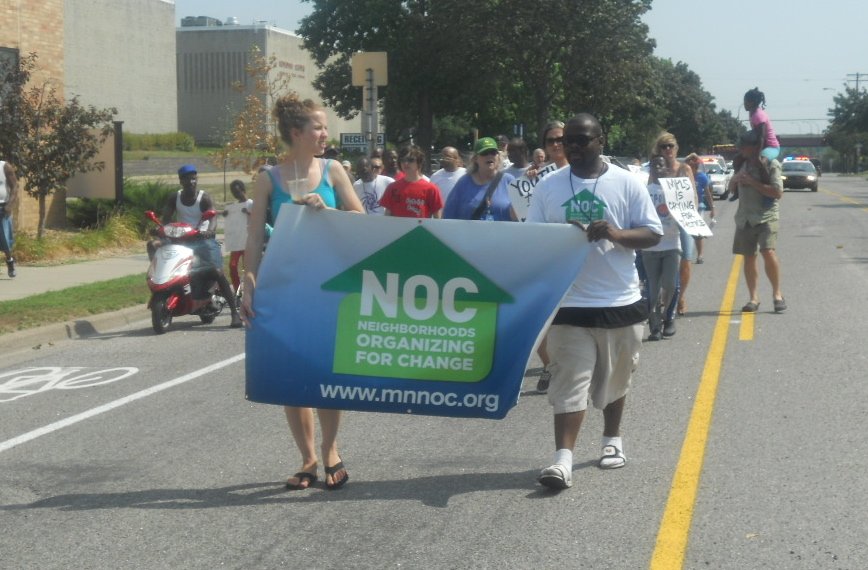
At 3 p.m. on Tuesday, August 27, students spilled out of Patrick Henry High School in Minneapolis, hands waving in front of their faces like makeshift fans. It was hot outside, and maybe even hotter inside Henry’s nearly 100-year-old building.At a press conference called by north Minneapolis non-profit Neighborhoods Organizing for Change (NOC), along with the Minneapolis Federation of Teachers, organizers spoke about how the early start date for Minneapolis schools has impacted students and staff during this late August heat wave.No teachers showed up to speak at the press conference, but students had plenty to say. Sophomore Laura Sosa and her friend, junior Karen Miranda, said the school was “really hot,” which made them “tired” during the school day. Both girls said that some classrooms had temperatures of over 99 degrees, and that teachers “were complaining” about this.Sosa and Miranda also were grateful for the Gatorade-type water jugs provided by the district. Each filled their own water bottles several times during the day with the district-provided water.Also speaking outside the school was freshman Shaheed Bell, who said that the heat made students “not very productive.” Shaheed said that, while he didn’t think the lack of air conditioning was “unfair,” given how old the Henry building is, he does think school should start “after Labor Day.” Bell said it was so hot inside the school that no one could concentrate on their work.Senior Todd Riser also spoke out, saying students were “drowsy,” and “didn’t want to work.” According to Riser, a chemistry teacher told the students that their classroom temperature was “over 100 degrees.” In Riser’s view, such intense heat made it hard to concentrate.Anthony Newby, who is the executive director of NOC, called the press conference to raise awareness of equity issues. Continue Reading

AVID helps Twin Cities teens become first generation college students

Augsburg College senior Edgardo Becerra always knew he wanted to go to college. He comes from what he calls a “financially unstable” family, with parents working overtime and second shift jobs. While they worked, Becerra stayed home and took care of his younger siblings. Becerra said he knew he would need “every possible resource to get into college and be prepared.”Becerra found those resources at Minneapolis’ Southwest High School, when he enrolled in the AVID program. AVID, the acronym for Advancement Via Individual Determination, is a national college readiness system that operates in all seven high schools and twelve middle schools in Minneapolis and at 26 elementary schools as well as middle schools and high schools in St. Continue Reading