Youth coordinator of interfaith group encourages questions about religion
|
Coming of age in Minneapolis, Fardosa Hassan dived with enthusiasm into any community-service opportunity that contributed to helping society and improving the city.
Twin Cities Daily Planet (https://www.tcdailyplanet.net/author/ibrahim-hirsi/page/5/)
Coming of age in Minneapolis, Fardosa Hassan dived with enthusiasm into any community-service opportunity that contributed to helping society and improving the city.

“The Youth/Dhalinyarada” project, which consists of portraits and a short video narration of both the success and challenging stories of 13 Somali-American men, was among the featured exhibits at the June 16 Community Day at the University of Minnesota’s Weisman Art Museum.“This project highlights the contributions these men are making in America,” said Mohamud Mumin, a photographer and the man behind the project. “The subjects of these photographs share the conflict they feel in just trying to be themselves. As much as they try to adapt, they often feel foreign at home, here in Minnesota.”The men featured in “The Youth/Dhalinyarada” include community activists, young professionals, artists and athletes.Mumin added: “The project explores their journey from Somalia to America, how they are engaged in their community and what it means to be young, Muslim, and Somali-American [living in Minnesota].”To those at the event, it was a chance to meet some of the men and ask Mumin questions about the project.Abdi Farah — well-known as “Abdi Phenomenal” — is one of the men in the project. He’s a Twin Cities spoken word artist, youth activist and an actor.Abdi Phenomenal took to the microphone, reciting a spoken work entitled “More Than Heroes,” which is about the challenges and hopelessness the Somali youth are facing.In a poem, Phenomenal sent a message about how some of the Somali youth are “confused” with their “dreams broken” and have “no choice but to sell their dreams for a token.”He continued reciting the poem, encouraging the youth to take the right path: Hope. Peace. Continue Reading

When several Somali-American friends in Minneapolis recently discussed ways to give back to their community, they figured the most essential thing would be to contribute to the educational welfare of the community’s youngsters.They brainstormed whether they should start tutoring programs for the struggling Somali students in the Twin Cities public schools, create mentoring opportunities or find ways to link the students with resources funded by local non-profit organizations and city programs — and how they would do so.The group of friends wanted to do something unique.After much discussion, they finally voted on one action: the establishment of Shanta Foundation, the first and the only known Somali-run scholarship program, which gives money to high school seniors who plan on attending colleges and universities in Minnesota.Shanta Foundation has turned into a living legacy for seven passionate community activists and engaged citizens, who gave birth to the program: Osman Ahmed, Faiza Hassan, Sandol Khalaf, Fardosa Hassan, Sade Hashi, Omar Mahamed and Osman Calolgeel.“The sole purpose of Shanta Foundation is to empower and prepare the leaders of tomorrow by investing in them today,” said Faiza Hassan, co-founder of Shanta Foundation.The foundation announced its first scholarship winners Zamzam Ahmed and Aisha Warsame during a grand opening ceremony and dinner reception at Safari Restaurant & Banquet Hall in Minneapolis last week.Some dignitaries at the event included Theresa Battle, associate superintendent for Minneapolis public schools; Robert Lilligren, Minneapolis city council member; and Said Salah, Somali language professor at the University of Minnesota.Scholarship recipients Ahmed and Warsame are both 2013 graduates of Ubah Medical Academy, a 9-12 charter school in Hopkins.When Ahmed and Warsame start their first semester this fall at St. Catherine University to pursue health-related majors, each will have $500 in their accounts, and another $500 in the following semester.The foundation awards a one-time fund of $1000 towards tuition payment.“This scholarship is different than other scholarships,” Ahmed said, “because it’s sponsored by Somali people, unlike other scholarships, which are sponsored by very rich people.”Ahmed, who will be the first in her family to attend college, added that the scholarship is “very special” because the money is coming from the pockets of her people.Ahmed said she’s excited to see her community assisting her financially so she can grow to become a successful person — hence an asset to the community and to the world.When teachers at Ubah Medical Academy told students about the Shanta Foundation scholarship opportunity, Warsame said she was surprised to learn about Somalis pledging to offer scholarship funds.“It was really a good thing and I was happy that our people are helping us and giving us opportunities,” Warsame said.Seven high school seniors applied for the scholarship, but Warsame and Ahmed were picked as the strongest candidates in the pool, said Osman Ahmed, director and co-founder of Shanta Foundation.“They showed excellence in their academic performance and community services,” Osman Ahmed added. “We are committed and dedicated to continue the service and to expand the number of scholarship recipients in the future.”Shanta Foundation is not a legally recognized non-profit organization with 501(c)(3) status, but the founding members said they’re currently in the early stages of the foundation’s establishment and plan on moving toward attaining the non-profit status.Reporting for this article supported in part by Bush Foundation. Continue Reading

Submerged in black hijab and with tears of sorrow streaming down her cheeks, Hali Mahmoud stood before hundreds of Somali-Americans at the State Capital to commemorate the murder by stoning to death of her younger brother in South Africa.“He died a painful death,” Mahmoud said June 7 of her 27-year-old brother, Abdinasir Mahmoud. “May God have mercy on his soul.”Abdinasir Mahmoud, who moved to South Africa in 2008, was a grocery store owner and operator, Hali Mahmoud told TC Daily Planet. Under the clear daylight of Thursday, May 30, a mob of black South Africans attacked him and two other relatives in store in Port Elizabeth.At first, Abdinasir Mahmoud escaped for his life, parting from the two relatives he was in the store with, Hali Mahmoud said. They took off in a different direction. Moments later, Abdinasir Mahmoud made his way back to the store to make sure his men were safe. But he found himself surrounded by the mob, forming a shocking scene that spelled out the last moments of his life.The scene, which was captured in a video that surfaced on Facebook and Twitter last week, brought grief to millions of Somalis throughout the world. Continue Reading

When Congressman Keith Ellison invited Minnesotans to hear his explanation of his proposed “Strengthening Refugee Resettlement Act” as part of the ongoing immigration reform discussions, over a hundred people joined him at the Minneapolis Urban League in north Minneapolis on May 28.Many were eager to hear how the bill will help prospective immigrants and those who are already in the United States.Ellison said the bill will offer English language classes and job training for refugees while they are still in programs in abroad. It will also allow refugees to enter the United States as permanent residents, instead of waiting for months or years — depending on the status of the refugee — in America to get their green cards.“This bill makes sure refugee families have the resources they need to be self-sufficient as quickly as possible,” Ellison said.With Congress discussing comprehensive immigration reform, Ellison reiterated his support for immigration reform, drawing on a personal story about why the reform is significant to him. He talked about two brothers, who were close friends of his children.“I didn’t know that their father was picked up by ICE [Immigration and Customs Enforcement] and battling deportation,” Ellison said. “These kids are like my nephews. And yet, because their father didn’t have the documents, they try to send him to Mexico, and here we don’t even know it.”Ellison added: “I am a very strong advocate of immigration reform. Continue Reading
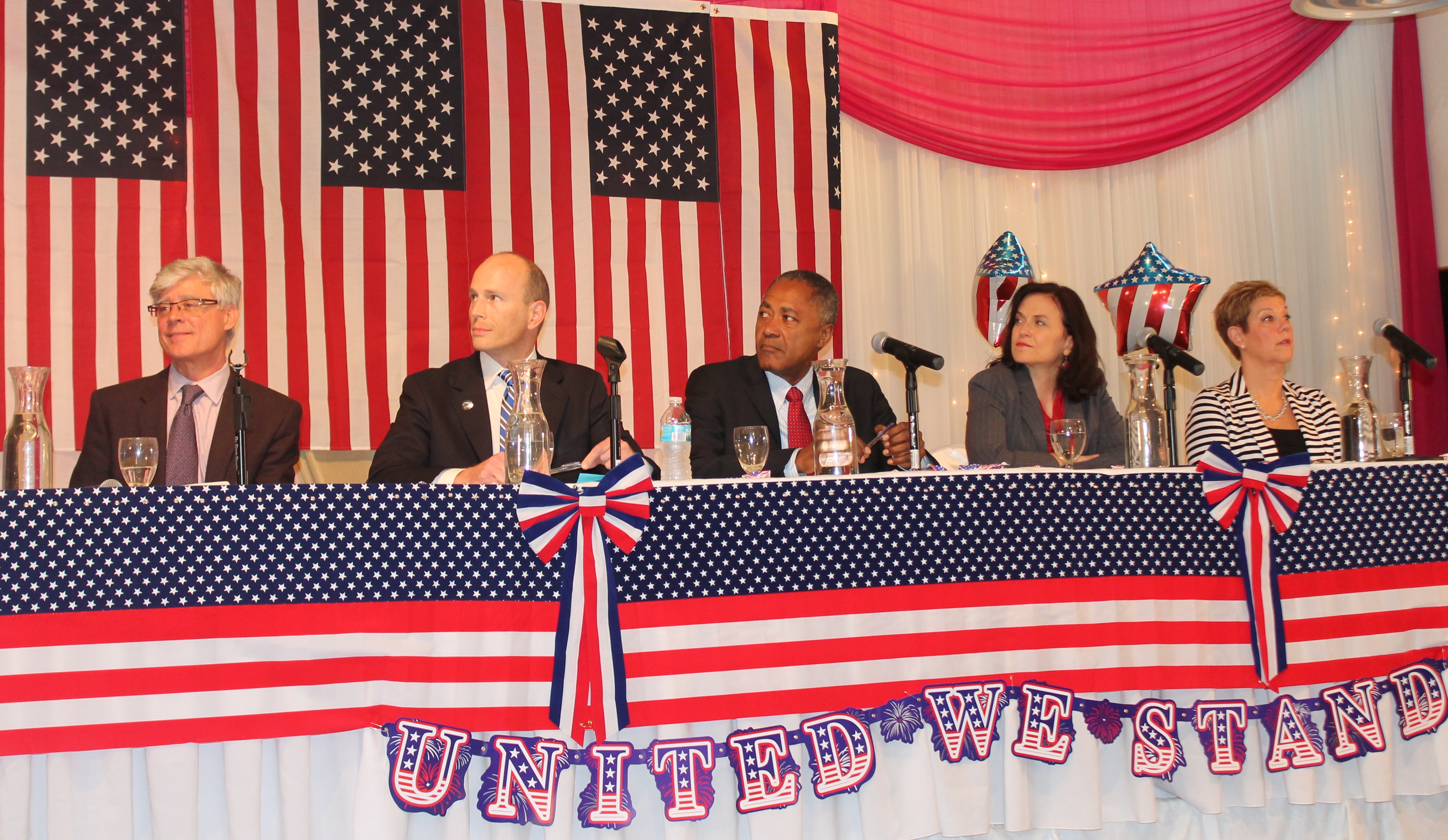
More than 170 Somali-Americans gathered to hear five Minneapolis DFL mayoral candidates on May 31 at Safari Restaurant & Banquet Hall in Minneapolis. Appearing on a stage wrapped in stars and stripes, candidates Betsy Hodges, Don Samuels, Gary Schiff, Jackie Cherryhomes and Mark Andrew put forth their political cases to win the community’s vote.Some candidates mixed Somali sentences into their introductory remarks. Samuels described his arrival in New York City as an immigrant from Jamaica more than four decades ago to study industrial design and with only $83 in his pocket.“I know what it means to have to adjust to the culture, to be understood,” Samuels said. “Part of my agenda is certainly to help the adjustment of the immigrant community.”The candidates responded to questions from moderators Mustafa Jumale and Ilhan Omar, about unemployment in the city, discrimination in the workplace, education disparity, and youth and homeless issues.“I will continue to support job training programs and the expansion of job training programs for our people,” said Andrew. “I will also continue to work on the successful record I had in Hennepin County in actually hiring more communities of color and more diverse populations into the Hennepin County workforce, which we were successful doing.”Like Andrew, other candidates echoed that creating job-training opportunities and removing regulatory codes at the city hall are important for the community’s growing small businesses in south Minneapolis to thrive.Plans for youth issuesSince many young people of the community are in jail, have been detained or deported to Somalia for crime-related reasons, the candidates were asked about their plans on the city’s youth issues.“When children don’t have hope, they think that a gang will provide them with opportunity,” said Schiff. “But that is not true. Continue Reading

For years, Hennepin County residents traveled to Century Plaza in downtown Minneapolis to see their social workers and case managers for access to government assistance programs. A new project will relocate services throughout the county, offering shorter trips and shorter lines.There’s still time for your voice to be heard! Wednesday night (May 22), there will be another meeting for community input from 6-9 p.m. Previous meetings have had Hmong and Spanish translation, and this one will have Somali translation. The meeting is at Pica Head Start, 700 Humboldt Avenue North. Click here for more information on the North Minneapolis hub.Hennepin County is closing down Century Plaza by the end of next year, taking its services closer to areas where clients live, work and attend schools. The county is moving human services to six human service centers, with each hub providing a full range of financial, social and public health services — just like those currently provided at Century Plaza. Continue Reading

When Cathy Heying served on the pastoral staff at St. Stephen’s Catholic Church several years ago, she took note of the common issue facing those who came to the church for assistance: they needed running vehicles.Heying learned that people are in need of cars to get to work on time. Because most of them live each week from paycheck to paycheck, it’s difficult for them to have their old, malfunctioning vehicles repaired.Some people with predicaments about their cars told Heying: “The car repair guy says it’s going to cost about $400. If I don’t keep my car running, I can’t get to work and I’m going to lose my job. If I lose my job, I’m not going to be able to pay for my rent, and I’m going to lose my housing.”Heying decided to fight the issue herself.In 2008, she went to Dunwoody College of Technology in Minneapolis, earning an associate degree in auto technology two years later. Continue Reading

“This is not a talk show,” said Abdullah Kiatamba, executive director of the African Immigrant Services, at the May 9 civic engagement forum. “It is not a conference for resolution. It’s about shifting people from being observers to active leaders.”Hundreds of Africans, African-Americans and other minority groups gathered May 9 at Brooklyn Park’s City Council Chambers for intense conversations on how to better increase civic engagement among the city’s minority communities.The three-hour event, which brought together more than 350 community leaders and concerned citizens, felt like a college classroom: There were presentations, small group discussions and questions about civic engagement — and participants stayed energized in receiving and sharing information throughout the forum.For many participants in the small groups, the message was the same: Whatever their differences may be, they will either stand or fall together. The majority of those in attendance were West Africans. Other groups included East Africans and African-Americans.Brooklyn Park is about 48 percent nonwhite, according to news reports. Continue Reading

With a red scarf wrapped around her head and reading a few sentences in Somali from note cards, Minneapolis mayoral candidate Betsy Hodges asked dozens of Somali-Americans for two things: their support and vote.Speaking May 1 at Safari Restaurant and Banquet Hall in Minneapolis, Hodges acknowledged the increasing number of Somalis in the city and promised them employment opportunities, a safer city and housing accessibility. “Part of the reason I’m here with all of you tonight is because the Somali community in the city of Minneapolis is very, very powerful,” said Hodges, currently the Ward 3 City Council member who represents Southwest Minneapolis. “There’re a lot of people and there’s a lot of power in this community. And we need to make sure that you’re doing well if our city is going to do well.” Hodges said that she shares the concerns of Somalis about income, education and opportunity disparities in Minneapolis.“We’ve education divisions, employment divisions, geographic divisions, people being treated differently, living differently,” she said. “Unless we fight that as a city, we’re holding ourselves back from really a great future.” Hodges spoke of some particular issues and concerns the community has expressed in the past, regarding relationships with the police department. She explained that she has been working on the issues for many years. “I’ve made it a requirement for my support for police chief that they understand the seriousness of police accountability issues, that they build the culture of the police force widely and well, and know that strong community relationships create more public safety,” Hodges said. Abdirahman Ahmed, owner of Safari Restaurant, organized the event and moderated the forum, which brought together some community advocates and political organizers.Ahmed said he’s not expecting anyone to solve community problems. However, he expects a leader who’s willing to work with the community in resolving its problems. Community organizer Abdirahman Muse said he thinks that Hodges is the most progressive candidate in the mayoral race and can make a difference in the city’s social justice issues.Other mayoral candidates are: Mark Andrew, Jackie Cherryhomes, Don Samuels, Gary Schiff, Jim Thomas and Cam Winton. Continue Reading