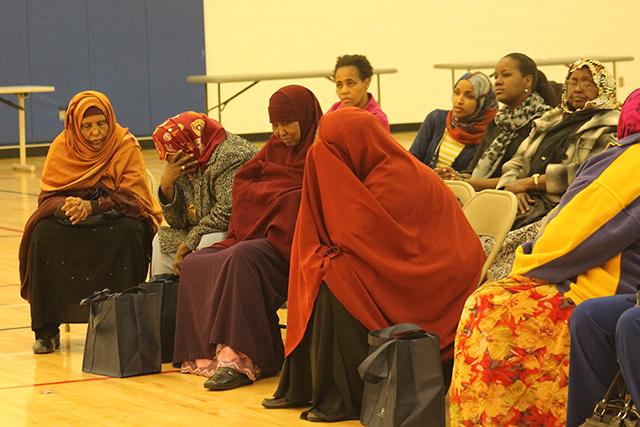
After members of the Twin Cities’ Somali-American community said their afternoon prayers Friday, they gathered at the state Capitol to express solidarity and demand justice for relatives in Kenya.
Losing loved ones to gun violence isn’t unusual for many Somali-Americans, a community uprooted by a civil war that claimed hundreds of thousands of lives, tore their homeland apart and displaced millions.
Fourteen years ago, longtime community activist Abdirizak Bihi received a call informing him of an after-school fight that broke out between Somali-American and African-American students at Roosevelt High School in Minneapolis.
Since the civil war erupted in Somalia more than two decades ago, thousands of families have flocked to the United States and left some of their loved ones in the war-ravaged country, which now has one of the highest unemployment rates in Sub-Saharan Africa.With their minds on those left behind, Somali-Americans have been sending a share of their paychecks in remittances, which amount to almost the annual aid the United States government sends to Somalia each year, according to a new study.“Approximately $215 million comes from Somali-Americans and Somalis in the United States — comparable to the total amount of development and humanitarian assistance that the U.S. government sent to Somalia in fiscal year 2012 ($242 million),” stated the July study, “Keeping the Lifeline Open: Remittances and Markets in Somalia.”The study finds that amount Somali-Americans send helps reduce Somalia’s dependency on foreign aid and “allows individuals and families to spend money based on their needs and priorities.”The report added: “Continued support from the Somali diaspora is essential for Somalia to successfully emerge from its protracted humanitarian emergency and political crisis, as well as to build the foundations for its long-term development.”About 40 percent of the Somali population relies on remittances the Somali diaspora throughout the world sends, said Degan Ali, executive director of Adeso, a humanitarian and development organization, which in part conducted the research.When Somalia was stable, its main source of economy included livestock and agriculture, Ali said in an interview in Minneapolis. “These beneficiaries have left the livestock system. They’re no longer pastoralists. They’re coming to the cities and becoming urban people.”This means that money sent from abroad is a way of survival for these people, she added. Somalis around the world send approximately $1.3 billion to Somalia each year, according to the study.Money transfer operatorsWhen the civil war broke out in 1991, all the formal institutions in Somalia had collapsed. Continue Reading
For some Somali women, having lighter skin tone is the ultimate beauty goal and they use skin products containing dangerous chemicals to reach that goal, according to a new University of Minnesota study.
Professor Ahmed Samatar has been a leading advocate for a united Somalia and a strong critic of the country’s clan-based political system that continues to divide Somalis. Demonstrating his views through academic writings, interviews and speeches, Samatar once described the current Somali politics as “sewage.” In a recent speech, Samatar described a shift in his opinion, from advocacy for a completely unified Somalia to advocacy for independence for Somaliland.Samatar, an international relations professor at Macalester College, received his undergraduate degree from University of Wisconsin-La Crosse and his master’s and Ph.D. degrees from University of Denver.In recent years, Samatar has shifted his role from being a mere political commentator to being an active participant in the process of redefining the politics he’s disparaged for decades: He recently served as a member of the Somali parliament and ran for the presidency last summer, although he lost the election.Editor’s note: Since Professor Ahmed Samatar’s discussion was in the Somali language, reporter Ibrahim Hirsi roughly translated the quotes into English. On August 10, Samatar spoke to nearly 300 people at Brooklyn Park Community Center about his recent visit to Somaliland, a self-proclaimed independent state, which has been struggling to gain recognition from the international community for the last two decades.“I’ve seen peace, security and a trace of law and order everywhere I visited in Somaliland,” Samatar said, addressing his audience in Somali. “I’ve seen people paying tax willingly because they are satisfied with what the government is doing. Continue Reading
Thouni Seneyakone embraced and kissed her grandmother goodbye at age 5, leaving behind the farming life in Laos more than two decades ago to establish a new life in Minneapolis.Although Seneyakone has forgotten many details of her childhood years in Laos, the whisper of her grandmother, Tonglor Seneyakone, into her ears still reverberates in her head: “Come back home when you finish school.”And she’s now doing just that — but more than 20 years later.Seneyakone, 28, is packing for a one-way trip in September to relive the simpler life of her homeland and to fulfill Tonglor’s dreams of empowering disadvantaged people in Laos, standing by the victims of sex trafficking and convincing them that life has more in store for them.“My grandma wanted me to get education in the states and use my education and talent to assist the needy,” Seneyakone. “I’ll work with and train young people in Laos so they can become advocates for themselves.”Community Sketchbook focuses on the economic and social challenges facing communities, especially low-income communities and communities of color, and how people are trying to address them.It is made possible by support from the John S. and James L. Knight Foundation, The Minneapolis Foundation, and some Minneapolis Foundation donor advisors.Community Sketchbook articles may be republished or distributed, in print or online, with credit to MinnPost and the foundations.Seneyakone is leaving her operations associate job at Wallin Education Partners to relocate in Laos to work with Village Focus International (VFI), a nonprofit organization that focuses on leadership development and social change efforts in Laos and Cambodia. (She has been my co-worker at Wallin Education Partners, a Minneapolis nonprofit organization that gives scholarship money and advising services to low-income college students who graduate from high schools in the Twin Cites area.)According to the VFI website, the organization has three major programs: protection and empowerment of women and children, healthy villages and local leadership and land and livelihoods.While Seneyakone will be involved in all these programs, she said one project is closest to her heart: working with victims of sex trafficking.“You’ll see very young girls, who were lied to,” she said. “Somebody told them that they would be working at well-paying jobs at factories outside Laos. But when they get there, they’re forced to work as prostitutes.”Lao people who fall victims to sex trafficking are mostly migrants in search of jobs in neighboring countries such as Thailand, according to a 2012 United States government report.“Many Lao migrants, particularly women, pay broker fees, normally ranging from the equivalents of $70 to $200, to obtain jobs in Thailand,” the report states. Continue Reading
Wearing a white coat over a green dress and with her dark hair sweeping her shoulders, the Rev. Darcel Hill stood tall last Friday before a sea of enthusiastic children, dancing to inspirational songs in the gymnasium of Capitol Hill Gifted and Talented Magnet School in St. Paul.Following various rhythmic dance movements, the nearly 400 people chanted words that embodied messages of confidence and pride:Something inside so strong / I know that I can make it / Though you’re doing me wrong so wrong / You thought that my pride was gone / Oh, no, something inside so strong / Oh, oh oh oh oh something inside so strong.This is how each weekday of the summer begins for 361 elementary-age students of St. Paul Area Council of Churches and St. Paul Promise Neighborhood Children’s Defense Fund Freedom School. The six-week SPACC/SPPN CDF Freedom School program helps minority students, primarily African-Americans, remain connected with education to thwart the learning gap students may experience when school is not in session.“Music is really important because it has a way of energizing your spirit, soul and body,” said Hill, director of SPACC/SPPN CDF Freedom School. Continue Reading
For years, any time photographer Mohamud Mumin turned to local television channels or to newspapers for news about the Minneapolis Somali community, what he found left him disappointed.Mumin said the media highlights the dark side of the community and abandons the many success stories and positive contributions Somali immigrants are making in their new home — a remark many in the community agree with.“There are many great things the community is doing,” he said. “Why can’t I see those stories in the media? Why only the negative ones?”Mumin, 36, recently took matters into his own hands. In 2010, he began capturing the images of 13 Twin Cities Somali-American men, documenting their stories in “The Youth/Dhallinyarada,” a multimedia project that focuses on the effort these men are making to improve the lives of those around them. (“Dhallinyarada” means “the youth” in Somalia.)The Weisman Art Museum in Minneapolis launched last week an exhibition of Mumin’s project that will be on view through Feb. Continue Reading