Though government officials have officially declared the end of the tidal-wave Great Recession, its economic aftereffects continued in 2012. David Jordahl, 54, found himself jobless and homeless. But he had an entrepreneurial spirit. He bought a laptop with $1,000 from MicroGrants Partnering with People of Potential, and the Minneapolis man has taken steps toward developing a 501(c) 3 to produce an interactive, community-service and resources website to be financed in part by foundation grants. He also serves on the executive committee of Heading Home Hennepin, a program to end homelessness. His story:
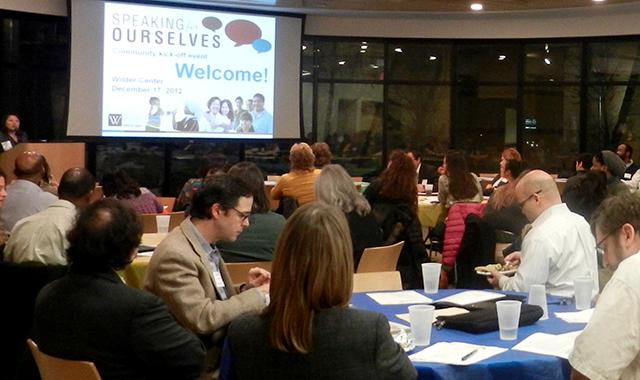
Is there a kind of caste system among the foreign-born in Minnesota where the undocumented are treated as outcasts? What about incidence of domestic violence, access to medical care and food, unemployment and sex trafficking among the state’s immigrant and refugee populations?These issues and others worthy of study surfaced this week when Wilder Foundation gathered together about 90 people, those who work with and live in these communities, to talk about just how well the state’s fastest growing immigrant and refugee groups are faring from day to day.The changing face of Minnesota, especially the Twin Cities, is a well-known story, though our state is less diverse than many. Latest data reported in Minnesota Compass shows about 380,000 people or 6.9 percent of the Minnesotans are foreign-born.Community Sketchbook focuses on the economic and social challenges facing communities, especially low-income communities and communities of color, and how people are trying to address them.It is made possible by support from the John S. and James L. Knight Foundation, The Minneapolis Foundation, and some Minneapolis Foundation donor advisors.Community Sketchbook articles may be republished or distributed, in print or online, with credit to MinnPost and the foundations.Now Wilder Research, at the direction of the Wilder Foundation, is kicking off a deeper study of Hennepin and Ramsey counties’ refugee and immigrant populations: their assets, greatest needs and the challenges to accessing services.“We are trying to do a community assessment,’’ explains Nicole MartinRogers, the project manager, about “Speaking For Ourselves.” In its earliest stages, Wilder officials are involving the community as they consider which immigrant populations to study, as well as what questions to ask, and how to reach these populations.Among those groups being considered for study are Latino, Cambodian, Hmong, Vietnamese, Karen, Somali and Oromo.Documenting current conditions is a first step toward working to capitalize on the communities’ strengths and meet their needs, MartinRogers says.By calling the meeting, researchers hope to involve people from a wide spectrum of minority communities, including Latinos.Conveying the perspective of members of the grassroots group Asamblea de derechos civiles was co-founder Pablo Tapia, who carries a message of “liberation” for undocumented workers and the establishment of a path toward legal citizenship.In a small group discussion, Tapia described how undocumented persons in this country are “not only discriminated against but also taken advantage of,’’ being paid lower wages and “working under close to slavery conditions.’’ The Wilder survey, he says, should include questions that reveal that class division and discrimination.Further, Tapia hopes survey results document the need for change, a need for a partnership between undocumented people and the majority community to, as he says, “advocate for the liberty of our undocumented people.’’It’s not the first time Wilder researchers have surveyed the state’s newer residents. Their 2000 “Speaking for Themselves” study touched on the state’s immigration history, pointing out that 28.9 percent of the population in 1900 fit that description while only 4.6 percent in the state did in 1990. The research went on to focus on Hispanic, Hmong, Russian and Somali groups.That survey, suggested by the St. Continue Reading
A convoy of Red Lake High School shooting survivors is bringing a message of hope and the promise of healing to the heart-broken town still memorializing its dead 6- and 7-year-olds and the adults who died trying to protect them.
Betty Skye was discovered dead early last spring on the boardwalk that fronts Lake Superior in Duluth and Jane Mitchell died in a Minneapolis hospital, both victims of hard-living and homelessness.
With the convening of a new Legislature just around the corner and signs of an economy in recovery, advocates for the poor aren’t wasting any time in revisiting the 2009 recommendations of a bi-partisan commission that laid out a blueprint to end poverty in the state by 2020.
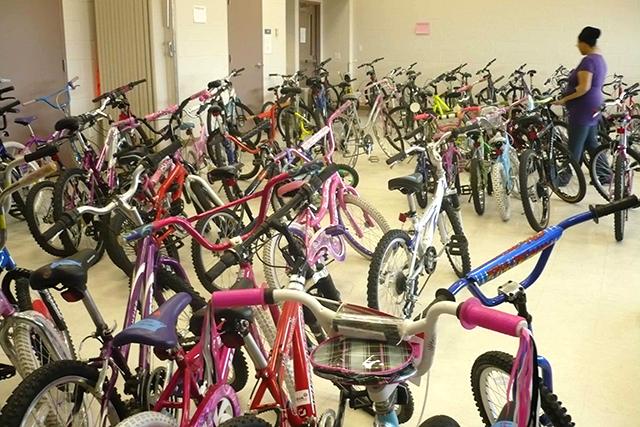
It took some coaxing to get 9-year-old Havy Nguyen out the door and onto the school bus Thursday. The excited youngster would much have preferred to go with her dad to pick up her shiny new two-wheeler.