Commuter rail, long a mainstay in megacities such as New York and Chicago, has had a bumpy introduction in the Twin Cities that could discourage all kinds of transit development in these parts for decades to come. Continue Reading
Lake Street is the commercial lifeline of south Minneapolis, teeming with storefront businesses, the state’s second-busiest bus route and thousands of cars and trucks daily.
Whenever America’s historically low gasoline prices inch up, it’s hardly surprising that economic conspiracy theories abound. Nearly everyone, especially in transit-challenged places such as most of Minnesota, has to fill up to stay mobile, and each uptick at the pump hurts. Suspicions arise when every gas station in your neighborhood jacks the price, seemingly in unison.
It doesn’t take rocket science to figure out that all modes of transportation support and complement each other. Even astronauts drive to the base and walk to the launch tower before blasting off. On a more mundane level, we walk to cars and transit and walk again when we debark. We drive or ride to the airport and walk or tram to the jetway. Biking, walking and transit are similarly joined.Different transit modes—light rail, commuter rail and buses—also work hand in hand. Continue Reading
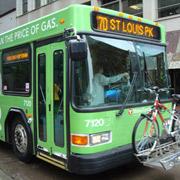
Transit and human-powered transportation have gone hand-in-hand since the first horse-drawn streetcars plied city streets in the 19th century. Despite the current dominance of private cars for travel in America, the relationship between nonmotorized mobility and buses and trains remains strong and growing.Metro Transit research has shown that more than four out of five bus riders walk to their stops, mostly a half-mile or less. In addition, an increasing number of passengers pedal to catch the bus or train and load their bikes on board. That figure nearly doubled over just 18 months in 2007 and ’08. A new survey by the Twin Cities transit agency of bike-to-ride usage is due out in a few weeks.As we celebrate Twin Cities Bike Walk Week June 2-10, exciting new links between foot power and transit may be just over the horizon. Continue Reading
As we approach Twin Cities Bike Walk Week June 2-10, there’s so much positive news about foot-powered transportation that it’s hard to cram it all into one post. So let’s summarize with bullet points:Minneapolis was just named the runaway winner of Walk Score’s new Most Bikeable Cities ratings, garnering 79 points to runners-up Portland and San Francisco’s 70. Bike Score grades cities based on a combination of bicycling lanes and trails, destinations and road connectivity and the number of bike commuters. The Twin Cities standing will only improve as the Nice Ride Minnesota bike-rental system adds 30 new stations this summer, mostly in downtown St. Paul. Continue Reading
It’s a bedrock American principle that public facilities should be accessible to all the people, even if we haven’t always honored it. Continue Reading
Five years ago, the Twin Cities area was one of four across the country to land a $25 million federal grant to encourage bicycling and walking for everyday transportation. This, of course, drives many conservatives nuts. Continue Reading
The late namesake of the Hubert H. Humphrey Metrodome famously observed that without professional sports the Twin Cities would be nothing more than “a cold Omaha.” Well, we’ve dodged that bullet. Even if the Vikings leave town without getting a new playground, we’d still have three major pro teams, plus the football Gophers, performing in their own publicly-funded facilities. Omaha can’t come close to matching that.Where the Twin Cities don’t measure up to their smaller, warmer Midwestern neighbors, however, is in transit connectivity to jobs. A 2011 report from the Brookings Institution found that our metropolis trails not only Omaha, but also Des Moines, Madison, Milwaukee and Wichita, in getting people to work by bus or rail.We have fewer working-age residents near transit stops and less frequent service than the national average, which is led, surprisingly, by many cities in the West. Continue Reading
It’s mid-April in Minnesota, and our state policymakers are still pussyfooting around their best chance to rev up a sluggish economy: Investing in growth-producing public infrastructure. There’s no serious disagreement with repeated studies showing that the right transportation, water and public facilities projects boost output in the short and long terms, especially for the benefit of middle-class Americans, and often with greater returns than those of private business ventures.But anti-government sentiment in some quarters has stalled progress in St. Paul on a capital investment bonding bill that would put the state’s enviable credit rating and nearly $2 billion in borrowing capacity to work at a time of historically low interest rates, bargain-basement bids from job-hungry contractors and lingering high unemployment in the construction industry.Throw in the sorry state of Minnesota’s roads, bridges and other infrastructure—even the State Capitol is crumbling—and this should be a no-brainer. Unfortunately, well over a dozen members of the state House Republican majority won’t vote for any bonding bill, according to Capital Investment Chairman Larry Howes, R-Walker.This counterproductive stance complicates the prospects for state capital investment this year, making bipartisanship key to reaching the 60 percent legislative supermajorities required to borrow on the state’s credit card. Little sign of that has emerged so far, with GOP-controlled House and Senate committees each proposing about $500 million in bonding (on very different things) and DFL Gov. Mark Dayton bidding for $760 million. All those figures are well below half the $1.9 billion borrowing ceiling calculated under the most restrictive debt service guidelines laid down by the administration of Republican former Gov. Tim Pawlenty. What’s at stake here? Continue Reading
 Commuter rail, long a mainstay in megacities such as New York and Chicago, has had a bumpy introduction in the Twin Cities that could discourage all kinds of transit development in these parts for decades to come. Continue Reading


 It’s a bedrock American principle that public facilities should be accessible to all the people, even if we haven’t always honored it.
  Five years ago, the Twin Cities area was one of four across the country to land a $25 million federal grant to encourage bicycling and walking for everyday transportation. This, of course, drives many conservatives nuts.
