An earmark revival?
|
 I’ve argued in the past for the usefulness of congressional earmarks, especially in federal infrastructure programs. Continue Reading
Twin Cities Daily Planet (https://www.tcdailyplanet.net/author/conrad-defiebre/page/10/)
I’ve argued in the past for the usefulness of congressional earmarks, especially in federal infrastructure programs. Continue Reading
 Libertarians screamed when Minnesota finally got serious about enforcing its seat belt law in 2009, allowing police to stop and ticket scofflaw drivers without observing any other infraction. Continue Reading

On July 1 this year, Minnesota’s highway fuel tax will go up a half-penny to 28.5 cents a gallon, the last of seven phased increases that began in 2008. Absent legislative action, it won’t go up again — ever. Before you raise a cheer, let’s consider what that may mean for the safety, comfort, efficiency and even the cost of driving in the long run.Unlike the major government levies on income, property and sales, excise taxes based on gallons of fuel do not automatically adjust for inflation. When prices of everything the gas tax buys — bridge and pavement materials, land for highway right-of-way, construction labor — go up, revenues for those goods stay put. Lately, fuel tax collections are actually in decline because of improved fuel economy and a long-term trend toward less driving.This results in tax cuts on autopilot and increasing subsidies from general taxation, which is no way to finance a transportation system. Continue Reading
 As Minnesotans continue to debate whether to restrict voting to citizens with government-issued photo identification, the lack of another kind of plastic card already denies many people access to services most of us take for granted. Continue Reading
 Retail stores count on steady foot traffic to keep the cash registers ka-chinging. Now there’s a unique opportunity to set up shop in a St. Paul travel hub expected to draw at least 4 million annual potential customers in the coming years.

Firearms enthusiasts like to say that guns don’t kill people; people do. They also claim, arguably, that more guns in law-abiding hands will lead to less violent crime. Similarly, smartphones don’t cause traffic fatalities, but people using them unwisely sure do. On the other hand, “smartcar” wireless technology may eventually make vehicle crashes a thing of the past.The National Transportation Safety Board (NTSB) raised hackles this month with a unanimous recommendation that states prohibit all use of wireless devices behind the wheel, hand-held or not. The move carries no force of law, but it could presage a federal mandate tied to highway funding, like those that dragged states into tightening drunken driving and seatbelt laws.Given that no state has yet ordered all motorists to hang up and drive, Congress probably won’t go that route anytime soon. Continue Reading

Little noticed amid the celebration of an unexpected state budget surplus projection was more good news for Minnesota’s economic future: nearly $2 billion of general obligation borrowing capacity. Budget officials arrived at this figure based on stringent guidelines adopted during Gov. Tim Pawlenty’s administration.Part one of a two-part series. Tomorrow: Conservatives Who Get It on Bonding and Infrastructure.In these days of sovereign debt crises stretching from Athens to Washington, some may consider more public borrowing a fast road to ruin.It’s not when a state like Minnesota can build on its tradition of prudent fiscal management to accelerate recovery from the economic doldrums and set the stage for stronger prosperity to come.Tapping the state’s highly rated credit is especially advisable at a time of record-low bond interest rates, declining infrastructure quality and catastrophic unemployment in the construction industry.Unlike the crushing national debts of Europe and the proportionally lesser U.S. federal debt load of $15 trillion, not a penny of Minnesota’s $6 billion in outstanding capital bonds was used to plug government operating deficits. Instead, our taxpayers continue to benefit from the long-lasting public facilities built with bonding as they pay off the costs over decades. This is a sustainable route to growth employed by countless private businesses.Meanwhile, as cash-strapped European countries have been scrambling to raise money at interest rates above 6 and 7 percent, Minnesota recently sold $769 million in general obligation bonds for capital projects at 2.82 percent, the lowest rate in state memory. Continue Reading

Boasting one of the nation’s lightest bond debt loads, Minnesota is ideally positioned to pump up its economic recovery with strong capital investment in public facilities.Part two of a two-part series. Read part one.At a time of record low interest rates, this opportunity to repair aging infrastructure, increase productive capacity and get thousands of construction workers off the jobless rolls should be a top priority for the 2012 Legislature.The only thing standing in the way may be reflexive conservative opposition to government spending.Once upon a time, taxing and borrowing for infrastructure wasn’t a partisan issue. Conservatives and progressives alike proclaimed the economic and quality-of-life benefits of first-rate public facilities, from Interstate highways to state college campuses. Over the past 20 years or so, these investments suffered collateral damage in right-wing antigovernment campaigns. But now there are signs of a change for the better.Conservatives in Congress have backed off from their former resolve to cut federal transportation funding by one-third. Continue Reading

At the busy corner of University and Snelling Avenues in St. Paul, there’s a sign in a store window reading “We Survived Blight Rail.” It’s a punny swipe at Central Corridor transit construction work that disrupted traffic on University for most of this year.
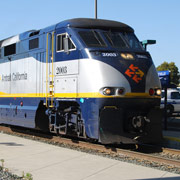
These are discouraging times for advocates of improving America’s decrepit intercity passenger train service. While dedicated taxes, government subsidies and private investment keep flowing to auto and air travel, modest efforts to rebuild the U.S. rail network for more efficient movement of people and freight keep hitting roadblocks.The latest is an agreement in Washington to cut funding for Amtrak, the national passenger rail system, and zero out federal investments in development of so-called high-speed rail.”So-called” because, aside from a few true bullet train projects on the east and west coasts, most of the rail improvement programs begun under former President George W. Bush focused on incremental increases in speed on existing routes.This could be called “fast” or “faster” rail, not exceeding the 110-miles-per-hour U.S. speed limit on tracks also used by freight trains. While that’s only half as rapid as the gleaming rail rockets of Europe and Asia, it would bring a significant increase in the value and marketability of U.S. train travel at a fraction of the economic and social costs of the real thing.Along those lines, Minnesota, Wisconsin and federal rail officials have agreed that the best corridor for improved passenger rail service from the Twin Cities to Milwaukee, connecting then to Chicago, is the existing Amtrak Empire Builder route along the Mississippi River to La Crosse and across Wisconsin north of Madison. (For dedicated transportation wonks, here’s the 310-page report.)This pushes aside competing desires to run trains through Eau Claire or Rochester, although proponents still insist those routes could be viable in the future alongside what is now designated as “the one reasonable and feasible passenger rail alternative” — the Mississippi River alignment.Now we have needed clarification for continued planning and construction of the most important leg of the Midwest Regional Rail Initiative, a 15-year dream of better passenger train service radiating from Chicago to cities in nine states. What it doesn’t do is guarantee any funding or a way around newly energized opposition to most passenger rail improvements.But even in Wisconsin, there’s room for hope. Continue Reading