Myths and more about fuel taxes
|
CNN stirred up a hornet’s nest of right-wing pettifoggery the other day with an insightful opinion piece headlined “Five myths about your gasoline taxes.”
Twin Cities Daily Planet (https://www.tcdailyplanet.net/author/conrad-defiebre/page/11/)
CNN stirred up a hornet’s nest of right-wing pettifoggery the other day with an insightful opinion piece headlined “Five myths about your gasoline taxes.”

Across America, budget-conscious governments are cutting public workers’ pensions and bargaining rights to save taxpayers’ money. Why then do some state and federal agencies insist on spending more when it comes to managing how those employees get to work?Jodie Zurn wondered the same thing when federal officials derailed a transit incentive program for the staff of 215 at her U.S. Department of Agriculture office in downtown Minneapolis and ordered it replaced with one that cost $97,000 a year more —making it less convenient for the program managers and commuters as well.”It didn’t make sense,” she said. “I started pounding on doors.”For her efforts, which resulted in a money- and hassle-saving reversal of policy last month, Zurn received a Change Agent award at Metro Transit’s annual Commuter Choice luncheon last week in St. Paul. The switch not only cut USDA’s costs and paperwork, it boosted the number of transit riders among the agency’s Animal and Plant Health Inspection Service staff in Minneapolis to 180, 84 percent of the workforce.The change replaced employer-paid vouchers for regular transit fares, which cost upwards of $113 a month per person, with $76 monthly Metropass cards good for unlimited discounted rides on Metro Transit buses and trains as well as suburban routes. Continue Reading

A Sim City-like case study in conflicting dynamics is playing out these days in Winona County, where mining companies want to start digging up silica sand in three locations for hydraulic fracking extraction of oil and natural gas in faraway places. We need the fossil fuels to heat our homes and power our motor vehicles. Trouble is, trucking all that sand from the proposed mines is likely to wreck the roads we drive over with the energy resources the sand produces.Does this sound like a dog chasing its tail?The complex connection between fossil energy and transportation has been with us since the days of the coal-fired steam locomotive. It’s grown to where vehicles emit nearly one-third of the carbon dioxide linked to potentially catastrophic climate change, with the U.S. share estimated at half the entire world’s.But just try to chip away at this gas-guzzling problem with options that sip or totally abstain from polluting fuels — transit, fast intercity trains, bicycling and walking — and you’ll run into no-holds-barred opposition. In recent weeks, for example, conservative U.S. senators have mounted several efforts to eliminate federal funding for bike paths, walking trails and other transportation enhancements, using arguments most charitably described as misinformed.These include repeated claims that taxpayer money has gone to refurbishing a giant roadside coffee pot structure in Pennsylvania (it didn’t; private funds paid the cost), a movie theater in Kentucky (actually a driver-training simulator) and $6 million “turtle tunnels” in Florida (culverts that divert all sorts of critters from endangering traffic on U.S. Hwy. Continue Reading
As the 2011 construction season winds down, Central Corridor light-rail crews are rushing to reopen four lanes of traffic on University Avenue before the snow flies. So far, the weather has cooperated enough to project 40 percent completion of the $957 million project by year’s end.

More ubiquitous than McDonald’s, structurally deficient bridges are found across Minnesota and the rest of the United States.While not every one is in imminent danger of falling down, new research has found that Americans take more than 210 million trips over these suspect spans every weekday.That’s more than three times McDonald’s worldwide daily customer count of 64 million. It’s no mystery why. The nearly 70,000 failing arches across the country outnumber the Golden Arches five to one.Despite the iconic tragedy of the Interstate Hwy. 35W bridge collapse in Minneapolis four years ago, Minnesota fares relatively well in three important new studies focusing on the nation’s bad bridges. According to the conservative-leaning Taxpayers for Common Sense, all but one of Minnesota’s eight congressional districts has a lower percentage of structurally deficient spans than the national average.Progressive-leaning Transportation for America reports that Minnesota and the Twin Cities metropolitan area both rank around the top one-third of the nation in overall bridge condition.In the Twin Cities, however, 21 drivers still cross a deficient bridge every second. Continue Reading
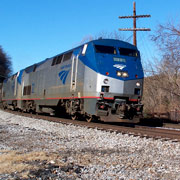
It’s become so commonplace that it barely makes news, but Amtrak just reported its eighth ridership record in the past nine years. In the federal fiscal year that ended Sept. 30, 30.2 million passengers boarded U.S. intercity trains, a 5 percent increase over fiscal 2010.On top of that, ticket revenue of $1.9 billion for the national rail passenger system was up more than 8 percent, indicating growing market appeal.Amtrak’s Acela Express already draws more passengers than the airlines in the crowded New York City-Washington, D.C., corridor. And the Empire Builder long-haul train from Chicago to the Pacific Northwest through the Twin Cities remains the top volume service on Amtrak’s 15-route National Network, boarding 469,167 riders in fiscal 2011.These figures are all the more impressive considering that flooding in the Upper Midwest and hurricanes and record snows in the Northeast disrupted train service for significant periods. Meanwhile, Amtrak, long unfairly portrayed as a symbol of galloping government subsidies, is covering more than 85 percent of its operating costs from fares and advertising revenues. Continue Reading

One of the deepest critiques of expansionary American growth patterns comes from a surprising quarter: Minnesota fiscal conservative Charles Marohn. He even blames suburban sprawl for our current financial crisis.”The great experiment of suburbanization that America embarked on following World War II has no precedent in human history,” Marohn writes in his Strong Towns blog. “As it enters its third generation, the flawed assumptions that were overlooked are now coming back to bite us in a cruel way. Like any Ponzi scheme, there is only one way this ends.”As Marohn acknowledges, this is an extremely dark vision of a problem for which there is “no solution,” only “rational and irrational responses.” And he minces no words in his disdain for an autocentric social order built on “two-ton prosthetic devices” and “snout houses” with garages sticking out the front. Continue Reading
 For the hundreds of autoworkers who will be displaced when Ford Motor Co. shutters its Twin Cities Assembly Plant in St. Paul on Dec. Continue Reading

It should surprise no one that the dirtiest air in the United States hovers over the densest cities, where gridlocked traffic and tall, tightly packed buildings emit more pollution per square mile than practically anyplace else. About the only contrary word comes from vacuum cleaner and air purifier salesmen, who insist the air inside your home is the worst.If that’s the case, I guess it’s a good thing our growing legions of bicycle riders usually don’t pedal indoors. But a new study in congested London, England, found that bicycle commuters absorbed more than twice the amount of black carbon soot in their lungs as did those who walked to work.Some have questioned the preliminary study’s methodology, which involved only 10 subjects unmatched by age. The researchers suggested this explanation for their conclusions: “Cyclists breathe more deeply and at a quicker rate than pedestrians while in closer proximity to exhaust fumes.”OK, that makes sense. What doesn’t is to take findings such as this and contort them into sweeping arguments against Smart Growth — compact urban development interlaced with transit and nonmotorized transportation infrastructure — in favor of autocentric suburban sprawl. Continue Reading

In the United States, you are three to fives times more likely to die in a bicycling crash than in European countries that have gotten serious about the safety of nonmotorized travelers.Even in Minnesota, considered a national model for healthy, economical and earth-friendly biking and walking, 11 percent of traffic fatalities last year were suffered by folks not in a motor vehicle. But little or no state money addresses this problem. That’s been left to local governments and national programs, which are under fierce attack from autocentric conservatives over their 1.5 percent of federal transportation spending devoted to biking and pedestrian safety.Fortunately, the Twin Cities landed $25 million from Washington several years ago to make getting around on two wheels or two feet less dangerous and more attractive. The positive results are visible as more and more people take to bikes and shoe leather around here. Bicycling is an economic boon, too, generating $315 million a year in manufacturing, distribution, retail and service in Minnesota, according to Minnesota Business magazine.The next few weeks will be particularly rich in ribbon-cuttings of bike lanes, a University of Minnesota bicycle service center and even the state’s first bicycle stop light. Continue Reading