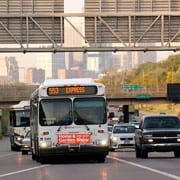
Minnesota has 142,000 miles of streets and highways, 4,458 miles of railroad track, 3,880 miles of walking and biking trails, 135 public airports, 77 counties with full transit service and nine ports for waterways shipment. Practically all of this multibillion-dollar array of transportation infrastructure is a product of intensive public planning. It won’t keep underpinning our access, mobility, safety and prosperity without continued efforts to smartly map out maintenance, rebuilding, repurposing and expansion across all the modes.
You’ve probably heard of “food deserts,” inner-city and deep-rural communities that lack good access to stores with healthy, affordable groceries.Well, east of St. Paul, there’s a different kind of wasteland, relatively affluent suburbs with little or no transit. Continue Reading
Minneapolis, the national poster child for bridge failure since the deadly 2007 collapse of the I-35W span over the Mississippi River, is celebrating three bridge reopenings this month. All three projects were initiated after the 35W disaster killed 13 and injured 145. Continue Reading
In the 1950s, long before America’s social atomization described in the book “Bowling Alone,” my dad went to work in a carpool. The other travelers were his fellow Ph.D. scientists at DuPont’s ivy-covered Experimental Station in Wilmington, Delaware. Many of the old laboratories on the DuPont campus are gone, and carpools are largely a thing of the past, as well.Among the Twin Cities’ 3 million residents, barely 7,000 people commute in registered car and van pools, according to the latest Metro Transit and Metropolitan Council counts. That’s not to say there isn’t continuing interest in this efficient and economical way of getting to work. This year alone, more than 3,600 people have searched for carpool partners using Metro Transit’s online ride-matching software.October is Rideshare to Work Month, Metro Transit’s effort to tell more commuters about the ease, reliability and perks that come with carpooling. Continue Reading
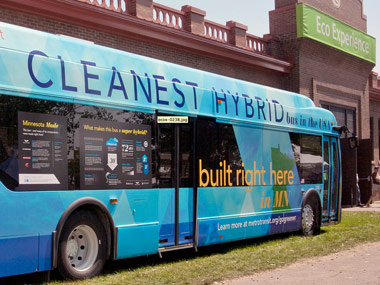
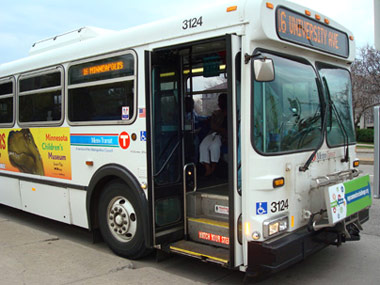
Metro Transit’s newest hybrid-electric buses were unveiled at the State Fair, a fitting introduction for state-of-the-art technology that’s made right here in Minnesota. Continue Reading
Even though I seldom venture downtown, I’ve always thought the Minneapolis skyway system — the most extensive and successful in the United States — was pretty cool.
If you’re planning to visit the Minnesota State Fair starting Thursday, it’s a smart move to study the many alternatives for getting there. Because of the huge crowds that assemble daily at the 320-acre fairgrounds in Falcon Heights, the customary default choice, the private car, is probably the most expensive, time-consuming and exasperating option.
There’s for-sale sign on the Ray Busch United Auto Workers Local 879 union hall across Ford Parkway from the shuttered Twin Cities Ford assembly plant. Continue Reading
“We can feel pretty good about the level funding and support for transit in Minnesota,” Tony Kellen, president of the Minnesota Public Transit Association, wrote in the group’s latest newsletter.Kellen, the voice of transit in 76 Minnesota counties, praised state and federal governments for holding transit systems harmless from budget cutting, adding to capital funding and directing meaningful shares of rising state motor vehicle sales and lease taxes to bus and rail operations.As a result, the Minnesota Department of Transportation says the state remains on track toward its statutory goals of meeting at least 80 percent of greater Minnesota transit demand by 2015 and 90 percent by 2025.”Thanks to advocates speaking up for transit all across the country, the final federal transportation reauthorization bill does not remove federal gas tax dollars from the Mass Transit Account and it maintains funding for important transit programs we rely on,” Kellen added. “The ability of Congress to pass a new transportation bill despite the rhetoric we hear in an election year is really a tribute to the importance of basic transportation services and systems that people need every day of their lives.”In lightly populated greater Minnesota, that’s more than 11 million riders in 2010, just a tick below the record recession year of 2008. This is the payoff from doubling the number of countywide bus and van services to 70 over the past 20 years. The future looks bright, too, with more than $100 million of increased federal transit appropriations for Rural Area Grants. Both state and federal funding have been vital to rural transit’s growth, so important to people who can’t drive but still need to get around.Those folks particularly will welcome the federal transportation bill’s inclusion of an American Public Transit Association proposal to combine several programs that boost their mobility. Continue Reading


 There’s for-sale sign on the Ray Busch United Auto Workers Local 879 union hall across Ford Parkway from the shuttered Twin Cities Ford assembly plant.