Gay and lesbian athletes and allies speak out against homophobia in sports and schools

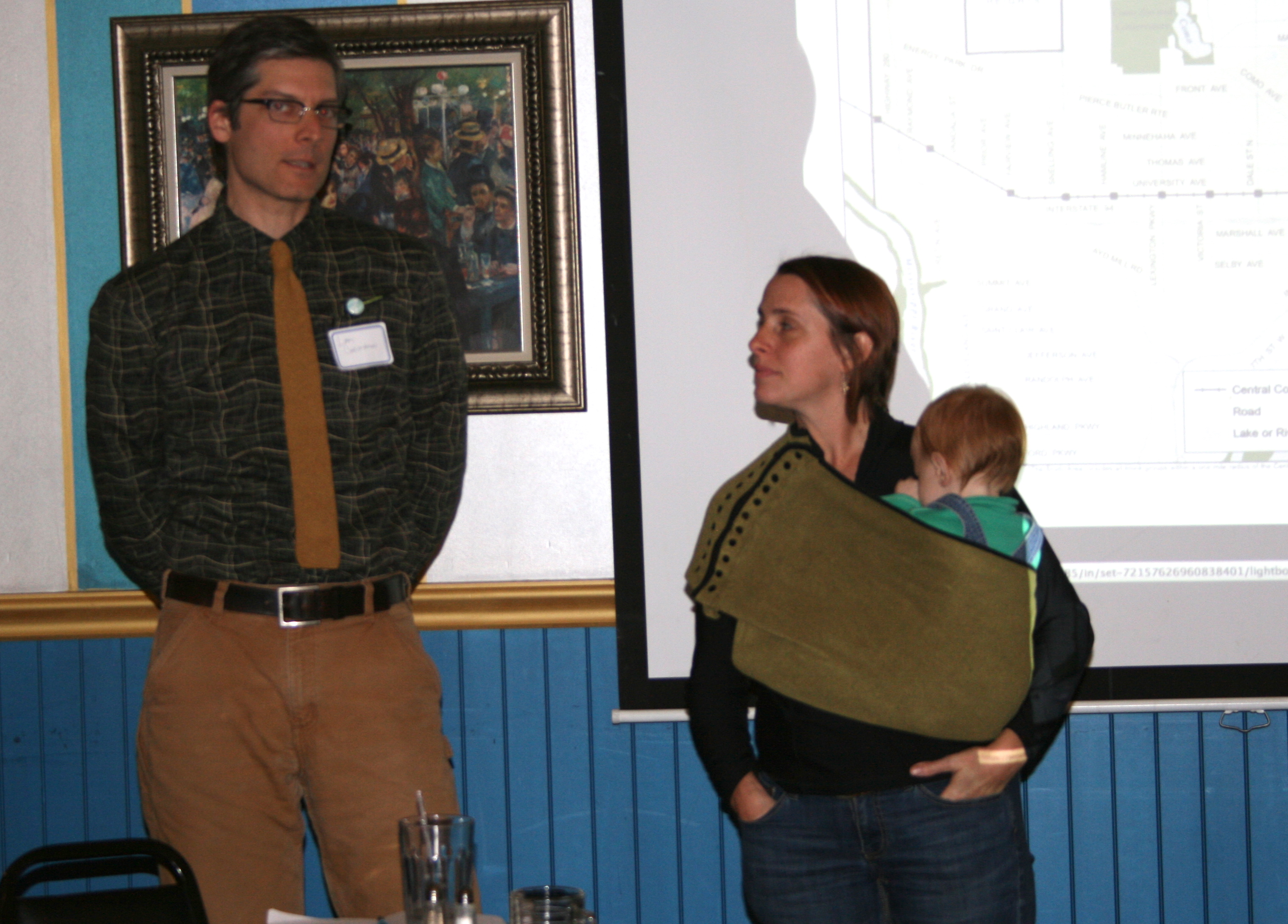
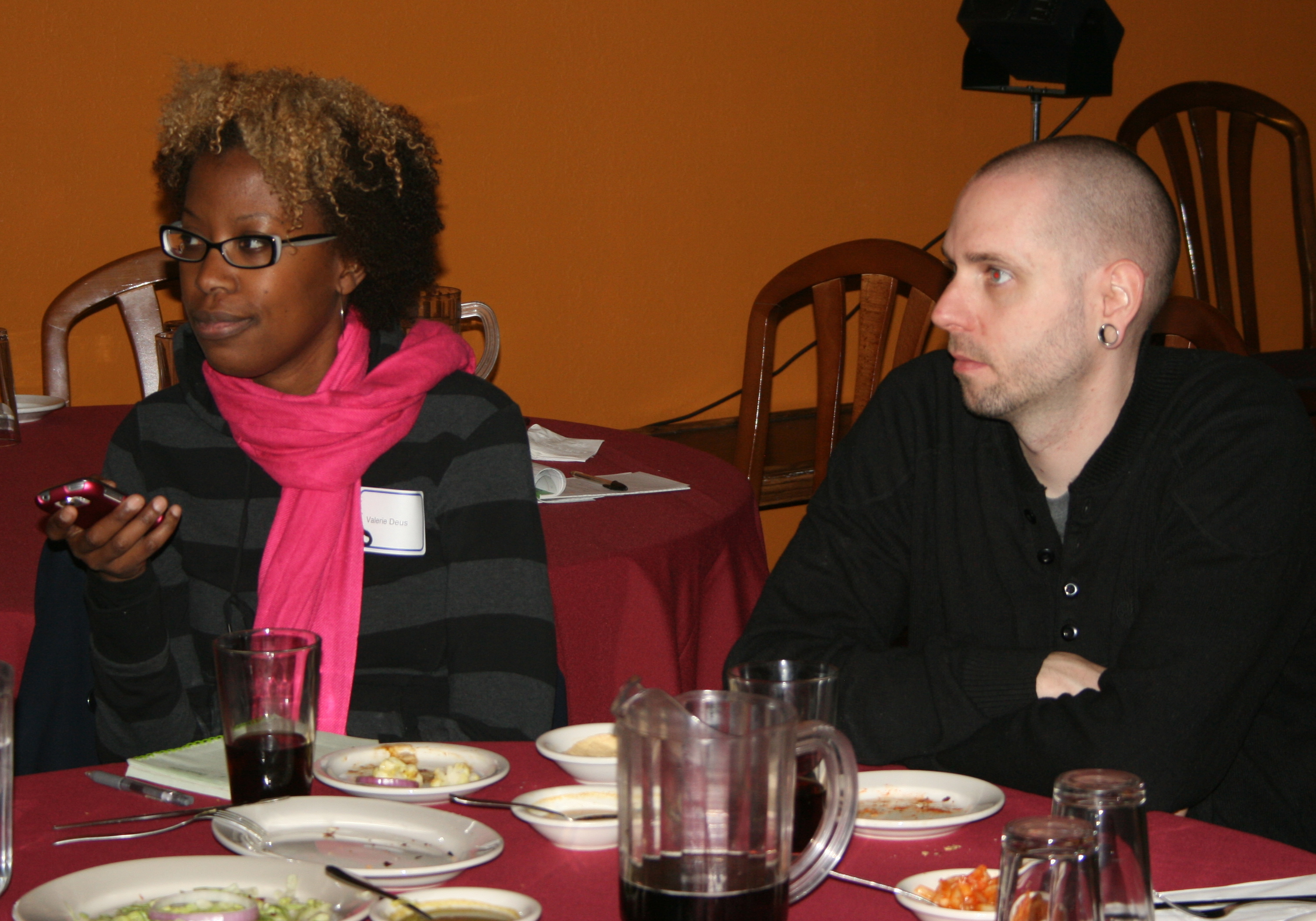
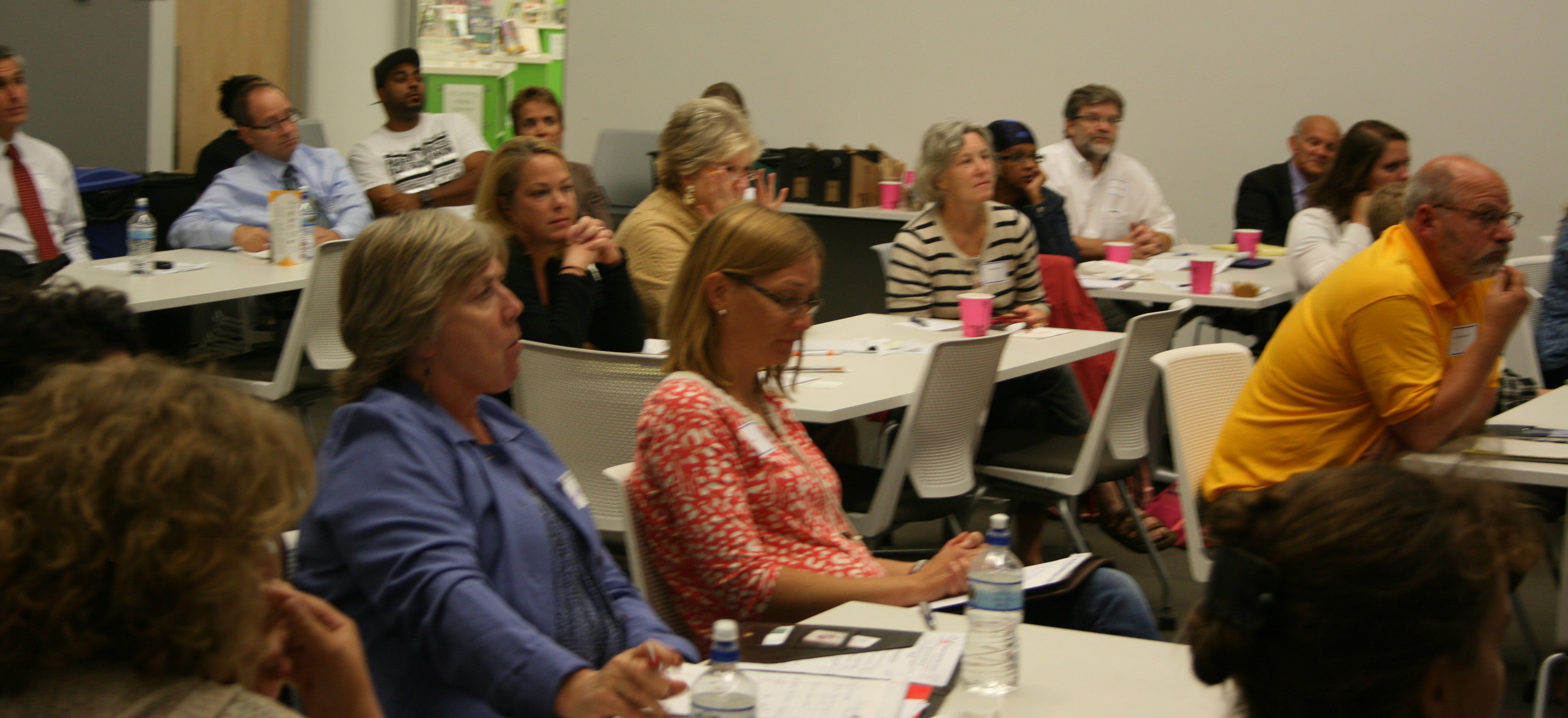
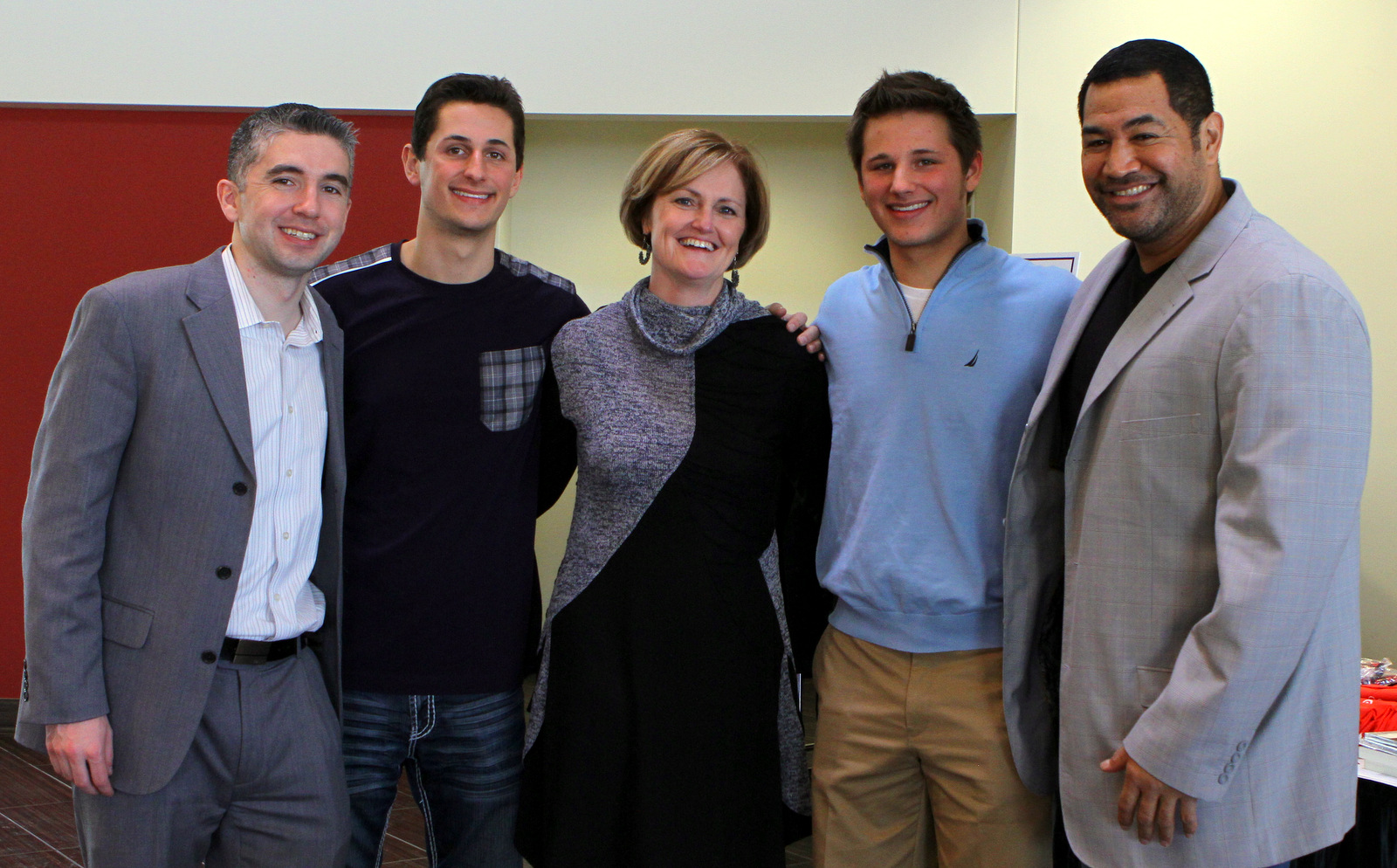
Esera Tuaolo, once an NFL defensive tackle for the Minnesota Vikings and Green Bay Packers, is convinced that he’d be dead if he had come out as gay in high school. By contrast, Nick Kleidon, former player on the Breck School hockey team, and 25 years Tuaolo’s junior, did come out in high school, with no negative consequences. Tuaolo, who remains a Twin Cities resident, described “getting choked up,” when he first met Nick, standing alongside his partner, Colin.Some of the audience assembled at HamlineBoth athletes shared their stories at Cultivating Respect, a conference and awards dinner dedicated to work being done in the Twin Cities to create safe schools for all students. Organized by PFLAG (Parents, Families, and Friends of Lesbians and Gays) Twin Cities, the event was held at Hamline University on January 18. Also participating in the Invisible Athletes Forum was Becca Lindquist, a recent University of California Berkeley grad, Division 1 rower and winner of conference and NCAA championships.If you can play, you can play Moderator Patrick Burke, a scout for the NHL’s Philadelphia Flyers, set the tone and context for the forum. Burke is founder of the You Can Play Project, an effort to end homophobia in sports. He and two others launched the project last year in memory of Brendan Burke, a student manager for the Miami University Red Hawks hockey team, and Patrick’s younger brother. Continue Reading

Wedge Co-op in Minneapolis awards support good work in the community

The 17th annual WedgeShare awards ceremony, held January 17 at the Wedge Community Co-op, honored work being done by nine local non-profit organizations.Josh Resnik, the Wedge Co-op’s new CEO, said that overseeing a philanthropic program that gives a portion of the co-op’s annual profit back to the community is one of the most satisfying parts of his job. Since 1997, Wedge Cooperative member-owners have awarded more than $600,000 in WedgeShare grants to organizations whose work aligns with the co-op’s values. Resnik explained that all nominees must advance the International Cooperative Alliance’s Principle #7, demonstrating concern for the community. To be eligible, an organization must also be non-partisan, non-sectarian, and engaged in activities related to the natural environment, health and wellness, natural foods and sustainable agriculture, community involvement and capacity-building, or cooperative-related activities. Members vote on WedgeShare grant recipients at their annual fall meetings. In October 2012 they decided that these organizations would divide a total of $75,000:•       Emergency Foodshelf Network•       Open Arms of Minnesota•       Water Legacy•       Minnesota Food Association•       Community Design Center of Minnesota•       Centro Campesino•       Great River Greening•       Midtown Farmers Market•       Cycles for ChangeTwo organizations were showcased. Michael Venker, a board vice president, spoke on behalf of Open Arms of Minnesota, best known as the state’s only nonprofit committed to preparing and delivering free healthy meals tailored to the needs of people living with HIV/AIDS, multiple sclerosis, ALS, breast cancer and other diseases. Venker also highlighted lesser-known efforts, such as ensuring that children living in South Minneapolis’s Phillips neighborhood, where Open Arms is based, have access to healthy foods in the summer. A world away, he said that Open Arms has been working with communities in sub-Saharan Africa to provide food and technical assistance to people living with and affected by HIV/AIDS. Midtown Farmers Market was recognized for its committment to providing all community members with better access to healthy and affordable foods. Continue Reading

Two leaders step up in Minneapolis American Indian community

CORRECTION 12/20/2012 – On Tuesday, Jay Thomas Bad Heart Bull was named president and CEO of the Native American Community Development Institute (NACDI). That very same day, the Greater Minneapolis Council of Churches announced that Patina Park would become executive director of its Division of Indian Work (DIW).NACDI’s board of directors has been seeking a new president and CEO since that organization’s founder, Justin Huenemann, departed earlier this year. DIW has been involved in a similar search process. Its board had set a goal of having a new executive director hired by year’s end.Jay Thomas Bad Heart BullRobert Lilligren, Minneapolis City Council vice president, serves as NACDI board chair. He praised Bad Heart Bull as a “strong, dynamic leader,” and “a young, positive member of our community who has the skills and experience to take NACDI to the next level.”In announcing the selection of Park, Noya Woodrich, president and CEO of the Greater Minneapolis Council of Churches, cited Park’s “stellar” organizational management and fundraising abilities. Continue Reading

Amendments on front burner at 2012 fall media forum

Many had yet to catch up on sleep from a late election night four days earlier, but that didn’t keep around 90 people from attending the Twin Cities Media Alliance 8th Annual Fall Media Forum. Held at the University of Minnesota’s Urban Research and Outreach-Engagement Center (UROC) on November 10, this year’s theme was, “After the Elections: Change Work, New Media and the Challenges Ahead.” The day-long event provided an opportunity for participants to make sense of election results, analyze media coverage, contemplate challenges, and share ideas about valuable tools and strategies. It also served as the final major piece of TCMA’s New Normal 2012: Get Connected! project. Continue Reading

Ten tips for creative placemaking emerge from Get Connected! meeting in St. Paul

Have you ever wondered what creative placemaking is? A top-ten how-to list from Jill Mazullo, Envision Minnesota’s director of communications and development, reveals what it is by describing how to do it: Go where the people are.Block off the street.Make it easy for people to come.Feed people.Show pictures of what’s possible.Have people vote with post-its.Give people something to do.Have fun projects for kids and grownups.Invest people in the outcome.Use social media to your advantage.Irrigate, an artist-led creative placemaking initiative that spans the Central Corridor Light Rail line in Saint Paul, gives a more formal definition of “placemaking” as, “The act of people coming together to change overlooked and undervalued public and shared spaces into welcoming places where community gathers, supports one another, and thrives.“ Placemaking can involve temporary activities such as performances and chalked poetry, or more permanent installations such as landscaping and unique art.Connecting over placemakingCreative placemaking was the focus of the final Twin Cities Media Alliance Get Connected! community meeting, held in partnership with Envision Minnesota at St. Paul’s Chatterbox Pub on October 30. Mazullo’s list comes from a blog she wrote about the event, synthesizing the lessons of the Charles Avenue Friendly Streets group.The Get Connected! event featured opening remarks by Mazullo and Envision’s executive director Lee Helgen. Most of the evening was devoted to presentations by Hamline Midway Coalition members Lars Christensen and Erin Pavlica, and Twin Cities Media Alliance neighborhood engagement coordinator, Marcos Lopez-Carlson.Lopez-Carlson, in his presentation, illustrated how blogging, Reddit, and other new media tools can play a major role in placemaking. Continue Reading

Connecting over popcorn and a Koch brothers documentary with IATP

A documentary film, Koch Brothers Exposed: The 1% at Its Very Worst, was the focus of a Get Connected! community meeting co-hosted by the Institute for Agriculture and Trade Policy (IATP) and Twin Cities Media Alliance on October 29. IATP works locally and globally at the intersection of policy and practice to ensure fair and sustainable food, farm and trade systems.A large audience turned out to learn how the Koch brothers, two of the nation’s top polluters, are affecting much more than environmental policy by contributing to the campaigns of elected officials, serving on the board of ALEC, and funding not just conservative think tanks, but programs at colleges and universities across the United States. The documentary illustrates how deeply involved the Koch brothers are in politics at all levels. From local school board races on up to the federal level, the billionaire brothers bankroll a vast network of organizations working to undermine the interests of most Americans. For example, with financial backing from the Kochs, politicians write and support legislation to gut environmental regulations. Weakened regulations mean more dire consequences to natural habitats and people’s health, something the film shows is occurring in rural Arkansas communities where Koch-owned industrial plants are located.The brothers are also behind efforts to support major changes in Social Security and upping the retirement age. Continue Reading

Connecting to tell a different story about farming and food systems

As a local foods organizer in the Big Stone Lake region of western Minnesota, Rebecca Terk has come to appreciate the power of new media tools.In Terk’s work for the Land Stewardship Project (LSP), her Big Stone Bounty blog entries, tweets, and Facebook posts serve multiple purposes. They amplify the voices of farmers and other rural area residents, circulate important information about proposed development, and connect and organize citizens to help them determine what’s best for their communities.Terk told a group gathered at Gandhi Mahal restaurant for a Get Connected! meeting on October 10 that new media tools allow her to hold a mirror up to a wonderfully rich culture.Chipping away at dominant narrativesTerk’s work contributes to one of LSP’s core goals: challenging the dominant narratives about family-owned farms and rural towns in an era dominated by corporate agribusinesses.Dominant narratives being promoted by powerful interests are that factory farms are “state of the art,” that they represent “the future of farming,” that “the family farm is dead” and that rural communities are “old” and fading away.Megan Smith and Rebecca TerkChipping away at those narratives requires sharing more and alternative stories of rural communities, said Megan Smith, LSP membership assistant.Telling different stories, showing people that they have choices as consumers, and revealing the implications of policies being promoted by corporations and their allies, are among the things that can be achieved, in part, through smart use of media tools. Bringing the voices of rural people into areas where they are not typically heard is another part of the work. On its website, LSP profiles new farmers who have been through Farm Beginnings, “a farmer-led, community based training and support program aimed at getting more farmers on the land farming sustainably.” There been more than 500 graduates of the program, said Smith.Local control requires democratic participationCreating food systems based on community needs, not profit, is a primary aim of LSP, a private nonprofit organization, said Mike McMahon, its director of individual giving.Mike McMahonIn a blog post, McMahon wrote:We know what happens under unchecked corporate power—the people suffer. That’s why family farmers across the Midwest organized in the 1890s, and the 1910s, and 1930s, and the 1980s—building farmer co-ops, passing public policy that reigned in corporate power and assisted family farms, and establishing farm organizations to fight for the well-being of family farmers, rural communities, and the land.LSP sees the U.S. being in the thick of another such period, with big corporations taking control over our seeds, livestock, milk, land, and public assets. Continue Reading

Connecting parents, educators, and others who work with people with developmental disabilities

Educators, psychologists, social workers, and behavioral therapists were all part of the mix. Moms, however, comprised the largest portion of the audience at an October 8 Get Connected! community meeting focused on the importance of addressing challenging behaviors early in life. This helps children with intellectual and developmental disabilities experience full inclusion as they grow up, then fit more successfully into the workplace as adults, participate fully in the community, and lead happy, productive lives.Although it’s not widely known, people with developmental disabilities constitute one of the largest disability groups in North America. One out of every 10 Americans has a family member with a developmental disability. Families often feel isolated, which is where The Arc comes in. The Get Connected! Continue Reading