Northside schools create partnership for student success

A new science, technology, engineering and math (STEM) focus will be fully introduced this fall at both North Community High School and, a few blocks away, at the “new” Franklin Middle School. North Principal Shawn Harris-Berry and Franklin Principal Karon Cunningham are working collaboratively across the schools.There was a strong relationship back in the ‘80s and the ‘90s” between the two schools, recalls Harris-Berry, a 27-year Minneapolis Public Schools (MPS) veteran. Since then, however, both schools have undergone major changes. North now is a “small college-preparatory” high school with nearly 300 students.“[It] is not a big box school. Everybody knows you by name,” proclaims North’s principal. Continue Reading

Minneapolis Urban League in trouble

Two weeks ago we wrote about the confusion regarding those who say the Minneapolis Urban League (MUL) is now close to death’s door (see our blog entries of April 1 and April 6), just as the St. Paul Urban League died three years ago, and current leadership who say all is well, and will get even better with more government and nonprofit funding. What do we make of the April 13, 2015 Star Tribune headline: “Minneapolis Urban League accused of potential double dipping,” and the April 16, 2015 headline: “Legislative auditor to investigate Minneapolis Urban League.”Even more troubling is that the concern seems to be the double dipping, not the fact that the programs are not working. Had they not double dipped they could have gone on, business as usual.The hard work of the MUL was once identified by Vernon Jordan as one of the most respected affiliate stars in the Urban League movement in meeting the challenges of the 1920s and on through the 80s. The decline began in 1990, right after the last “State of the MUL in 1989” (see Chapter 14 of The Minneapolis Story, “The Role of Minneapolis Black Organizations”). Continue Reading

Tax exemptions are bad for city

A proposal for a new soccer stadium in downtown Minneapolis is drawing controversy because of how it may be funded. The owners of the Minnesota United soccer club have stated that they will privately fund the stadium, which will cost an estimated $150 million, without any direct subsidies from the state. However, their proposal for the stadium included a request for a sales tax exemption of about $3 million, as well as a permanent property tax exemption.These requested exemptions have received mixed reactions. Some are potentially supportive of the deal. Several City Council members have asked for more details about the proposal, and Gov. Mark Dayton has said he may offer public dollars for certain stadium improvements.  Others oppose any permanent tax exemptions. Minneapolis Mayor Betsy Hodges called the request a “public subsidy” that “will have a direct and negative impact on the taxpayers of Minneapolis.” On Monday, the state Senate voted almost unanimously to ban state funds from being spent on the new stadium. Continue Reading

Columbus Statue Celebrates Genocide and Should Be Removed

Native American activist groups in Minnesota would like people to learn the real history of Christopher Columbus and quit putting him up on a pedestal at the State Capitol.“We all know in 1492 he sailed the ocean blue,” said American Indian Movement Chair Mike Forcia. “And in 1493 he stole all that he could see.”For more than 83 years a statue of Columbus has gazed from the Capitol toward Minnesota’s Justice Center. For Forcia, real justice would be removing the statue.“We need to deport Columbus,” said Forcia. “We can’t be celebrating genocide anymore.”Genocide isn’t a word most history books associate with Columbus, but he enslaved Native Americans. As governor of the large island he called Espanola (today Haiti and the Dominican Republic), Columbus’ programs reduced the native population from as many as eight million at the outset of his regime to about three million in 1496.Minnesota’s legislature is considering a bill that would change the engraving on the statue from “Discoverer of America” to “Christopher Columbus landed in America.” A co-sponsor of the House bill includes Rep. Dean Urdahl (R-Grove City), who taught high school government classes 35 years.That change misses the point, say Native Americans who marched through downtown St. Continue Reading

Improving urban public education: 8 ideas from a veteran teacher

t’s hardly news that less than half of the kids in Minneapolis and St. Paul public schools are proficient in reading and math. Education “experts” have weighed in on this topic, but we haven’t often heard the perspective of classroom teachers. What follows are eight ideas for improving urban education; they’re based on what I learned from 34 years of teaching in public and private schools:1. Provide one year of free preschool for all children from low-income families. Critics of urban public schools rarely acknowledge that many kids come to kindergarten already a year or more behind. Continue Reading

Green Line Businesses bounce back

For some businesses along the Green Line light rail, the nearly two years of transit construction proved to be too much to keep operations steady. The light rail’s construction from 2012 to 2014 pushed some Stadium Village and Prospect Park businesses — like 56-year-old Campus Pizza and Pasta — too far below their bottom line, and many of the area’s storefronts cut costs and changed some of their business practices. But now, those businesses that survived the road work are bouncing back from the years of low sales and slow foot traffic that came with the construction.In order to stay open, many area businesses reduced their staff sizes and inventory to keep revenue flowing. Though Stub and Herbs has a loyal fan base and a 76-year-old legacy, owner Josh Zavadil said the business struggled through the two-year construction period.  Zavadil said he restructured the property’s mortgage and cut back on some spending during the construction to cope with the restaurant’s dwindling business as a result of the area’s lack of foot traffic. The business relied heavily on customers from University of Minnesota hockey and football games, he said. Other businesses along the light rail resorted to hosting events with the hopes of drawing positive attention to a depressed area.  While Art and Architecture Inc., an antique store in Prospect Park, didn’t struggle as much as other area businesses, manager Jodi Hohman said, morale in the area was low during the road work. “Everybody was down in the area,” she said. “People were closing up shop.” The antique store held a number of events, including “junk markets” — which are comparable to yard sales — to spur extra business, Hohman said. The removal of parking spots came with the light rail’s construction, and businesses that relied heavily on those spaces are still feeling the loss. During the construction, Paradigm Copies owner Gary Magee said his business on Washington Avenue Southeast removed some of its printing machines and shrank in size to reduce its rent cost.  He said the store lost a lot of walk-in business and didn’t attract any customers. But now that the light rail is up and running, Magee said his storefront is more robust, and he expects its customer base to continue to grow. “I’m seeing a lot of positive signs,” he said. “We’re on our way to doing much better.” Few business owners in the area know their exact property values, but many said most of the land prices along the Green Line have gone up in recent years.  And owners who own their own buildings instead of rent, like Textile Center in Prospect Park, say they are glad that they do. Nancy Gross,  director of the center’s administration, said since the train started running last summer, the nonprofit has seen more people visit its gallery space, and its consignment store has had higher sales. On the Green Line light rail’s route, trains slowly turn onto University Avenue Southeast after the line’s Prospect Park stop — half of their windows facing the Textile Center. “There are lots of eyes on us,” Gross said. “We love it.” Continue Reading
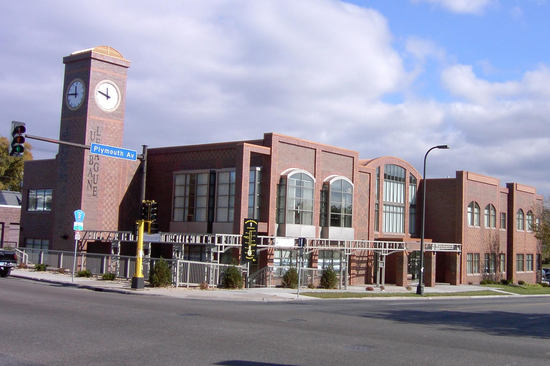
Fire devastates West Broadway businesses, upstairs housing units

A Wednesday (April 15) early morning fire roared through a row of businesses and residences leaving many homeless and one high profile community organization in search of new operating facilities. The fire that started in the UnBank, a check cashing business located at 913 W. Broadway in north Minneapolis, quickly spread to neighboring businesses and second floor apartments in the connected row of the 900 block of West Broadway Avenue. The first call to the fire department came in around 8:30 a.m. and by 9 a.m. the fire had already claimed several of the block’s businesses and apartments. No injuries were reported but there was extensive property damage along the block.In addition to the UnBank, a longtime neighborhood grocery store, Brix, was lost, as was the headquarters to community action group, Neighborhoods Organizing for Change (NOC). While the cause of the blaze has yet to be determined, there is speculation that the fire could have been intentional.”All we know is that the scene is under investigation, but some folks on the (fire) department that I talked to said it’s unusual as to how quickly the fire spread and how hot the fire got,” said Anthony Newby, executive director of NOC.Calls to the Minneapolis Fire Department were unreturned.Newby said while his organization is without an office, he’s most concerned with those who are without a home due to the blaze.”Our first concern is for the residents who were living in the apartments on the second story,” said Newby. “Our thoughts and prayers go out to them.”More than just thoughts and prayers, NOC is sending relief as well. Continue Reading

Meet Sadam Haska, founder of the popular Oromo Vine

On Nov. 10, 2013 Sadam Haska, 23, started his popular Facebook-based Oromo Vine with a simple post: “Hey guys plz pass these to your friends.” The page now commands more than 6000 likes.The Brisbane, Australia based comedian and satirist says he was propelled into action out of frustration that the Oromo — despite being “funny and numerous”— lacked proper venues to channel their inner funnyness.Haska is the lead actor and producer of the vlog collective. Most of his stints focus on smart caricutures of the tension between Oromo and western culture. But Haska says his work is not all for laughs: he has taken stances on social issues such as #OromoProtests and also challenges old customs such as certain Oromo marriage practices. Last month, during his visit to Melbourne, he sat down with OPride contributor Sinke Wesho. Continue Reading

Body cameras benefit the police

Whether or not they care to admit it, I am positive that every student, professor and community member has an opinion on body cameras for police officers. Perhaps a body camera would have been useful in the shooting of Michael Brown in Ferguson this past summer. But while body cameras are certainly useful in situations like Brown’s, they also reward the police officers who are doing a good job. Therefore, I am glad that many police departments are moving toward using them. Having cameras available for law enforcement officers is important for several reasons. First, it enables their superiors to determine whether the officers are doing their jobs well.  Most importantly, the use of cameras will help the fight to end racial injustice. A report by the Washington Post found that in three-quarters of fatal shooting cases since 2005, the police officers were white, and two-thirds of officers’ victims were black.  Prosecutors won’t press charges against officers unless there is a substantial amount of evidence. Continue Reading

Latino renters allege mistreatment in Lyndale

Inquilinos Unidos por Justicia (United Renters For Justice), along with several leaders of the Lyndale Neighborhood Association (LNA), gathered outside the Q.T Properties office on Hennepin Avenue  to protest the numerous fines and alleged mistreatment levied by the building owners. The associations wielded letters from tenants, and a petition demanding better conditions, demanding management to come outside and negotiate. Some were holding signs, and all were holding a sense of frustration.For the past year, there have been frequent complaints of mistreatment and deterioration of conditions at the buildings from Latino renters, along with difficulties in resigning their leases.“Every other moment they have letters saying we’re going to be fined, for their children playing in the hallway, for using the common area outside the apartment spaces, for leaving shoes or bicycles in common areas. These are things people should be able to do in their living spaces, and not have to fear for retaliation,” said Natasha Villanueva, LNAAs each speaker went up to list off their complaints, a common theme was clear: The heavy fines and shifting lease agreements seem designed to push them out. Most of the latino renters are working-class families who can’t afford to take time off work to deal with management, and the persistent fines are taking a toll.“They fined my car twice, which cost me $700. Continue Reading