The Geography of Twin Cities Race

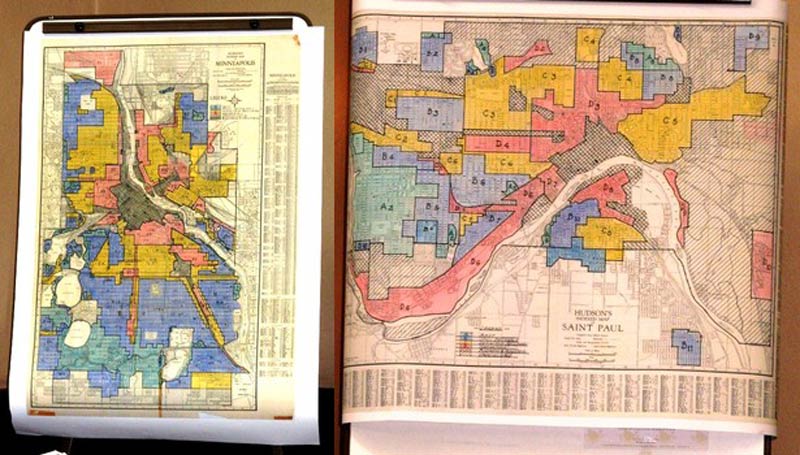
An earlier version of this essay appeared in the March 18, 2015 edition of Politics in Minnesota. Why are the Twin Cities so segregated?  This is the perplexing question and title of report recently issued  by Myron Orfield and the Institute of Metropolitan Opportunity at the University of Minnesota.  Why perplexing?  It is because he juxtaposes how the “Minneapolis-Saint Paul metropolitan area is known for its progressive politics and forward-thinking approach to regional planning” with the reality of the educational and residential segregation that exists. Continue Reading

Stadium update: Where are the true numbers?

It has been a while since we have talked about what is supposed to be the greatest employment story in the history of Minnesota: the new Vikings stadium, with its price tag of over a billion dollars and thousands of jobs.In terms of dollars added to the local economy, it is a success. In terms of jobs for Whites, it is a success. But in terms of jobs for Blacks, it is a disaster. Worse, it is another scam our Black leadership pulled on our own Black community.Black leaders are as corrupt as White leaders. Not the kind of integration and equality we were looking for. Continue Reading

Mall of America v Black Lives Matter: The Difference Between Civil Rights and Free Speech Laws

The Mall of America (MOA) is private property.  So are the other shopping malls in Minnesota.  One may not agree with that legal fact but that is the law in this state.  This means that owners of shopping malls have a right to deny the public access to their property for the purposes of exercising free speech rights but that does not mean they can deny them access on the basis of race.  This distinction seems to be lost in the dispute regarding the trespass prosecution in the “Black Lives Matter” case. Continue Reading

Learning in traditional ways from Native children’s literature

n Ojibwe tradition, as well as in all other Native cultures that I know of, womanhood from birth until the return to the spirit world is a sacred state, honored and respected. Countless generations of storytelling, combined with observation and experience, are the foundation of Ojibwe teaching and learning. For girls, this has been intertwined with preparation for the passages of the female life; the words themselves, ikwe for woman and kwesens (“small woman”) for girl, indicate a meaningful seamlessness in the cosmology of tribal womanhood. The position of Ojibwe woman is equal in status and power to that of Ojibwe men; this concept is so basic to our worldview that it is rarely even stated. Many Native women feel that our cultural role, including our gifts and resulting obligations, is beyond the constructs of majority American feminism, that “indigenous feminism” as defined by majority feminists is not empowering and inclusive so much as simply missing the point. We are Native women; our culture honors womanhood. The students in the American Indian Women course that I teach, both Native and non-Native, have sometimes struggled to understand (and to reconcile with some preconceived stereotypes) the manifestations of female power and position in cultures unfamiliar to them. As their teacher – a storyteller and an older Ojibwe woman – I thought that they might find it helpful to apply their own experience and knowledge to their questions by stepping back to their childhood days through an examination of Native children’s literature. Diverse though our experiences may be, we were all children once, and I believe that reading children’s literature helps us to see and learn through the lens of that commonality. Continue Reading

Increased Black home ownership would slice wealth gap

Researchers studying the affects of public policy on the racial wealth gap estimated that the median wealth of Black households would rise 451 percent if Blacks owned homes at the same rates as Whites.“With policies that advance the rate of Black and Latino homeownership to the same rate as White households, Black median wealth would more than quadruple and Latino media wealth would more than triple,” said Catherine Ruetschlin, a senior policy analyst at Demos, a public policy group that advocates for political and economic equality.A joint effort by Demos and the Institute on Assets and Social Policy (IASP), a research group that advocates for economic opportunity, security and equity for individuals and families, detailed the key factors in housing, education, and the labor market that have contributed to the racial wealth gap for generations.The report by said that the median Black household had $7,113 in wealth holdings compared to the median White household, which had $111,146 in wealth holdings in 2011.“Black households hold only 6 percent of the wealth owned by White households, which amounts to a total wealth gap of $104,033, and Latino households hold only 8 percent of the wealth owned by White households, a wealth gap of $102,798,” stated the report. “In other words, a typical White family owns $15.63 for every $1 owned by a typical Black family and $13.33 for every $1 owned by a typical Latino family.”According to the report if public policy eliminated racial disparities in income, the median Black wealth would grow $11,488 and if disparities in college graduation rates were eradicated, median Black wealth would grow $1,313.Thomas Shapiro, the director at IASP, said that the racial wealth gap is one of the most critical issues as the United States moves into the 21st century. Shapiro said that researchers designed a new tool called the “Racial Wealth Audit,” to get a real, objective handle on the impact of policy on wealth accumulation in the United States and what the racial wealth gap really looks like.Tamara Draut, the vice president of policy and research at Demos, said that while researchers and policy analysts have been heartened by the burgeoning debate surrounding rising inequality in the United States and the implications that it has for all of our standards of living, the underlying racial divide that underpins so much of the inequality in this country is less understood and less talked about.“In addition, Black and Latino college graduates saw a lower return on their degrees than White graduates: for every $1 in wealth that accrues to median Black households associated with a college degree, median White households accrue $11.49,” stated the report.Black families also experienced lower returns on the income that they earned, when compared to White families.“If households of color had the same wealth returns estimated for White families with similar incomes, the racial wealth gap would decrease by 43 percent,” said Tatjana Meschede, the research director at IASP. “To make progress in closing the racial wealth gap, policies need to address both income inequality and differential wealth returns to income.”Meschede said policy recommendations to address income inequality included raising the minimum wage, the creation of a federal jobs program and increasing unionization.“Homeownership is the largest reservoir of wealth and financial stability that American families have,” said Thomas Shapiro, the director at IASP. “It’s just that it is so inequitably distributed at this point in time in the value of wealth that it creates.”With the creation of the Federal Housing Administration in 1934, the United States government sanctioned lenders to use “redlining” to systematically deny Blacks access to that reservoir of wealth for decades.“While redlining was officially outlawed by the Fair Housing Act of 1968, its impact in the form of residential segregation patterns persists with households of color more likely to live in neighborhoods characterized by higher poverty rates, lower home values, and a declining infrastructure compared to neighborhoods inhabited predominantly by White residents,” stated the report. Continue Reading

Council on Black Minnesotans being weakened

In the new movie Selma, Martin Luther King, Jr. works tirelessly to integrate Black Americans socially (education, opportunity), economically (jobs, housing), and politically (voting, holding office). He understood “American” refers not to race, religion or country of origin, but to the ideal of “truths to be self-evident, that all men are created equal…with certain unalienable rights.”Our leaders have taken their eyes off this prize, turning the Civil Rights Movement into a rewards program for Black “leaders,” not Black communities. On March 8, 2015, this genie of truth was exposed when an “alert” message was sent by Council on Black Minnesotans (COBM) Executive Director Ed McDonald, identifying House and Senate bills calling for gutting the COBM’s power to look into the issues of diversity, affirmative action, or complaints of violations of the rights of Black Americans in Minnesota.Mr. McDonald identified the legislation and the sponsors and asked his board to authorize him to file suit in the federal district court in St. Paul. The COBM Board, with the exception of two members, refuses to endorse this legal action.Do not these actions reflect how Black American leaders and White Liberal leaders (Democrat Farm Labor/DFL Party) contributed to our Losing the Race: Self-Sabotage in Black America, and how The Dream [became] the Nightmare, as they try to shift blame in their finger-pointing at White Republicans?For a decade I have written on the failure to integrate Black Americans with White Americans in stadium and arena construction (Twins, Gophers and Vikings). Continue Reading

The Art of Resistance

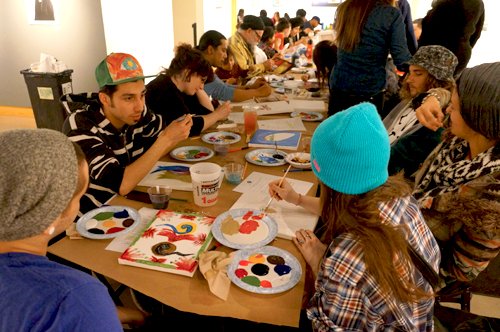
Art is powerful. For Indigenous communities, art is medicine with incredible healing properties. It is a way to create beauty in the messy process of decolonization. It is also a means to educate, inspire and enliven Indigenous activist movements.Minneapolis is no stranger to Indigenous activism, so the “Art of Resistance” exhibition opening on the American Indian Cultural Corridor’s All My Relations Gallery complemented the rich activist history in the Twin Cities. The traveling exhibit reflect over 30 years of environmental justice work of Honor the Earth, a national Native-led organization based in White Earth, Minn. Continue Reading

Bloomington’s ‘Special Presentation’ on Black History involved no Blacks

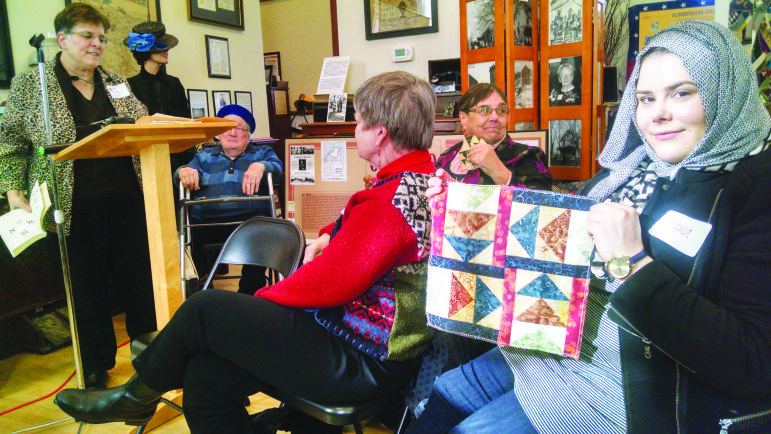
An all-White crowd heard about slavery and the Underground Railroad from an admittedly uninformed White presenterOn Sunday, February 22, in honor of Black History Month, the Bloomington Historical Society and the Human Rights Commission of Bloomington, Minnesota invited the public to a free “Special Presentation” on the use of quilts by slaves seeking their freedom via the Underground Railroad. Deb Meyer, from Henderson, MN was hired by the Bloomington Historical Society to present and unravel the mystery behind quilts and the coded patterns sewn on them to guide slaves along the Underground RailroadThe room in Bloomington’s Old Town Hall, 10200 Penn. Ave. S., was filled to capacity with just over 100 people, 90 percent of them women. Besides the MSR writer covering the event, there was only one other African American present. Continue Reading

Rights forum attacks racial income gap

Nearly 200 community members gathered at the Neighborhoods Organizing for Change office for a forum on workers’ rights in Minneapolis and throughout the state, including a need for earned sick and safe time, fair scheduling, a living wage, and ending wage theft on Saturday, February 28. “When I was working at McDonald’s, I had a baby and had to go back to work ten days later or lose my job–even though I had a C-section,” said Octancia Adams, an organizer with Neighborhoods Organizing for Change. “They wouldn’t give me paid time off. We need earned sick and safe time for all workers.”Rosa Garcia Perez, a cook at McDonald’s organizing with Centro de Trabajadores Unido en la Lucha (CTUL), spoke about the difficulties of raising a family in a low-wage job. “I have to work the overnight shift by myself–and sometimes I don’t even have time to go to the bathroom or drink water,” said Rosa. “I’m currently four months pregnant, so I need to do both of those things a lot. Continue Reading