The Inequality Debate Needs to be Careful about Scale

Two weeks ago, the Atlantic published a short (and facile) post called “the Miracle of Minneapolis” that (as is the way of media circles in insecure places) launched itself right onto the forefront of the Twin Cities social media scene. And, with good reason, the article re-kindledconversations about racial disparities that have been going on for years. Before I dive into my argument, I want to outline two crucial caveats. First, I love that we’re discussing racial disparities with increasing frequency these days. We have ignored the way that our cities have created wealth only for some (white) people, and made it almost impossible for others. The Fair Housing Act was only passed in the 60s, which isn’t very long ago, and we need to always remember how our cities treat people differently depending on race, class, and culture. Continue Reading
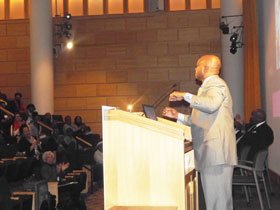
Leadership forum crafts united urban agenda

They came together for the greater good. A one-day gathering of several hundred at the University of Minnesota Humphrey School of Public Affairs was convened by the African American Leadership Forum (AALF) and it brought together some who may have had diverging thoughts but common goals. These goals are to put into plan actions that will empower area African-Americans – many of whom have been marginalized and are not seeing the same economic, educational and political gains as their white neighbors. At a time when Blacks in the Twin Cities and throughout Minnesota are woefully lagging behind in areas of jobs, housing, education, health and political leadership, and are encountering the criminal justice system at near epidemic proportions, Jeffrey Hassan, the executive director of AALF, said the issues facing Blacks are at a critical level.African American Leadership Forum executive director Jeffrey Hassan addressing the attendees of the recent Crafting a United Agenda conference.”It’s been critical for 400 years,” said Hassan, underscoring the persistent struggle from slavery to current day for Blacks in America. “But at this time – at this moment – we have everything we need to move forward. So as Kim (Nelson, a speaker at the forum) said, if we don’t get things done now, it’s on us.”In addition to Nelson, a senior vice president at General Mills, forum attendees heard from Congressman Keith Ellison; Minnesota’s only Black state legislators, State Sens. Bobby Joe Champion and Jeff Hayden and State Rep. Rena Moran; Harvest Network founder and CEO, Eric Mahmoud; the Rev. Jerry McAfee and a host of others. Continue Reading

Professors Join Fray Over Mall Protest Prosecutions- Bloomington Responds

University professors and researchers are joining the call for City of Bloomington prosecutor Sandra Johnson to drop charges against organizers of a “black lives matter” protest at the Mall of America in December. The protest was in response to highly publicized police violence against blacks in Ferguson, Missouri and New York City as well as some cases in Minnesota.117 university professors and researchers based mostly in the Twin Cities metro, but some from greater Minnesota signed an open letter calling the plan to charge the organizers “political persecution.”“We are deeply disappointed in the City of Bloomington’s decision to use its considerable power to actually add to the obstacles that are blocking the movement toward a better, more peaceful, and more just society. We urge the City of Bloomington to drop all charges against those who participated in the recent peaceful protest at the Mall of America.” (Full text of the letter is below)The letter comes a day after more than 100 faith leaders signed a similar open letter.Eleven people will appear in court on March 10th for their arraignment on charges ranging from trespassing to disorderly conduct for their attendance at the peaceful demonstration which included nearly 3,000 individuals on December 20, 2014 at the Mall of America.Bloomington City Attorney Johnson issued her own open letter on Tuesday responding to the faith leaders. In it she said “the criminal justice system must look at the conduct not the content of the messages behind the illegal conduct. To approach protest or demonstration cases any other way would result in viewpoint discrimination based upon the popularity of the message with the prosecutor and with the community. Continue Reading

CenturyLink may exclude service to minorities, critics say

Competition is good, right?Of course it is. Competition in business is so needed that there are rules in our nation that guarantee a competitive marketplace. So it may come as a shock that when CenturyLink announced it wants to compete against Comcast – Minneapolis’ only cable provider since 1983 – the communications company was met with opposition. But those opposed to CenturyLink say they agree with competition in a free marketplace, what they don’t agree with is CenturyLink being able to cherry pick where to compete – especially if CenturyLink chooses not to service areas of lower income that tend to be minority concentrated. “I would support cable competition,” said Pete Rhodes, who operates BMA Network, a channel dedicated to multicultural programming and distributed through Comcast. “It’s good for our consumers and minority communities as long as it provides minority business and programming opportunities and a fair and equitable distribution of services.”In its application to the city CenturyLink has said it will launch via new and existing lines with a 15 percent minimum coverage, but at issue is the low threshold and the company’s unwillingness to say where that area of coverage will be.”We do have maps of coverage, but we don’t want to show them in a public forum because they’re competitively sensitive and Comcast would love to have that information as well,” said CenturyLink executive, Jim Campbell during a hearing of the Minneapolis City Council Ways and Means Committee.Ward 8 Councilwoman Elizabeth Glidden said the 15 percent coverage was too low of a threshold to start and called for a minimum 30 percent city coverage and a growth plan beyond that. Continue Reading

The original visionaries of Lao Minnesota: Phouninh and Khoutong Vixayvong

For the Lao in Minnesota, heritage preservation was robust and vital in building community roots in the late 80s through early 90s. Lao PTA and Lao Assistance Center of Minnesota had programs focused on Lao language, culture and arts; and even a Lao Summer School for youth. One of the many well-known leaders during the resettlement period was Phouninh Vixayvong, a retired educator with a fierce teaching style. She’s also a long-time social services veteran at Lao Assistance Center of Minnesota, where she still assists elders navigating the public system one minute and debating with Lao men in the lobby about the latest community issue the next minute. She is one of many maes to the Lao community, teaching the first wave of Lao refugee immigrants for 15 years and founding the first ever Lao Women’s Association in the state, addressing teen pregnancy and breast cancer awareness. Continue Reading

City Of Bloomington? 100+ Faith Leaders Want A Word With You

The City of Bloomington’s insistence on prosecuting organizers of a “Black Lives Matter” protest at the Mall of America is getting more pushback from Minnesota’s religious leaders.A letter signed by more than 100 faith leaders asks City Attorney Sandra Johnson to have a community-wide dialog about race instead of prosecuting people.“The energy you have put into this aggressive prosecution needs to be redirected to a community-wide effort toward open dialogue between our justice system and those who do not receive equal and fair treatment and protection from our current system,” says the letter. “We would like to meet with you at your earliest convenience to discuss these matters.”Eleven people are charged with crimes ranging from trespassing to disorderly conduct for their attendance at the peaceful demonstration which included nearly 3,000 individuals on December 20, 2014 at the Mall of America. The protest was part of a larger nationwide demonstration reacting to police violence against African-Americans.This is the second letter faith leaders have sent to the city. The previous letter was signed by 41 clergy and also asked for the city to stop its prosecutions and invited the city to charge them too. Full text of the letterBlack Lives Matter Minneapolis Faith Leaders Letter of SupportDear Sandra Johnson,We, the undersigned, members of the clergy in the city of Bloomington, write to express our support of the Black Lives Matter movement. As a matter of background, on January 20, 2015, individuals working with the Black Lives Matter Minneapolis group were invited to present to the Bloomington Conference of Evangelical Lutheran Church in America and Minneapolis Area Synod at our monthly gathering, at which some of the undersigned were present. A representative from the synod office was also in attendance.We did not know what to expect when we invited this group to meet with us. Continue Reading

FBI director on police violence

I kept waiting for someone to call out the FBI director James Comey’s recent so-called candid speech on race. Surprisingly too few people did, but he clearly should be called out because he didn’t have an honest conversation about race. However, he reminded us that this is more likely to stay the way it is.An honest conversation would have included telling cops to stop brutalizing and murdering U.S. citizens, not justifying their savage behavior. While people like the socially unaware Don Lemon of CNN applauded FBI director James Comey’s speech saying he was courageous. The truth is that the director actually codified and gave justification to police violence aimed at Black folks, while at the same time blaming Black folks for their own victimization by law enforcement.To be fair, he acknowledged that it is the unjust system that has put Black folks in the position they are in. Continue Reading

U rightly shifts stance on alerts

The University of Minnesota announced Wednesday morning that it will modify its crime alert policy after more than a year of scrutiny for how the messages can perpetuate racism and stereotyping, particularly harming young black men.Under the change, Vice President for University Services Pam Wheelock and the police chief will evaluate on a case-by-case basis whether there’s enough information to include a suspect description when a crime alert is sent.This change is just one of many steps the University must take to make all its students feel comfortable on campus. But effective reform takes time, so we are pleased to see the University finally take this action.The Minnesota Daily’s newsroom uses a similar policy to the University’s new one when reporting on crime. As evident in the Daily’s pages and those of other major newspapers, suspect descriptions are almost always too vague to be helpful.Sufficiently broad policies allowing for case-by-case decisions can be effective, but they require great care.In a crime alert sent Monday, the University listed a suspect as having spoken “with an accent” without any indication as to what that manner of speaking may have been. This exemplifies a detail that does more harm than good in keeping the community safe — the opposite effect the alerts should have.As the University continues with its new, improved policy, we urge officials to err on the side of not using suspect descriptions unless they could clearly benefit to campus safety. [For original article click here: http://www.mndaily.com/opinion/editorials/2015/02/25/u-rightly-shifts-stance-alerts] Continue Reading

Eating the Traditional Asian-American Diet is Healthy!

[See original article here: http://biculturalhealth.apacommnet.org/?p=507]Asian Americans who grew up in the U.S. have been influenced over their lifetime of how to eat healthy. The American diet is shown in a food pyramid that doesn’t really represent or incorporate foods from other cultures. Many people choose to mix in both diet and switch other things. But did you know that many Asian cultures actually have a healthy diet too? Here’s an example of what many Asian foods consist of.So what are the main differences between the two diets?1. One difference between Western and Eastern diet is at the bottom of the pyramid. Continue Reading

Laomerican Cuisine: Laopherd’s Pie

[You can read the original post here: http://littlelaosontheprairie.org/2015/02/11/laomerican-cuisine-laopherds-pie/] Recently, Little Laos on the Prairie’s Bryan Thao Worra coaxed acclaimed Northside blogger and community builder Jeff Skrenes into being the guinea pig for a new addition to Lao American cuisine with a concept he referred to as Laopherd’s Pie. Ever a good sport, Jeff Skrenes took him up on it and shared his after-action report with us. You can read the original at North by Northside: A recent Facebook conversation with my favorite former Minnesotan,Bryan Thao Worra, centered around cultural comfort foods and culinary fusion.  As more and more Southeast Asians (and other immigrants) locate in Minnesota, they will bring their comfort foods with them–laab meat, papaya salad, sticky rice, etc.  Here in the midwest, we’ve already got plenty of our own comfort foods, such as shepherd’s pie, the infamous hot dish, and various jello and fruit conglomerations.So we began to ask ourselves, what would happen if some of these Scandinavian and Southeast Asian foods were to be combined in some unholy culinary syncretism? Continue Reading