Red Lake Tribal Council to research feasibility of marijuana

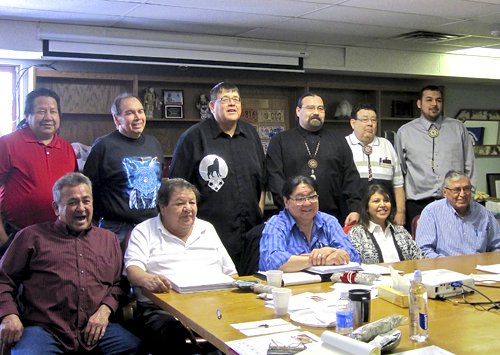
RED LAKE, Minn. – Although the subject was not on the printed agenda for the Red Lake Tribal Council at the regularly scheduled monthly meeting on Jan. 13, recent acts by the federal government concerning Indian tribes, hemp and marijuana prompted several tribes to explore the feasibility of growing medical marijuana and industrial hemp.Red Lake Chairman Darrell G. Seki, Sr., added the agenda item shortly after the call to order. He said he felt the federal ruling should at least be discussed. Seki cited several tribes that are looking deeper into the issue and mentioned fewer yet that were actually taking action.Immediately, Red Lake citizen and Gardening Tech at Red Lake Traditional Foods David Manuel asked to address those assembled and spoke of the economic advantages to getting involved with at least industrial hemp and possibly medical marijuana. Continue Reading

Hennepin, Ramsey counties excluded from plan to redirect funds for roads

The House’s rural-urban divide took a big city vs. suburban turn Wednesday with the House Transportation Policy and Finance Committee giving its OK to a bill that would reallocate millions of dollars in sales tax revenue to all but the state’s two most populous counties. HF710, sponsored by Rep. Jon Koznick (R-Lakeville), would move $32 million in sales tax collected on motor vehicle leases from the General Fund and put it toward Greater Minnesota transit and to the County State-Aid Highway Fund for use on metro area roads — except in Hennepin and Ramsey counties.Suburban residents have been “paying more than their fair share” toward metropolitan transportation projects, Koznick said, many of them in the state’s two counties that are home to Minneapolis and St. Paul.Redirecting proceeds from the motor vehicle lease sales tax, he continued, would provide more funding for suburban transportation infrastructure and rural transit needs “without higher taxes or higher fees.”Current state law dictates the first $32 million of revenues collected from the tax each year are deposited in the General Fund. The remainder is split evenly between the County State-Aid Highway Fund and the Greater Minnesota transit account.Approved by the committee and sent to the House Taxes Committee, Koznick’s bill would split those reallocated funds evenly between rural transit and county state-aid highways in the Twin Cities’ “collar counties.”There is no Senate companion.Some members took exception to the exclusion of the state’s most populous counties, with Rep. Clark Johnson (DFL-North Mankato) saying the move pitted one part of the state against another for much-needed transportation funding. Rep. Ron Erhardt (DFL-Edina), whose district lies entirely within Hennepin County, said much of the leased vehicle sales tax revenue is generated in Hennepin and Ramsey counties. To exclude them from the reallocated tax revenue, he said, “That’s baloney.”“You say, ‘We’ve been paying for it,’” Erhardt told Koznick. Continue Reading

Public health spending focuses on children, mentally ill

Minnesota’s greatest health challenges fall into two categories: children living in poverty and gaps in care for people with mental illness, according to Human Services Commissioner Lucinda Jesson.For the past two days, Jesson and division directors laid out Gov. Mark Dayton’s health care proposals to the House Health and Human Services Finance Committee, which took no action.The governor’s overall proposed $35.5 billion budget for the Department of Human Services includes $12.8 billion from the General Fund, about $176.5 million more than the projected base funding for the 2016-2017 biennium. The remaining department operating funds come from the Health Care Access Fund, federal matches, lottery revenues, special revenue fund and fees for services.Not all of the initiatives would require changes in law, but many do.Caring for the childrenA disproportionate number of babies born to mothers addicted to opioids occur in tribal communities. Department officials are calling for early, in-utero intervention, which may result in public fund savings because it’s more expensive to treat the babies in the neonatal intensive care unit after birth. The grant program would enable clinics to target pregnant at-risk women and direct them into services for substance abuse and public health services.To improve access to quality child care, regulations for assistance would be simplified and the Basic Sliding Fee program for child care would be expanded to reduce the number of families on waiting lists. The sliding fee is capped and some counties have long waiting periods for families that qualify. Continue Reading

Solidarity is not a Crime. Response to Rowley Sarfehjooy Article

 As members of an organization committed to peace and justice, the Minnesota Committee in Solidarity with the People of Syria (CISPOS), it was disheartening for us to see an article in Huffington Post that falsely alleges that we are working “in sync with neocon warhawks to produce and sustain a perpetual state of U.S. war.” Coleen Rowley and Margaret Sarfehjooy’s article “Selling ‘Peace Groups’ on US-Led Wars” does not provide insightful analysis and is constructed on unfounded claims.The article is fallout from the widespread controversy in the peace movement over how to respond to the brutal war in Syria.Many anti-war pundits and activists have bought into U.S. propaganda that the U.S. is actively supporting the Syrian rebels to overthrow the Assad regime in Syria. They point to the 1997 Project for a New American Century plan for regime change in Afghanistan, Iraq, Libya and Syria. They believed Hillary Clinton in 2012 when she said the Assad regime must go and that the international community stands with the Syrian people.  In fact…the U.S. has given very little training, small weapons, and funds to very few rebel groups.  Congress recently dropped $300 million for the Syrian rebels from the defense bill, almost completely cutting what the Syrian opposition already saw as paltry support from the U.S.  On the other hand, the CIA has long had a working relationship with Assad, sending him numerous terrorist suspects to torture as part of their rendition program. Assad has provided Israel with a secure border.Talk with Syrians and you’ll learn that U.S. aid was never enough to counter Assad’s MiGs, attack helicopters, Scud missiles, heavy tanks, chemical weapons. They repeatedly state that the U.S. bombing of ISIS has helped Assad – the bombing has sometimes targeted groups aligned with anti-Assad forces and never hit the regime. Continue Reading

How do your wages stack up? New analysis pinpoints cost of living in Minnesota

As debate swirled at the State Capitol in recent years over whether – and how much – to raise Minnesota’s minimum wage, lawmakers found themselves confronted with a question their own experts could not easily answer.How much do workers need to earn to meet their most basic costs?To zero in on an answer, the Legislature charged the Minnesota Department of Employment and Economic Developmentwith conducting a study.DEED’s Labor Market Information Office devised a plan to break down the cost of living not only statewide, but by county and region, taking into account geographic disparities in seven cost categories: transportation, housing, child care, health care, food, taxes and other necessities.Now the results are in, and DEED’s new Cost of Living tool, available on the department’s website, sheds light on the challenges and difficult decisions Minnesota’s working families face.The results, said John Clay, a research analysis specialist for DEED who devised the study’s methodology, don’t “represent a middle-class income. It also does not represent a poverty-level income. Rather, it’s a basic income that meets health and safety needs.”The annual cost of meeting those needs in the seven-county Metro Area is $25,932 for a single worker without children, according to the new tool. Given a 40-hour workweek and year-round employment, a worker would require wages of $12.47 per hour to reach that annual income level.In other words, even with the scheduled increases in the state’s minimum wage – up to $9.50 per hour next year for most workers – the Metro Area’s lowest-paid jobs are leaving workers without the resources necessary to meet their basic costs.Those costs go up, of course, with family size. A single parent of one child in the Metro Area requires full-time wages of $24.97. Continue Reading

Lawmakers listen as educators share ‘achievement gap’ success stories

As Minnesota leaders in K-12 education continue to work toward their shared goal of narrowing the achievement gap, the House Education Finance Committee is looking to the educators themselves for examples of progress.On Tuesday, principals and superintendents from public and charter schools and school districts that have reported improvements in that arena shared their success stories.The purpose of the hearing, said committee chair Rep. Jenifer Loon (R-Eden Prairie), was to allow the committee to glean from educators successful tools and strategies they have used that have proven effective in closing the gap between students of color and white students with respect to their scores on Minnesota Comprehensive Assessments (MCA) exams.One of those schools is Global Academy in Columbia Heights.The public charter school with an enrollment of 430 kindergarten through eighth graders — 75 percent of whom are students of color — has been designated by the Department of Education as a “Reward School,” a status that recognizes the top 15 percent of Title 1 schools that have demonstrated exceptional student outcomes in helping to close the achievement gap.“‘How do we do this?’ People ask us that a lot,” said Helen Fisk, director. “Sometimes we are pretty stumped ourselves. But I think the answer is really pretty simple: it never occurred to us that our students wouldn’t be anything other than very successful.”Fisk pointed to the school’s International Baccalaureate learning program, ability to control quality of teaching staff based on at-will employment model and its one-to-one student-iPad ratio as a few of the reasons for its high MCA scores across the board in math, reading and science.About 68 percent math of its black students in grades three through eight were measured to be proficient in math, Fisk said. About 63 percent measured proficient in reading and 62 percent in science.In the most recent round of MCA results released by the Department of Education last fall, the gap between white and black students continues to persist on a statewide level. In reading, 33 percent of black students in grades three through eight were achieved proficient for their grade level, compared to 67 percent of white students. Continue Reading

BEHIND THE STORY | Paying for public servants

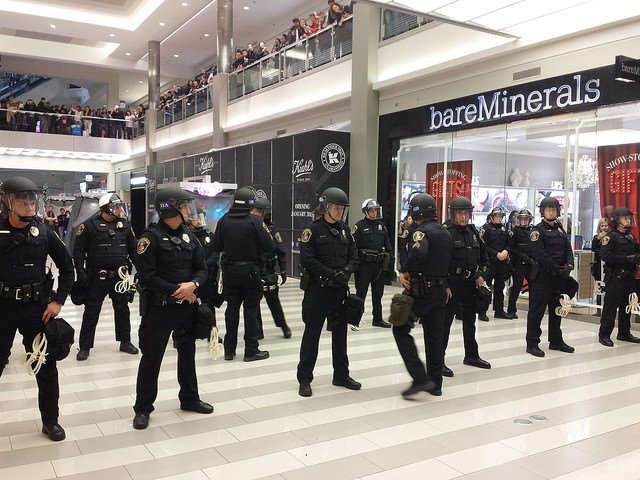
I thought law enforcement officials were supposed to be public servants. Like teachers, police and other law enforcement serve the citizens of a local area and are paid by taxpayer dollars. The latest threat to ten organizers of the December Black Lives Matter protest at the Mall of America, however, purports a different view. By charging these organizers with the cost of riot police and extra security ordered by the Mall of America, Bloomington City Attorney Sandra Johnson shifts our relationship with the police to extreme anarchist libertarianism, where citizens are individually charged for the “use” of these public servants, even when they didn’t request them.Imagine if parents were sent a bill any time their child had to stay after school for detention, or needed extra attention from their teacher. The idea is absurd, of course. Continue Reading