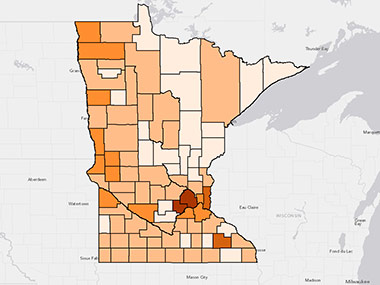
Statewide property taxes payable in 2014 are expected to decline by $181 million or 2.1 percent relative to what they would have been in the absence of changes made in the 2013 tax act passed by the Legislature last May. This reduction comes before factoring in the increase the homeowners’ and renters’ property tax refunds, according to a new simulation from the non-partisan Minnesota House Research Department.
In advertising—and occasionally in politics—claims of dubious merit are often dressed up with superlatives to dupe the audience into believing evidence supporting a claim is much stronger than it really is. Case in point is a recent e-mail from Minnesota’s conservative leadership, which cites “four indisputable truths” that purportedly prove right wing policies have turned Minnesota into a fiscal and economic nirvana. In reality, these “indisputable truths” are nothing more than a series of selectively presented factoids designed to put a positive spin on ill-conceived conservative policies.
During the 2011 special legislative session, Minnesota conservatives insisted on and—after a 20 day state government shutdown—succeeded in eliminating the homestead credit. The property tax increases resulting from the elimination of the homestead credit became a key talking point during 2013 legislative campaigns. As a result, in 2013 a progressive majority in the Legislature enacted the “homestead credit refund.”
Like Governor Dayton’s proposal and the House tax bill, the Senate’s a tax bill—Senate File (SF) 552—contains a significant income tax increase. The Senate tax bill extends further down the income ladder than the House’s and Governor’s proposals, but stops well short of affecting middle-class families.Minnesota’s current income tax has three tiers:The first tier consists of taxable income up to $35,840 and is taxed at a rate of 5.35 percent.The second tier consists of taxable income from $35,840 to $140,960 and is taxed at the rate of 7.05 percent.The third tier consists of taxable income in excess of $140,960 and is taxed at a rate of 7.85 percent.For ease of comparison, this analysis will focus on the tier breakpoints (or brackets) for married joint filers; the corresponding breakpoints for single filers and heads of households are lower than those of married joint filers.In order to target only high-income households, the Governor and House proposals each create a new fourth tier. Under the Governor’s tax proposal, the new fourth tier will include taxable income above $250,000 and will be taxed at a rate of 9.85 percent. This impacts the wealthiest two percent of Minnesota households.Under House File (HF) 677—the House omnibus tax bill—the fourth tier will begin at taxable income of $400,000 and be taxed at a rate of 8.49 percent. Approximately the wealthiest 1.1 percent of all Minnesota households will be affected by the House’s new fourth tier rate. Continue Reading
As noted in part one of this post, funding for the city Local Government Aid (LGA) program has been cut dramatically since 2002. As a result, the property tax leg of the Minnesota’s three-legged revenue stool has grown—that is to say, Minnesota’s dependence on the property tax for funding public services has increased. To reverse this trend, Governor Dayton’s tax proposal and the House and Senate omnibus tax bills each contain an $80 million (19 percent) increase in the LGA appropriation in 2014 to restore a portion of prior year cuts. Continue Reading
The anti-tax contingent of the Minnesota business lobby—calling itself “United for Jobs”—is using bogus statistics to frighten Minnesotans into believing that the tax increases being proposed by Governor Dayton and legislative leadership will crush the state’s economy. They’re full of baloney. Continue Reading
As of now, a new city Local Government Aid (LGA) formula (H.F. 1608 and S.F. 1491) is carrying bi-partisan support from metro area and greater Minnesota legislators, no small feat for a program that has stirred up quite a controversy in recent years. The list of authors includes current House Tax Chair Ann Lenczewski, House Property Tax Division Chair Jim Davnie, and Senate Tax Reform Division Chair Ann Rest on the progressive side and former House Tax Chair Greg Davids and former Senate Majority Leader Dave Senjem on the conservative side.
Dollar for dollar, no single program does more to reduce the regressivity of Minnesota’s state and local tax system than the renters’ property tax refund (PTR). A previous Minnesota 2020 analysis demonstrated the effectiveness of the renters’ PTR in reducing the regressivity of rental property taxes. The renter’s PTR successfully cuts the degree of rental property taxes in half, to the point where it is more in line with other categories of property taxes. Continue Reading
Tuesday, Minnesota 2020 presented information showing the percentage of taxpayers in each Minnesota county that would be affected by Governor Dayton’s proposal to create a new fourth income tax bracket. The percentage of full-year resident taxpayers affected by the proposed fourth tier ranges from 0.2 percent in Pine County to 3.4 percent in Carver County. Statewide, only two percent of Minnesota taxpayers with taxable income in excess of $250,000 (married-joint filers) would be affected by Dayton’s proposed fourth tier. Continue Reading