Cities need more flexiblity about bike parking
|
Bike racks might not seem like much. And, really, they’re not. Bike racks are simply a small piece of metal embedded into the ground. Continue Reading
Twin Cities Daily Planet (https://www.tcdailyplanet.net/tag/cycling/page/9/)
Bike racks might not seem like much. And, really, they’re not. Bike racks are simply a small piece of metal embedded into the ground. Continue Reading

The Franklin Avenue bridge is scheduled for a renovation by Hennepin County beginning next fall. The renovation will include a new deck, rebuilt railings, the installation of historically appropriate lighting, repaired arches and piers, and a widening of the east side of the bridge by ten feet. The County has also proposed that the renovation include a redesign of the bikeway on the bridge, allowing for a protected cycle track.Hennepin County project manager Jim Archer explained that the barrier would, “help channel bike and pedestrian traffic to designated crossing areas where they’re movements can be better anticipated by vehicular traffic.”Plans allow for 13′ wide vehicle lanes, and a 10′ wide sidewalk and 7′ wide bike lane on both sides of the roadway.The Franklin Avenue bridge (also known as the Cappelen Memorial Bridge) was built by two “prominent Norwegian engineers” according to the Minneapolis Heritage Preservation Commission. When it was built in the 1920s, the bridge was considered to have the longest concrete arch in the world. The bridge replaced a steel truss bridge built in the 1880s, and allowed for increased auto traffic and the expansion of the streetcar line to the east bank of the river.The bridge was added to the National Register in 1978, and renovation plans will need to be reviewed by the MnDOT Cultural Resources Office and the State Historic Preservation Office.Information is available on the Franklin Avenue bridge project page.If you like My Broadsheet, help us spread the word and tell your neighbors and friends. Continue Reading

East 32nd Street is a highly used bicycle route connecting the Corcoran and Longfellow neighborhoods. “I use it every day to get to the (Midtown) Greenway,” states bike commuter Megan Barr. “A lot of people use (this crossing) as an alternative to Lake Street.”A substantial and growing number of students at South High School are also among the cyclists who use this bike route everyday. Yet, the current condition of the crossing of 32nd Street and Hiawatha Avenue not only discourages bike use, but is also a dangerous intersection.Becca Krasky, a South High student leader, says “These improvements are not just something we think would be nice, but rather, things that we need because it is scary biking to school.”To further understand these safety concerns Hennepin County conducted a series of community meetings with the goal of improving the street crossing environment at several intersections from 32nd Street to 46th Street along Hiawatha Avenue. Neighborhood residents in attendance expressed the need to decrease pedestrian crossing distances, improve accessibility and mitigate safety hazards when crossing the four lane Hiawatha Ave, also known as State Highway 55.In December 2012, Corcoran Neighborhood Organization specifically requested that the County and the City to include additional measures at the intersection to improve cyclist safety as well as increase awareness that the roadway is shared by cars, bicycles and pedestrians. Continue Reading
The Midtown Greenway has recently been named the no. #1 bike path in America by Active Times. In a list of America’s 19 best urban bike paths, the Midtown Greenway came out on top with glowing reviews on not only the scenery, but also as being an efficient commuter artery and a safe alternative to city traffic. Active Times was impressed by the 24/7 usability of the trail, noting that the Greenway is plowed during winter months and lit at night. While those factors are indeed notable, the Midtown Greenway Coalition has many more programs that keep the Greenway the no. Continue Reading

In an effort to become more biker-friendly, St. Paul plans to add safer biking lanes along Marshall Avenue that will connect to other major bike routes. Scheduling of the project depends on funding, but St. Paul Department of Public Works Sustainable Transportation Engineer and Planner, Reuben Collins said that it could be completed by 2016.“While we can appreciate a bit of healthy competition with our neighbors to the west, the Twin Cities as a whole has far more to gain when we perceive ourselves to be collaborators rather than competitor,” Collins said. “Part of the reason Marshall Avenue is such a critical corridor is because it is one of only a few connections across the Mississippi River that facilitates interaction between residents and businesses across municipal boundaries.”Marshall Avenue was recognized as a bicycle alternative to University Avenue, and as an important connecting commuter route for bikers by the City’s 2010 Bike Walk Central Corridor Action Plan study. Continue Reading
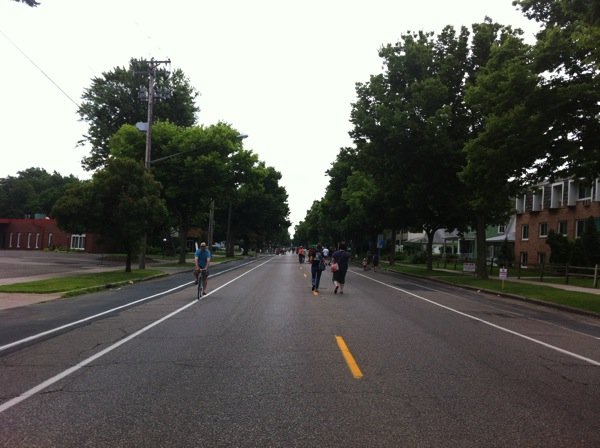
I went with my family to attend Longfellow neighborhood’s Open Streets on Minnehaha on Sunday August 11, 2013. I hadn’t been to an “Open Streets” before, though I had been to various events where streets were closed, and this was like that, but more spacious and far more bikey. Continue Reading
On Sunday, August 10, Minnehaha Avenue in South Minneapolis was closed to car traffic from 10 am to 4 pm for the first ever Open Streets event in Longfellow. Thousands of people walked and biked up and down Minnehaha to visit the many businesses and artists who were conducting activities in the street.Among the activities was a street animation station and a pop-up Cycletrack. These are featured in this video about the event Continue Reading

On Sunday (8/11), Minnehaha was closed to cars and opened to bikes, kids, games, and a whole variety of activities during Open Streets. While we don’t have the numbers yet, the roadway was packed for most of the afternoon.Trylon Cinema set up a Street Animation Station.The trainers at N2 Living show off their muscles.Play stations were located up and down the route. Here, kids could use huge cardboard boxes to build a space to play.Water – courtesy of the City of Minneapolis.Corrie Weikle from Gandhi Mahal/HECUA gave rides to kids on a rickshaw.There were lots of candidates out shaking hands with local residents. Here’s Henry. He’s heading up the Toddlers for Andrew Johnson campaign. Continue Reading

A recent policy change by the Minnesota Landscape Arboretum means that bicyclists are currently banned from the facility’s popular Three-Mile Drive. “In an effort to reduce the amount of traffic on Three-Mile Drive and for visitor safety,” reads the facility’s website, “bicycles are no longer allowed.” (Emphasis in original.)The decision was made “primarily for the safety of everybody who uses the Three-Mile Drive,” Arboretum director Edward L. Schneider told me via telephone. “I was getting a majority of complaints from pedestrians about bicycles whizzing by. We’ve got power walkers, mothers with strollers, older people with walkers, utility carts, cars, circulators—all using the very same Three-Mile Drive.”I also spoke with Steve Sanders, alternative transportation manager with Parking and Transportation Services at the University of Minnesota; the Minnesota Landscape Arboretum is part of the University of Minnesota, but though Sanders told me he recently spoke with Schneider and advised him that in his opinion, “I didn’t think there was a safety issue,” Sanders was not part of the decision-making process regarding the bike ban and had been under the impression it would be rescinded.It will indeed be rescinded, said Schneider—but not in the immediate future. Continue Reading
After two decades of planning and hoping, the Dinkytown Greenway opened on Sunday, August 4th, with a ride that took bicyclists from the St. Paul Campus of the University to the west side of the Mississippi River. The Greenway connects the #9 bridge to the University Transitway, creating an off-road connection that can take bicyclists from downtown Minneapolis to the Fairgrounds.The ride featured several stops, including one at the future site of Surly Brewing Co., which plans to build 200 bike racks in their future home, just off the University Transitway.Here’s a look at the ride.Coverage of issues and events that affect Central Corridor neighborhoods and communities is funded in part by a grant from Central Corridor Funders Collaborative. Reporting for this article also supported in part by Bush Foundation. Continue Reading