Night Owl Classic
|
I signed up for the Night Owl Classic bike ride on August 17th. There is still time to sign up. I have not decided if I will go on the 10 mile hoot loop or the 22 mile night flight. Continue Reading
Twin Cities Daily Planet (https://www.tcdailyplanet.net/tag/cycling/page/10/)
I signed up for the Night Owl Classic bike ride on August 17th. There is still time to sign up. I have not decided if I will go on the 10 mile hoot loop or the 22 mile night flight. Continue Reading
Overlooked in my article Thursday about Minneapolis’ burgeoning bikeway system was the Dinkytown Greenway, which celebrates its grand opening Sunday. Continue Reading
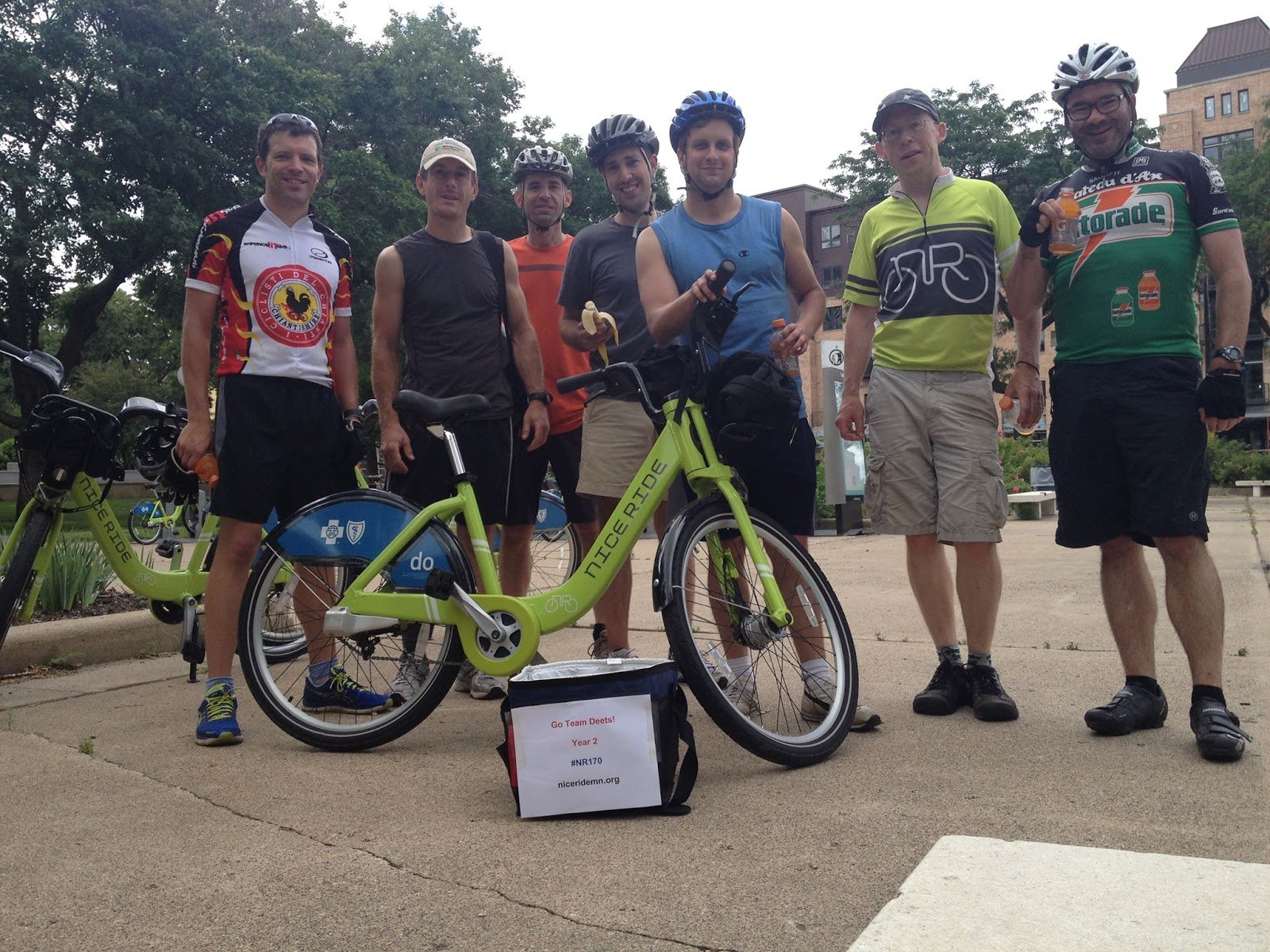
Ed Kohler of The Deets started a tradition several years ago by using Nice Ride bikes to hit every single kiosk in a single day. I wish I would have joined him for the first year, when there were only sixty-five stations that could be traversed in about three hours. In 2013, there are 170 stations spread out over 110 miles of biking–all of which, under the rules of the challenge, must be traveled using the 50-pound Nice Rides. Furthermore, a lot of the new stations are tucked away in obscure places that probably no one goes to. Like behind random buildings, or in St. Paul. Continue Reading

Looking for a great destination within a short bike ride of downtown Minneapolis? Head down Glenwood Avenue and in about 10 minutes you will find a bright red building with a mural on the side. As you walk into the cozy shop you will hear the beats coming from vintage records; then your eye drifts over to the left and you find the coffee bar, where among your options are a cold smoothie, hot tea, or the pour over, which is a cup of coffee made one cup at a time just for you. Then you see the bikes for sale, and now you know you are in one cool place.Venture North has a unique position in North Minneapolis; it is one of the few coffee shops on this side of the city, where bike repair and sale businesses are even more rare and they tie it all together with a youth empowerment service. The youth programs are the heart of Venture North: the staff take in youth and train them as bicycle mechanics and toss in some sales and customer relation skills as well.The empowerment programs and classes include the following: All About Bikes is the bike mechanic apprenticeship program for youth ages 15-23; Pedal Power is a special program for girls ages 10-12; Earn a Bike is a safety and basic repair school for ages 6-12, and upon completion of the program the youth get to keep the bike they fixed. Continue Reading

I often ride my bike to Paninos, Taste of Scandinavia, or other places along Hiway 96 in Shoreview for lunch. Good food, nice outdoor seating, and I often see a neighbor or two. Besides neighbors, the tables around me are usually filled with people from businesses along Lexington Ave such as Land O’ Lakes, Boston Scientific, Allina Healthcare and others. Continue Reading

I am writing in response to the TC Daily Planet’s recent article by Rebekah Peterson concerning the debate surrounding Minnehaha Ave cycle tracks. After carefully reviewing the scientific literature I’m afraid Hennepin County’s claim that in-the-street bicycle lanes are a safer alternative than cycle tracks has little merit. Studies comparing the relative safety of cycle tracks versus in-the-street bicycle lanes have found cycle tracks to be the safer option by statistically significant margins. In fact the most recent data suggest cycle tracks have less than 1/6th the risk when compared to in-the-street bike lanes (Teschke, et. al. 2012). Furthermore, cycle tracks are particularly effective at eliminating midblock accidents such as riding into a car door and being hit from behind, the latter having the highest fatality rate of all cycling injuries (Thomas and DeRobertis, 2013).Cycle tracks also increase rideshare while bike lanes do not. A recent study conducted by the Harvard School of Public Health found a 250% increase in ridership when compared to in-the-street bicycle lanes. This is important as increased ridership results in real safety benefits, as shown by Jacobson (2003), not to mention the associated societal health gains. Ridership rates are also an important consideration when contemplating the local economic benefits safe bicycling infrastructure provides. These benefits are one reason the City of Chicago is currently constructing more than 100 miles of urban cycle tracks. Related stories:Minnehaha Avenue: Residents speak up at Hennepin County public input meetings (Rebekah Peterson, 2013)Minnehaha Avenue reconstruction: Details from Hennepin County public input meetings(Rebekah Peterson, 2013)Minneapolis: Minnehaha Ave reconstruction delayed (Rebekah Peterson, 2013)Minnehaha Avenue reconstruction: What we know, what we don’t know (Rebekah Peterson, 2013)Where’s the space for community input on Minnehaha Avenue reconstruction? Continue Reading
Thursday night (7/11/13), Hennepin County held two meetings to discuss the Minnehaha Avenue reconstruction – an afternoon meeting was held for business owners, and an evening meeting was held for residents.Both meetings started with presentations by Nick Peterson from Hennepin County and CJ Fernandez of LBH. They were followed by an open forum – a time for attendees to voice concerns and ask questions. While some of the questions were answered at the meeting, Hennepin County plans to address the more in-depth questions online as well as at the next community meeting (not yet scheduled).This is the first of two articles on the Minnehaha Avenue Reconstruction meeting, it will cover the details presented at the meetings. The second article will cover the forum portion of the meeting.Roadway concepts illustrate the two options: bike lanes (top) and cycle track (below). Image courtesy of Hennepin County.Minnehaha Avenue Reconstruction DetailsCurrent Stats:9,000-12,000 cars travel Minnehaha Avenue per day, with 11,000-14,000 cars projected to travel the Avenue in the next 20 years.200-500 cyclists use the roadway daily (approximate number). Continue Reading

Get excited because the traveling bike festival known as Tour de Fat will be once again cycling its way to Minneapolis this month.
The Northeast Ride, a project of the Northeast Community Development Corporation, took bicyclists on a loop that touched all of the neighborhoods of Northeast Minneapolis. The second annual ride was held on June 22nd, the day after the storm that knocked down trees and left many residents without power. There were nine stops on the ride where riders could do everything from slow race Nice Ride bikes to writing haiku poetry about bicycling. Between stops, riders saw many examples of storm damage, from trees fallen in yards to trees blocking the bike path in Columbia Park. Continue Reading
In the last year, bikers on the Midtown Greenway in South Minneapolis have been attacked, robbed — and one man even had a Molotov cocktail thrown at him from an overpass.With the Dinkytown bikeway set to open near the University of Minnesota campus in early July, city officials are taking safety precautions before the public is free to ride.The path, which will run from TCF Bank Stadium to the pedestrian bridge crossing the Mississippi River near campus, will mainly rely on a high volume of riders and trail lighting to create a safe environment, said Stephanie Malmberg, the project’s construction engineer.Malmberg said she anticipates the path’s ridership will be high, which could deter crime.“It’s not the right environment to commit a crime,” she said. “There’s more people watching.”Soren Jensen, executive director of the Midtown Greenway Coalition, said a group of volunteers patrols the trail every night to monitor for safety concerns and added the path also relies on lighting and high traffic.Bikeways have set standards for lighting, but the Coalition has found some darker spots on the Midtown Greenway that still need better lighting, Jensen said.“The real question is,” he said, “is it light enough to make the bad guys feel uncomfortable?”Similar to the Midtown Greenway, the Dinkytown path runs along an old railroad corridor, which partially runs through a trench below street level.To address this potential issue, engineers added an exit at 17th Avenue Southeast, near the path’s midpoint.“Anytime you’re in a railroad trench, it’s always good to have a few different opportunities for getting out,” Malmberg said. “You can never guarantee 100 percent safety.”Don Pflaum, a city transportation planner, said designers for the Dinkytown path considered installing emergency phones and surveillance cameras on the path but couldn’t justify the high cost.He added that most trails in the Twin Cities don’t use phones or cameras, but the Midtown Greenway has them because of the corridor’s more crime-ridden history.Jensen said bikers should use their senses and call 911 if they see suspicious activity along a bikeway.“Don’t try to just power through it,” he said.Workers are currently putting the finishing touches on the Dinkytown Greenway, installing lighting, signs, striping and some landscaping.The path is expected to open in the first week of July. Continue Reading