Gordon eyes minor crimes

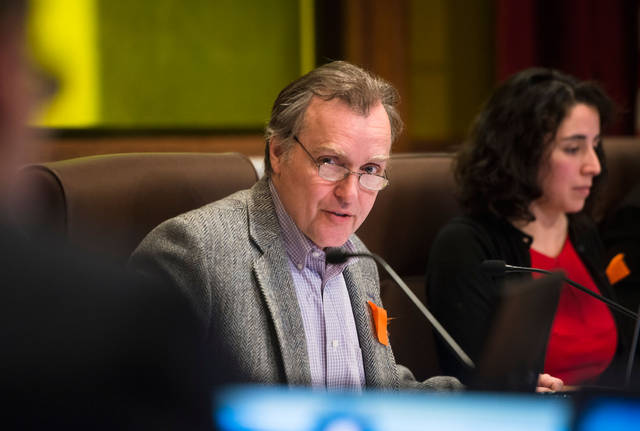
The Ward 2 Councilman wants to stop arrests for lower-level offenses like lurking or spitting.In an effort to combat racial profiling by law enforcement officials, two Minneapolis City Council members are asking the city to repeal certain low-level offenses that impact minorities at higher rates.At a City Council meeting Friday, Ward 2 Councilman Cam Gordon announced that he plans to repeal ordinances that made lurking and spitting on sidewalks illegal. Changes would go into effect after next month’s full council meeting if the measure is approved.Gordon said the need to counter racial profiling in the city is immense, and higher numbers of arrests in certain minority groups can contribute to economic inequality.“Once you get something on your arrest record, you can end up having a much harder time getting housing and finding work,” he said.Gordon and Blong Yang, who represents Ward 5, requested stop and arrest statistics from the Minneapolis Police Department in December after a report released last year showed heavy racial inequalities in the realm of low-level offenses, like lurking and spitting on sidewalks.Between 2009 to 2014, black people accounted for 59 percent of total arrests for lurking in the city, according to an analysis released by MPD earlier this month. The report also shows that blacks are arrested at significantly higher rates for marijuana possession, vagrancy and disorderly conduct.A similar report by the American Civil Liberties Union  showed that racial inequalities in arrest rates have long plagued Minneapolis.Gordon said perceived disparities in the city prompted him and Yang to request more detailed statistics from the police department, including who is arrested and stopped, as well as their age, race and location.“We’re trying to get numbers so we’re not just dealing with anecdotes and stories,” Gordon said.Understanding the racial dynamics of these crimes also includes more knowledge of who is being convicted after the arrests, Gordon said, adding that he and Yang haven’t yet received this additional data from MPD.John Elder, MPD’s public information officer, said neither of the two offenses are enforced regularly in Minneapolis.He said city officials can only determine if racial profiling is present if they know cases in which law enforcement officials were called to the scene and those that were initiated by the officers themselves.Without first differentiating between these types of stops, it could be possible to misdiagnose racial profiling, he said.Gordon said a deeper understanding of arrests and stops in Minneapolis could reveal whether racial profiling is an issue.Like MPD, University of Minnesota police officers rarely cite individuals for spitting on sidewalks, but often used lurking citations to deter other crimes, including bike thefts, said University police Deputy Chief Chuck Miner.“[Lurking] is something that we use a fair amount,” he said. “We feel it’s been a very effective ordinance for us.”Because there is no state law against lurking, he said he thinks Minneapolis should keep its lurking ordinance. [See original article here: http://www.mndaily.com/news/metro-state/2015/03/22/gordon-eyes-minor-crimes] Continue Reading

Mall of America v Black Lives Matter: The Difference Between Civil Rights and Free Speech Laws

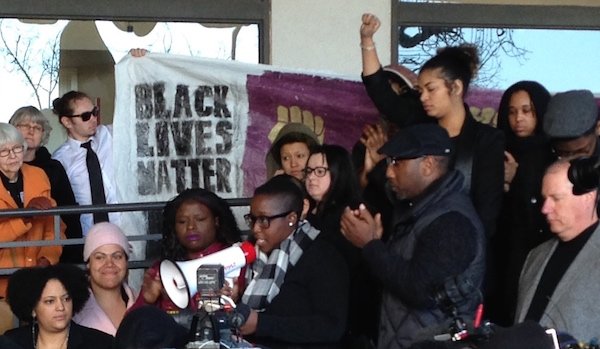
The Mall of America (MOA) is private property.  So are the other shopping malls in Minnesota.  One may not agree with that legal fact but that is the law in this state.  This means that owners of shopping malls have a right to deny the public access to their property for the purposes of exercising free speech rights but that does not mean they can deny them access on the basis of race.  This distinction seems to be lost in the dispute regarding the trespass prosecution in the “Black Lives Matter” case. Continue Reading

Black Lives Matter Calls for a Boycott of The Mall of America following first hearing

On the day of the first court hearing for the 11 defendants who are accused of various charges around the planning of the December Black Lives Matter protest at the Mall of America, Minnesota’s Black Lives Matter group is calling for a boycott of the Mall, through July 1st. The news comes a day after the group sent out a press release revealing that Bloomington City Attorney Sandra Johnson had exchanged emails with the Mall of America, offering advice.  The 11 defendants are accused of organizing a demonstration at the Mall of America over police violence against the Black community. City Attorney Sandra Johnson is seeking $40,000 in restitution for police overtime and lost revenue.  On March 9th, Black Lives Matter announced that they had obtained emails between the Mall of America and Bloomington City Attorney Sandra Johnson, which “show disturbing levels of coordination between the City of Bloomington attorney’s office and officials with the Mall of America,” according to a press release. The emails were obtained through a public records request by Tony Webster, according to a statement by Johnson, who did not respond to a request for an interview for this article.  The emails reveal that the Mall officials were pushing the city attorney to pursue more serious charges, and Johnson offering advice to the officials. In one email, Kathleen Allen, Corporate Counsel for the Mall of America said, “i’m concerned that if these other charges don’t carry greater penalties than a trespass charge, we’ll be in the same position as last year.”  In another email, Johnson encouraged the Mall to continue surveilling the organizers through social media. Continue Reading

The Inequality Debate Needs to be Careful about Scale

Two weeks ago, the Atlantic published a short (and facile) post called “the Miracle of Minneapolis” that (as is the way of media circles in insecure places) launched itself right onto the forefront of the Twin Cities social media scene. And, with good reason, the article re-kindledconversations about racial disparities that have been going on for years. Before I dive into my argument, I want to outline two crucial caveats. First, I love that we’re discussing racial disparities with increasing frequency these days. We have ignored the way that our cities have created wealth only for some (white) people, and made it almost impossible for others. The Fair Housing Act was only passed in the 60s, which isn’t very long ago, and we need to always remember how our cities treat people differently depending on race, class, and culture. Continue Reading

Professors Join Fray Over Mall Protest Prosecutions- Bloomington Responds

University professors and researchers are joining the call for City of Bloomington prosecutor Sandra Johnson to drop charges against organizers of a “black lives matter” protest at the Mall of America in December. The protest was in response to highly publicized police violence against blacks in Ferguson, Missouri and New York City as well as some cases in Minnesota.117 university professors and researchers based mostly in the Twin Cities metro, but some from greater Minnesota signed an open letter calling the plan to charge the organizers “political persecution.”“We are deeply disappointed in the City of Bloomington’s decision to use its considerable power to actually add to the obstacles that are blocking the movement toward a better, more peaceful, and more just society. We urge the City of Bloomington to drop all charges against those who participated in the recent peaceful protest at the Mall of America.” (Full text of the letter is below)The letter comes a day after more than 100 faith leaders signed a similar open letter.Eleven people will appear in court on March 10th for their arraignment on charges ranging from trespassing to disorderly conduct for their attendance at the peaceful demonstration which included nearly 3,000 individuals on December 20, 2014 at the Mall of America.Bloomington City Attorney Johnson issued her own open letter on Tuesday responding to the faith leaders. In it she said “the criminal justice system must look at the conduct not the content of the messages behind the illegal conduct. To approach protest or demonstration cases any other way would result in viewpoint discrimination based upon the popularity of the message with the prosecutor and with the community. Continue Reading

FBI director on police violence

I kept waiting for someone to call out the FBI director James Comey’s recent so-called candid speech on race. Surprisingly too few people did, but he clearly should be called out because he didn’t have an honest conversation about race. However, he reminded us that this is more likely to stay the way it is.An honest conversation would have included telling cops to stop brutalizing and murdering U.S. citizens, not justifying their savage behavior. While people like the socially unaware Don Lemon of CNN applauded FBI director James Comey’s speech saying he was courageous. The truth is that the director actually codified and gave justification to police violence aimed at Black folks, while at the same time blaming Black folks for their own victimization by law enforcement.To be fair, he acknowledged that it is the unjust system that has put Black folks in the position they are in. Continue Reading

U rightly shifts stance on alerts

The University of Minnesota announced Wednesday morning that it will modify its crime alert policy after more than a year of scrutiny for how the messages can perpetuate racism and stereotyping, particularly harming young black men.Under the change, Vice President for University Services Pam Wheelock and the police chief will evaluate on a case-by-case basis whether there’s enough information to include a suspect description when a crime alert is sent.This change is just one of many steps the University must take to make all its students feel comfortable on campus. But effective reform takes time, so we are pleased to see the University finally take this action.The Minnesota Daily’s newsroom uses a similar policy to the University’s new one when reporting on crime. As evident in the Daily’s pages and those of other major newspapers, suspect descriptions are almost always too vague to be helpful.Sufficiently broad policies allowing for case-by-case decisions can be effective, but they require great care.In a crime alert sent Monday, the University listed a suspect as having spoken “with an accent” without any indication as to what that manner of speaking may have been. This exemplifies a detail that does more harm than good in keeping the community safe — the opposite effect the alerts should have.As the University continues with its new, improved policy, we urge officials to err on the side of not using suspect descriptions unless they could clearly benefit to campus safety. [For original article click here: http://www.mndaily.com/opinion/editorials/2015/02/25/u-rightly-shifts-stance-alerts] Continue Reading

Who protects the protectors?

A man and woman are in the car ahead, and the car has a veteran’s license plate. Which one is the veteran?Most people would identify the man. But maybe this time it’s the woman. As the number of women in the military grows, so does the number of women vets.Life in the military can be hard for women. Like that license plate response, the military system was created with men in mind. Continue Reading