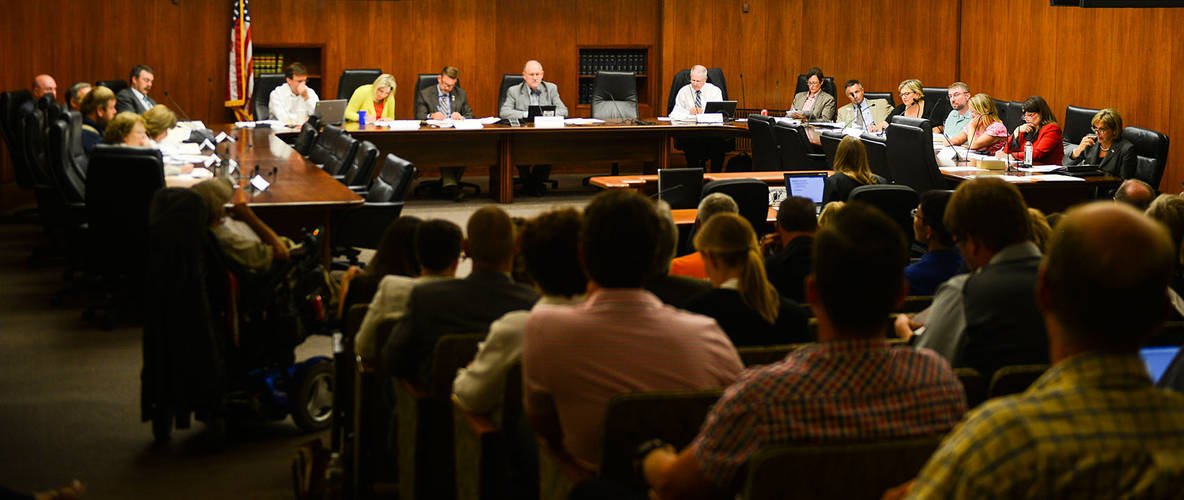
Task force weighs medical marijuana law
|
The task force charged with ensuring a smooth rollout of Minnesota’s medical marijuana law began its duties last week.
Twin Cities Daily Planet (https://www.tcdailyplanet.net/category/government/page/16/)
The task force charged with ensuring a smooth rollout of Minnesota’s medical marijuana law began its duties last week.

Urban agriculture may be a growing trend, but some Minneapolis farmers believe the movement may become stagnant if city officials don’t make active pushes to support it. Stone’s Throw Urban Farm co-owner Eric Larsen said urban agriculture could have a real, sustainable future if the City of Minneapolis chose to act on current momentum. But farm projects, like his in Minneapolis, won’t grow if the resources are not there to help the farms sustain themselves. “[Urban farming] may still carry on as it is right now, people practicing it on their own,” Larsen said. “But I don’t think it will take off unless there is some sort of motivated and unified investment from a real strategic level.”
Urban agriculture is the process of growing or raising food in urban areas, rather than in traditional rural settings. Continue Reading

For the first time in many years, we have an opportunity to repeal some particularly destructive state laws limiting investment in community networks. To be clear, this is our best shot. I’ve already covered the background and offered a blanket encouragement for you to post comments. Continue Reading

Each week about fifty oil trains, each carrying more than 1 million gallons of North Dakota crude oil, pass through Minnesota. Almost all of them go through the Twin Cities.
This may seem a bit long and tedious, but…..

Phones rang all afternoon at Sen. Al Franken’s campaign headquarters in St. Paul on July 30 as anti-war protestors listed the names of victims killed during recent violence between Israeli military and the militant group Hamas.
Public Record Media has several Freedom of Information (FOI) projects underway at present. The following updates relate to our most recent FOI work. Continue Reading

As part of this great nation’s foreign policy, when injustice takes place in any part of the world, America usually takes a stand. We saw this in the case of Russian atrocities in Ukraine, in America’s unity with the European Union (EU) and the United Nations (UN). However when it comes to Palestine, America turns a blind eye with the EU and the UN. Our government must condemn Israel’s human rights violations. The concept of justice necessitates equal treatment in condemning injustices carried by whoever and wherever, even if the transgressor happens to be an ally. Continue Reading

When Dinkytown trees get adorned with brand-new strings of twinkling lights, it’s because appointed representatives for the area made a request to improve the neighborhood’s aesthetic appeal and visibility.When garbage cans are overflowing in Stadium Village or the area’s sidewalks need shoveling, the area’s board makes those requests for extra services, too.Across Minneapolis, 13 commercial nodes actively serve as special service districts, including Uptown and Nicollet Avenue, though only two exist near the University of Minnesota. And as the campus area housing boom plays out and neighborhoods’ needs change, developers are becoming more active in local issues.The City Council approved seven new board members to Dinkytown and Stadium Village’s special service boards at the end of last month, four of whom have housing or development interests.Since 1993 and 1997, respectively, Stadium Village’s and Dinkytown’s special service districts have allowed an appointed group of property owners to petition the city for additional services, like snow removal, improvements to sidewalks or additional banners.“We let the business communities come to us,” said Mike Kennedy, of the city’s public works department. “The city doesn’t do this.”In the past, an overwhelming amount of small business owners served on the advisory boards’ nine seats, and some of those members say neighborhoods won’t feel dramatic effects from the boards’ change of representation.While most commercial areas have a business association, like Stadium Village and Dinkytown do, local squabbles and struggles to reach consensus can slow down attempts at progress, Kennedy said. But special service districts function more smoothly, he said, since they’re guided by city oversight and focused by appointed seat-holders.“[Neighborhoods] probably couldn’t get a lot of the services done themselves using a local business board because of consistency,” Kennedy said.Now, the growing presence of larger businesses and developers on Dinkytown’s board could benefit the area, said Laurel Bauer, former owner of the House of Hanson grocery store and service district board member from 2010 until this year.“It made it more cost-effective for the smaller businesses to include the larger businesses,” she said, which can better help alleviate the financial burden of special services on small, locally owned establishments.Bauer left her seat open when her business closed last summer to make way for The Venue, a student housing complex set to open this fall. She said it is very likely that a developer will take her place in representing the area.As traffic in Stadium Village spikes from the summer opening of the Green Line light rail and the upcoming fall debuts of housing projects, the demand for special services will continue, said Duane Rohrbaugh, manager of the Commons Hotel and one of Stadium Villages’ most recently appointed board members.“There’s going to be more students, more pedestrian traffic and the trash cans will fill faster,” Rohrbaugh said, “so they’ll need more servicing.”Members of the advisory boards meet informally a handful of times each year, members say, to prioritize which services the area needs. Continue Reading

Minnesota State Colleges and Universities’ recently announced a $2 million contract with consulting group McKinsey & Company to assist with a system-wide initiative, Charting the Future. The contract made headlines when Chancellor Steve Rostenstone did not mention McKinsey or the contract after a student asked about the cost of the initiative. Additionally, Rosenstone did not update the Board of Trustees on the contract agreement. Continue Reading