North Minneapolis parents want clarity, commitment from Minneapolis Public Schools

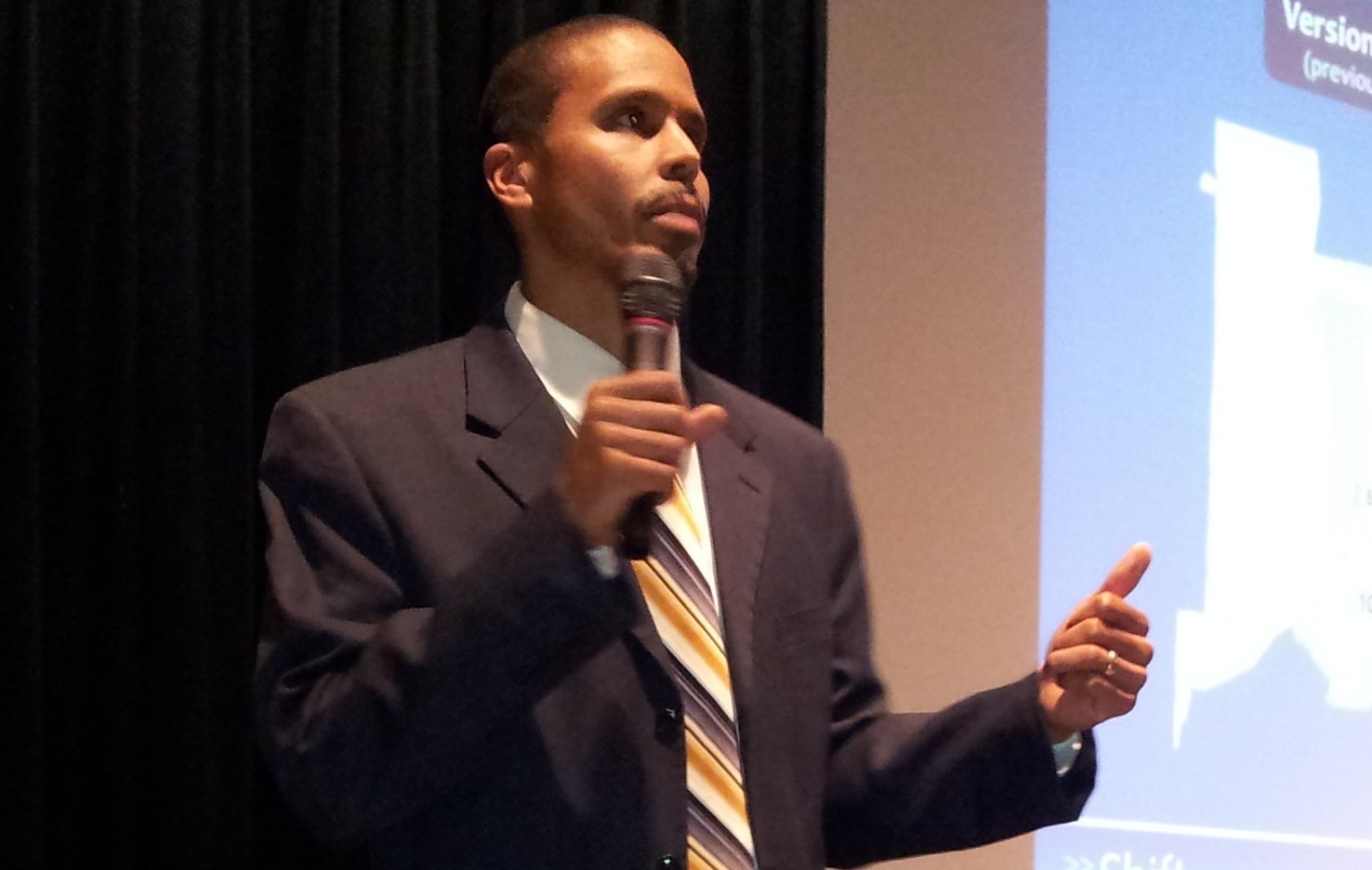
“How are we going to invest in Zone 1 so the community buys in?”This question hovered between Minneapolis Public Schools Associate Superintendent Michael Thomas and Zone 1 community and parent stakeholders. This zone, also known as Area A, includes school communities in north and northeast Minneapolis.The meeting, held at the Minneapolis Park and Recreation offices on November 18, was to inform interested Zone 1 residents and families about the latest version of the MPS’s “Five-Year Enrollment Plan.” As with the other Area A meetings, Thomas began the night with a PowerPoint presentation, followed by a question and answer session.Area A parents at the meeting emphasized pressing the district to commit—with clarity and community input—to strong north and northeast Minneapolis schools. One parent mentioned Olson Middle School in the Camden neighborhood, and noted that currently there is “no program being offered” that will entice parents to send their children to the school.Thomas agreed with this assessment, saying many Camden parents now choose to send their children to Northeast Middle School, which has an established IB program, instead of Olson. Saying the district needs the “community’s input about what we can do differently at Olson,” Thomas said he would like the school to be a strong option for north Minneapolis families.North High School also received a lot of discussion. North High once had a successful, sought-after math, science, and technology program called Summa Tech, and many expressed a desire to have a similar program restored to the school. Continue Reading

Ladan Yusuf and CrossingBarriers: ‘It is okay to talk about racism’

When Ladan Yusuf came to the United States from Somalia at the age of 13, she could not read or write English proficiently. By the time she was in the eleventh grade, at a public high school in northern Virginia, she was in an AP English class with native English speakers. Yusuf credits the strong English Language Learner (ELL) programs of the public schools she went to for her quick rise.She later studied international development and development economics at Saint Mary’s University in Halifax, Nova Scotia and got an Master of Public Administration degree from New York University.Now living in Minneapolis and running CrossingBarriers, a non-profit focused on training students and parents in education advocacy. Through CrossingBarriers, Yusuf focuses on helping youth of color, immigrant students in and out of ELL, and parents access the same kind of learning opportunities she had.I recently asked Yusuf to tell me more about her work with CrossingBarriers, which is located at 450 North Syndicate in St. Paul.You started CrossingBarriers in 2004 and 2005. Continue Reading

Playtime or focused instruction for three-year-olds? Some Minneapolis parents disagree with new ECFE structure

Has the Minneapolis Early Childhood Family Education (ECFE) program become too scripted and academic in focus?Some long-time Minneapolis ECFE families think so. Ted Moore, for example, takes his two children to an ECFE class at the Sullivan School location in south Minneapolis, and over the last couple of years, he has noticed some distinct changes to the more relaxed, play-based programming he has come to expect.Moore is one of a group of approximately ten ECFE parents who have contacted the Minneapolis Public Schools (MPS) this year about their dissatisfaction with changes they have seen in their ECFE classes. From Moore’s perspective, everything from the art projects and books available for kids to the overall curriculum and focus of the program has changed dramatically, and not in a positive way.Moore described the book choices made available to his young children as little more than “careerist manifestos,” about future “community hero” type of job opportunities for children, where once the books offered to the kids seemed more imaginative, and linked to seasonal themes or creative play ideas.Additionally, Moore sees the art projects offered to the kids now as more product-oriented, where the child is presented with a structured art project, such as a picture of a fire truck to decorate. It used to be, Moore said, that ECFE art classes were more about giving children “experience with crayons, painting, and things that activate the imagination.” Also new to Moore is the fact that “a lot of the art projects involve writing,” even for three-year-olds.ECFE Parent Angie Sonrode has been participating in ECFE classes for ten years now, and echoed many of Moore’s concerns. While she said she is a “huge proponent of the Minneapolis Public Schools,” and wants to support its programming, she feels upset by many of the changes she has seen in her ECFE class at Kenny School in south Minneapolis.One major change for Sonrode is the way ECFE classes now approach the early childhood staple of “circle time,” where parents, children, and the ECFE teacher sit together before the parents and children go into separate rooms. Previously, ECFE families would come to class as close to the starting time as they could, and circle time would begin a half hour or so after the scheduled class start time. Continue Reading

Parents prevail: Minneapolis school district drops plans to move Marcy

The Marcy Open School program will not be moving to a new building for the 2014-2015 school year, according to a letter posted on the Marcy website on Friday, November 8, by Minneapolis Public Schools Associate Superintendent Michael Thomas.While the letter acknowledges an expected increase of 700 students in areas of northeast Minneapolis, it states definitively that Thomas is “no longer recommending that Marcy Open be moved to any other location at this time.”Thomas’s letter comes on the heels of a contentious meeting at Marcy on November 6, where he addressed a packed room of parents and community members. At the meeting, Thomas stated that the idea to move Marcy, which many in the room seemed vehemently opposed to, came from representatives of the newly formed Downtown School Initiative group, which is seeking a path to a neighborhood school for downtown families.However, Eric Lasko, who heads up this group, said on November 8 that his group never expressed direct interest in the Marcy building, and never asked that the Marcy program be moved to make way for a new community school. Instead, Lasko said that the Downtown School Initiative group met with two district officials, including LeAnn Dow, and school board member Josh Reimnitz on October 28.  Lasko says that at this meeting, it was the district representatives who proposed the Marcy building as a potential home for a new community school, as one of several options to be considered.LeAnn Dow confirmed this version of events. In an email, she said that, in a later meeting with the district’s enrollment planning team, led by Minneapolis Public Schools CEO Michael Goar, the group “engaged in dialogue around moving the Marcy Open program to the Sheridan building.” Based on Thomas’s statements at the November 6 meeting, this idea was discussed among district officials for two weeks before it was brought to the Marcy community for consideration.Lasko, of the Downtown School Initiative group, maintains that his group’s focus is on making the emerging neighborhoods of downtown, such as the North Loop and Elliott Park, seen as viable communities who would like to send their children to a convenient, accessible neighborhood school. Lasko also mentioned that his group will soon meet with representatives of the Marcy Open School community in order to collaborate on possible solutions.The needs of the downtown parents may be part of what Thomas has called the “good challenge” of Minneapolis Public School’s growing enrollment numbers. Continue Reading

Angry parents challenge Minneapolis Public School plan to move Marcy Open

With less than one day’s notice — and that notice not sent to parents but posted on the Marcy Open School website — nearly 200 Marcy Open School parents packed the school’s theater on Wednesday, November 6, angrily confronting Minneapolis School District Associate Superintendent Michael Thomas, and opposing the last-minute plan to move Marcy. UPDATE 11/9/2012: The Marcy Open School program will not be moving to a new building for the 2014-2015 school year, according to a letter posted on the Marcy website on Friday, November 8, by Minneapolis Public Schools Associate Superintendent Michael Thomas. Full story here.A letter posted by the district on Marcy’s website on Tuesday, November 5, informed Marcy parents that the district had revised its Five-Year Enrollment Plan, and would now be recommending that the Marcy program move, intact, to the Sheridan school building, approximately one mile away, on Broadway Avenue.Thomas began the meeting by briefly explaining how the district came up with the idea to move Marcy. He also apologized for the lack of notice given to the community about the night’s meeting.Admitting that the meeting was the “first time we’re having real dialogue with the Marcy community” about the proposed building change, Thomas said he had received numerous phone calls and emails from Marcy families since announcing the new recommendation. These families turned out in force, and the anger, frustration, and confusion they expressed was unmistakable.Thomas tried to walk people through the district’s thought process surrounding this decision, saying that the option of moving Marcy came from conversations with downtown Minneapolis residents who have asked the district to carve out a clear school pathway for the many young families now living in downtown neighborhoods. Thomas also referenced the over-arching theme of the Five-Year plan, which concerns what he called the “good challenge” of growing enrollment within the district, and the need to reduce class sizes at overcrowded schools like Marcy.When the floor was opened up for questions, many in the crowd immediately let Thomas know that, from their point of view, moving the Marcy program was not an acceptable solution for the district’s problems. One parent spoke up and said she felt “brand new to this conversation,” and was “really concerned about Marcy’s inclusion” in the district’s decision-making process. Continue Reading

St. Paul teachers’ union head advocates ‘solution-driven’ approach to close gaps

St. Paul Federation of Teachers (SPFT) president Mary Cathryn Ricker spelled out her union’s new proposal, called the “Schools St. Paul Children Deserve” at an Achievement Gap Committee (AGC) forum on October 23. Ricker handed out the proposal at the forum, and explained that it is based on seven core principles, which were developed over the course of a few months by the union and citizen groups in St. Paul. The SPFT has been using the “Schools St. Continue Reading

Dr. John Jackson: Changing education emphasis from standards to supports

Should we, as a society, shift our focus from “standards-based reforms” in our schools to a “supports-based” approach?Dr. John Jackson, president of the Schott Foundation for Public Education, thinks so. On October 22, at the invitation of Parents United for All Public Schools, he gave a talk in St. Paul that outlined his argument that our schools need supports-based solutions for students just as much as they need standards.A crowd of around one hundred people, including state legislators and the heads of both the Minneapolis and St. Paul teachers’ unions, turned out to hear Dr. Jackson speak, and introduce the Schott Foundation’s latest initiative, called the “Education Declaration.” This declaration has a distinctly pro-public school bent, stating, for example, that, “We believe good schools are essential to democracy and prosperity—and that it is our collective responsibility to educate all children, not just a fortunate few.”On the topic of our “collective responsibility” to educate all children, Dr. Jackson spoke about how, according to another Schott Foundation report, in 36 out of 50 states, African American males have the lowest high school graduation rates; in the other 12 states, they have the second lowest rates, just above those of Latino males.While these numbers are disturbing, Dr. Jackson made the point that race is not to place blame for these low success rates. Instead, he spoke of states such as North Dakota and Vermont, which have very low populations of black students; in these states, where students can not be as easily segregated by race because of their low numbers, black students have graduation rates equal to that of white students.Therefore, Dr. Jackson asked the audience to think about education in terms of the opportunities and support we currently provide to students, and what we must begin to provide for them, if we want all students to succeed. Continue Reading

‘Creepy’ and ‘invasive’ school district survey revised for 2013-2014

“We all feel like a family.”“My teacher is distracted by other children.”“What adults do you live with?” (Followed by a list of options)These are examples of the questions and statements given to all Minneapolis Public Schools students, in grades K-12, last year, as part of the district’s use of the Tripod Project. The Tripod Project, which is based on Harvard Professor Ron Ferguson’s work, is a survey given to students in order to gather information about students, their teachers, and what goes on in classrooms across the district.Ferguson originally created the Tripod survey as a way to assess whether what he called the “7Cs Framework of Effective Teaching” was taking place in schools. These “7Cs” are based on what Ferguson sees as important teaching practices, such as showing “care” for students, practicing good “control” in the classroom, and delivering lessons that “captivate” students. The Tripod survey grew out of this framework, and asks students to agree with statements and answer questions, such as the ones listed above.For Minneapolis Public Schools teacher Flory Sommers, asking students how they feel about school is a good idea, but she has been critical of the approach favored by the district, through the Tripod Project. For Sommers, telling kids we “care about what they think,” and then giving them a survey that has no open-ended questions, and, in her opinion, many values-laden, leading questions and statements, is problematic.Sommers, who has been a teacher for 32 years, and has worked both at Emerson Spanish Immersion School and Barton Open School as a Spanish and language arts teacher, vividly recalled a kindergarten teacher describing what it was like to give the survey to her young students: One boy, when asked who he lived with, burst into tears, and told the teacher that his father had just moved out. Continue Reading