Can people eat healthy if they have just $31.50 to buy food for a week?This was a question that Laurie Radovsky, a participant in the Twin Cities Food Stamp Challenge, asked herself. As a family doctor, she tells her clients that it is possible to eat healthy without spending hundreds of dollars for food. Now she used the Food Stamp Challenge as an opportunity to test her own conviction. That meant committing to shop and eat for a week on a budget of $31.50 per person — the amount that, on average, food stamp recipients receive.(See article describing the 2012 Food Stamp Challenge here.)Before she went shopping, Radovsky and her husband sat down and discussed what she would buy. They tried to rank the groceries in an order of what is essential for daily life and what is luxury. This was not easy, as her husband ranked coffee as essential but Radovsky said she would do without it.They both agreed that milk, bread, hard cheese, eggs, cottage cheese and potatoes are essential daily needs. They also agree that, to have a healthy diet, people have to eat at least two to three servings of fruits and vegetables a day.As Radovsky entered Cub Foods, she immediately heeded for the fruit section and bought apples. Continue Reading
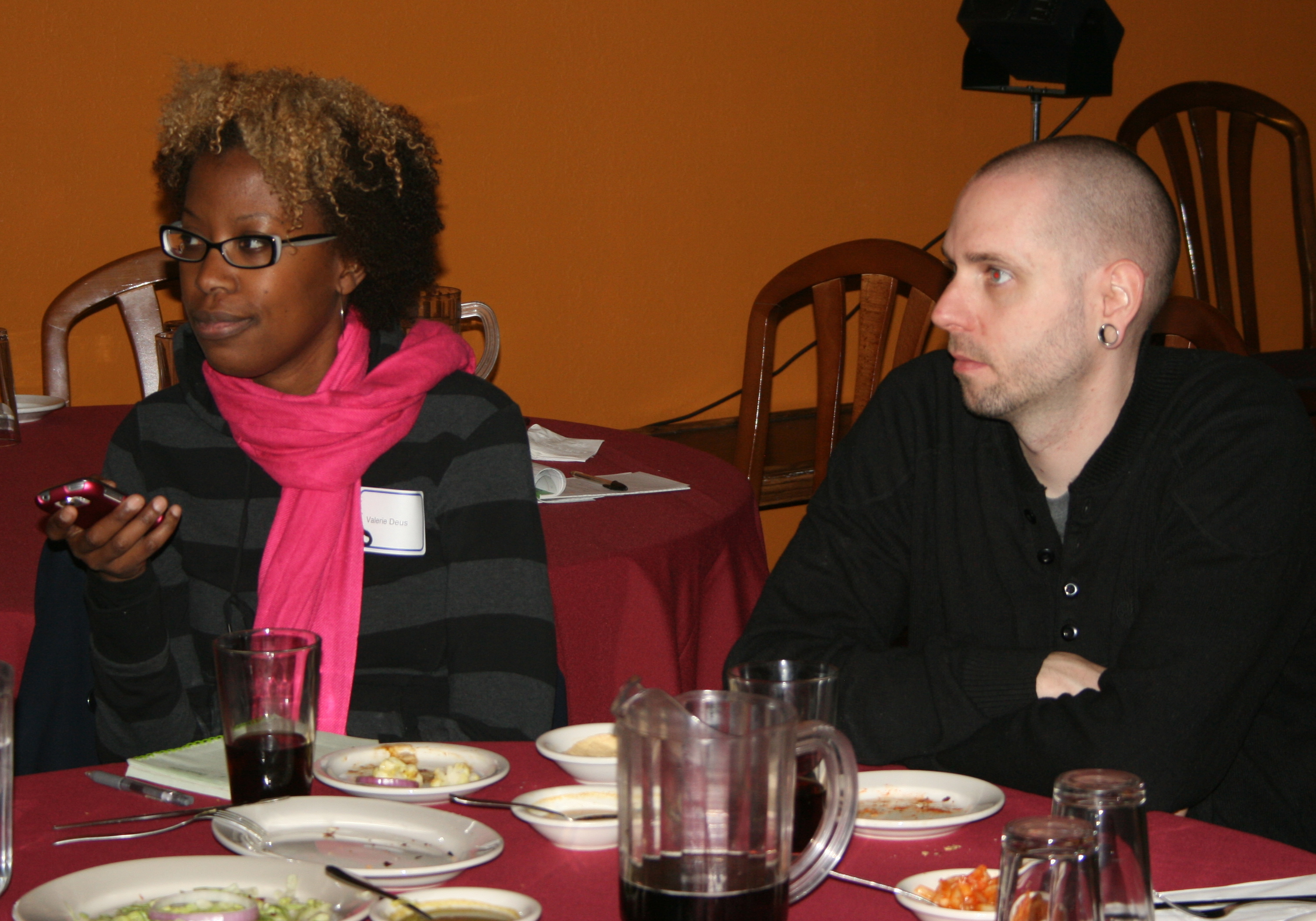
Can we imagine what does it mean to live on a food allowance of $31.50 per week? Participants in the Twin Cities Food Stamp Challenge week, November 11-18, now have a lot better idea of what it takes. Members of 15 groups took the Food Stamp Challenge from November 11-18. They tried to buy groceries from the $31.50 allowance that is the national average per person for food stamp recipients, and to eat for one week just from the purchased goods. This year was the second time that Rabbi Amy Eilberg had participated in the challenge and she had already made a list of essential things she wanted to buy. As she talked about her list at the opening gathering on November 11, one of the listeners raised his hand.The man asked: “Is anyone here poor?” Nobody raised his hand.55-year-old, Dennis Boe then said, “Because I am.” He got excited and claimed that this challenge would just be a game. Continue Reading
As a local foods organizer in the Big Stone Lake region of western Minnesota, Rebecca Terk has come to appreciate the power of new media tools.In Terk’s work for the Land Stewardship Project (LSP), her Big Stone Bounty blog entries, tweets, and Facebook posts serve multiple purposes. They amplify the voices of farmers and other rural area residents, circulate important information about proposed development, and connect and organize citizens to help them determine what’s best for their communities.Terk told a group gathered at Gandhi Mahal restaurant for a Get Connected! meeting on October 10 that new media tools allow her to hold a mirror up to a wonderfully rich culture.Chipping away at dominant narrativesTerk’s work contributes to one of LSP’s core goals: challenging the dominant narratives about family-owned farms and rural towns in an era dominated by corporate agribusinesses.Dominant narratives being promoted by powerful interests are that factory farms are “state of the art,” that they represent “the future of farming,” that “the family farm is dead” and that rural communities are “old” and fading away.Megan Smith and Rebecca TerkChipping away at those narratives requires sharing more and alternative stories of rural communities, said Megan Smith, LSP membership assistant.Telling different stories, showing people that they have choices as consumers, and revealing the implications of policies being promoted by corporations and their allies, are among the things that can be achieved, in part, through smart use of media tools. Bringing the voices of rural people into areas where they are not typically heard is another part of the work. On its website, LSP profiles new farmers who have been through Farm Beginnings, “a farmer-led, community based training and support program aimed at getting more farmers on the land farming sustainably.” There been more than 500 graduates of the program, said Smith.Local control requires democratic participationCreating food systems based on community needs, not profit, is a primary aim of LSP, a private nonprofit organization, said Mike McMahon, its director of individual giving.Mike McMahonIn a blog post, McMahon wrote:We know what happens under unchecked corporate power—the people suffer. That’s why family farmers across the Midwest organized in the 1890s, and the 1910s, and 1930s, and the 1980s—building farmer co-ops, passing public policy that reigned in corporate power and assisted family farms, and establishing farm organizations to fight for the well-being of family farmers, rural communities, and the land.LSP sees the U.S. being in the thick of another such period, with big corporations taking control over our seeds, livestock, milk, land, and public assets. Continue Reading
As an Asian, I am always enthusiastic about Asian food. Living in Minneapolis for two years, I saw many Chinese, Korean, Japanese, Indian, Vietnamese, and Thai restaurants around the metro area, but I had not seen or even heard of any Hmong restaurant. I know there is a large Hmong population in Twin Cities. So, I wondered, what do Hmong people eat and where do they eat?
The College of Food, Agricultural and Natural Resource Sciences (CFANS) is recruiting alumni and industry professionals to serve as mentors to its students during the upcoming school year.
Not to malign a dish that Thomas Jefferson reportedly served at a state dinner in 1802, nor to deny that many a child since has taken comfort from a steamy, creamy plate of macaroni and cheese cook
Minnesota is topping charts of places to eat and bike, but many may not know that we also live in the land of 1,000 co-ops. To celebrate Minnesota’s top ranking of business cooperatives, the Institute for Agricultural and Trade Policy (IATP) decided to host their second Bike and Bite community bike event, sending 210 bike enthusiasts on a co-op and local food treasure hunt through Minneapolis on August 18.Erik Ostrom, a Bike and Bite participant, enjoyed the day because of the people and the chance to be active. “I wanted to go last year, but it was sold out and signed up this year because I like biking and love food,” he said.According to Andrew Ranallo, IATP’s Communications Associate, the original Bike and Bite event celebrated the Institute’s 25th year anniversary. They decided to bring the event back this year to celebrate the 2012 International Year of the Cooperatives and connect with their local community.“We [IATP] do a lot of international work and but are proud to be based in Minneapolis and the work we do with local foods.” Ranallo continued, “ We thought a Bike and Bite this year would be a good chance to highlight the fact that Minnesota has more co-ops than any other state.”Each of the nine stops of the ride spread out through Minneapolis were co-ops or maintain strong relationships with co-ops and exemplify the IATP’swork of supporting a fair, healthy and sustainable food system. Chris Dignan and Rachel Gaulke plan their route to try to hit all the nine stops within the alloted time.The Prairie Fire Lady Choir performs as bikers plan for the day and drink Peace coffee.Everyone loves maps.After making sure their bikes were checked, their helmets were secured and their route was solidified the bikers embarked on their two and a half hour ride through Minneapolis.One of the closest stops on the route was the Wedge Co-op where bikers sampled different types of watermelon.At Growing Lots Urban Farm riders got to walk through the garden and sample some of the fresh produce.Peace Coffee teamed up with The Hub and Cookie Cart to make this a stop of coffee, bike information and cookies.After event participants did their best to make it to all nine stops they made their way back to the IATP for the after-party with food, beverages and live music. [Photo submitted by the IATP] Continue Reading
Just five weeks after the Merriam Station Community Garden broke ground at its site on Prior Avenue and Gilbert Avenue, 33 active gardeners’ plots are bursting with summer growth.