What’s next for Minneapolis Washburn High School?

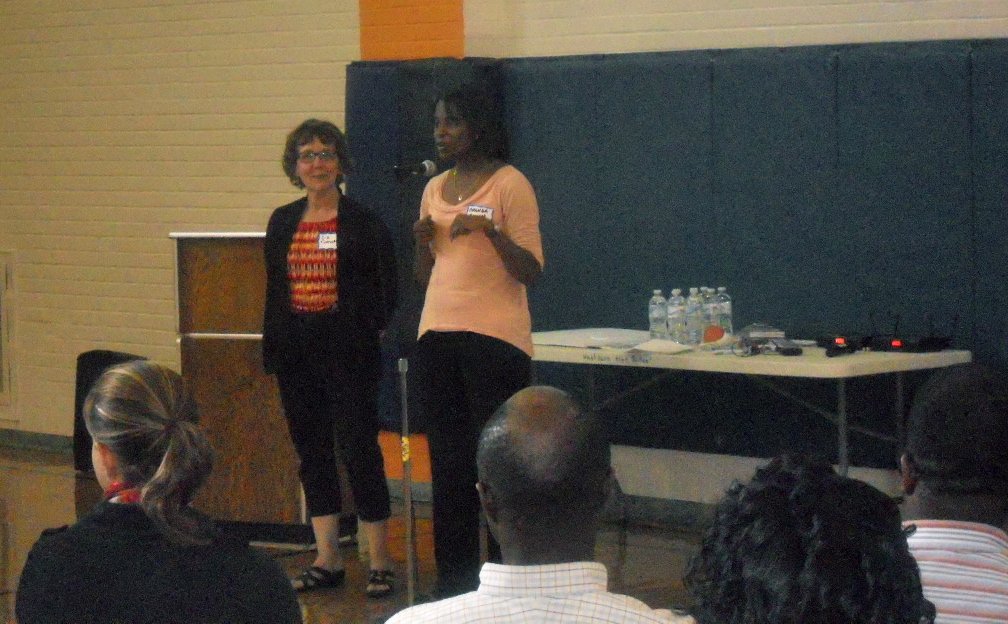
Washburn High School has had a tough year. During the 2012-2013 school year, high profile student misconduct with racist overtones, student protests, and a dispute between the athletic director and principal led to the sudden removal of principal Carol Markham Cousins. In the aftermath of these incidents, many in the Washburn community in Minneapolis anxiously wondered who would become the school’s new principal.On August 1, the Minneapolis Public School district announced that Patrick Exner, who had been working as an administrator at Ubah Medical Academy charter school in Hopkins, would be Washburn’s new principal. By August 8, he was removed from the job amid allegations that he falsified test scores in his previous post at Ubah Medical Academy, and later disclosures that his resumé contained some exaggerations.This rolling tide of events led the district to hold a community meeting at Washburn on Thursday, August 15, in order to address the hiring and immediate firing of Exner, and to assure community members that the school will be ready to welcome students for the 2013-2014 school year. About 200 parents and community members gathered in the Washburn gym to hear from Superintendent Bernadeia Johnson, parent leaders, and interim Washburn principal Linda Conley, among others.Sarah Lahm attended the August 15 meeting both as a Washburn parent and as a reporter. Continue Reading

Minneapolis mayoral candidate Cam Winton wants to offer “fresh eyes”

Minneapolis mayoral candidate Cam Winton considers himself a “fresh face” in Minneapolis’ political landscape, partly because he has lived in Minnesota for less than ten years, and also because, as a Republican running as an Independent, Winton believes he is an outsider who can bring “fresh eyes” to the business of city hall.Appearing on August 14 at the Minneapolis home of Vanessa Dayton, Winton shared his views with a small crowd as part of a casual “meet the candidate” series. He was the fifth candidate to speak to potential voters in this series, and was invited by Dayton, who said Winton is a promising candidate of interest to, “young professionals in Minneapolis.” Other articles on this series of candidate appearances:• Minneapolis mayoral candidate Betsy Hodges wants Minneapolis residents to be “militantly immodest”• Minneapolis mayoral candidate Jackie Cherryhomes claims “trifecta of experience”• Mark Andrew highlights green dreams in Minneapolis mayoral campaign• No more lemmings: Minneapolis mayoral candidate Don Samuels on educationAs a 34-year-old with two young children, Winton spoke of his desire to reach out to similar young families in order to create a “city that works for everyone.” In Winton’s view, Minneapolis has become an attractive place for recent college graduates beginning their careers, as well as empty nesters from the suburbs who want a more urban lifestyle, but, he said, the city needs to function better in order to remain livable for families.Winton cited snow plowing as one example, criticizing it as slow and inefficient.  Winton maintained that, for families trying to get out the door each morning, this is an important issue that needs to be addressed.Winton also expressed interest in closely reviewing the city’s contracts for garbage removal, saying he neither favored nor disapproved of contracting only with companies that employ union members. He said he wants every option considered so that the city will not be tempted to “do what it’s always done.”Winton then spoke about the need to rework the city’s regulatory services division, in the interest of encouraging entrepreneurial activity and job creation. Winton believes there should be less red tape involved, and that less regulation will lead to job growth more quickly than what he called “blue ribbon committees and task forces.”On the topic of education, Winton said he was interested in trying to change the city’s charter to allow the mayor to appoint school board members. Continue Reading

Minneapolis mayoral candidate Betsy Hodges wants Minneapolis residents to be “militantly immodest”

Minneapolis mayoral candidate Betsy Hodges wants Minneapolis to be the “greatest city of the 21st century.” To do this, Hodges advocates focusing both on Minneapolis’ “livability,” and the city’s disparities between wealthier and lower income residents.Speaking from the Minneapolis home of David Wilson and Michael Peterman on Wednesday, August 7, Hodges was the fourth candidate to appear as part of an informal “meet the candidate” series. On this mild August night, around sixty potential supporters gathered to hear Hodges’ ideas for the mayor’s office. The final candidate invited to speak is Republican Cam Winton, who is running as an Independent and will speak on August 14.Hodges began by telling the crowd that her vision is to move Minneapolis forward “based on people.” To this end, she spoke of the need to address the “wide chasm” between the “haves and the have-nots” in Minneapolis, in order to ensure that all residents have access to what the city has to offer.A key way to accomplish this, in Hodges’ opinion, is to increase the city’s transit options in order to “bring people to jobs and jobs to people.” She spoke of her support for bringing streetcars back to Nicollet Avenue, and possibly West Broadway Avenue in north Minneapolis. This is based on her belief that transit can “transform communities” and bring “confidence” and “permanent investment” to different parts of the city.Sam Rockwell, who was listening to Hodges speak, said he “doesn’t own a car” and “doesn’t want to.” He asked Hodges about her ideas for making transit more efficient, speed-wise. In response, she spoke about increasing all kinds of transit in the city and adding “more permanent bike infrastructure” to improve the efficiency of public transportation.On the topic of education, Hodges, like many of the candidates who have participated in this series, described the mayor’s role as that of a “convener” rather than an active decision-maker. Continue Reading

Minnesota college choices: In-state tuition for Saida Mahamud

Choosing a college is a bit like doing a balancing act on a tight rope. Students weigh factors such as the quality of the program, its location and size and cost, with factors such as the availability of scholarships, financial aid and loans all playing in to the decision-making process. For Saida Mahamud, deciding to go to the University of Minnesota after graduating from South High School had to do with taking advantage of in-state tuition, and taking advantage of internship and research opportunities available at a large university in an urban center.Luckily, because of Mahamud’s academic success in high school, she won a scholarship from the Wallin Education Partners, in addition to an academic scholarship from the University. Mahamud will be working on campus while she double majors in biology and global studies with a minor in either Spanish or Arabic.She will need those scholarships because the cost of college has risen dramatically, even at public institutions such as the University of Minnesota.In 1980-81, the average cost of tuition, room and board at a public, four-year college was $2,550. Even after adjusting for inflation, that would be about $6,381 in 2010 dollars. Continue Reading

Southwest Minneapolis principal on evaluations: Every teacher, every year

“Every teacher deserves written feedback each year,” says Bill Smith, principal at Southwest High School in Minneapolis. He sees the evaluation process as a way for each staff member at Southwest to assess teaching and learning and ask, “How can we do it better?” rather than being “just about teachers keeping their jobs.”Here’s an example of how it works. Last year, a successful teacher asked Smith for help in improving student transitions from one activity to another. Smith visited the classroom to observe for 30 minutes, and then “dropped in” twice during different class periods. Then he offered suggestions about class traffic patterns and class flow, and connected the teacher to others in the building who had similar teaching styles. Continue Reading

COMMUNITY VOICES | From near bankruptcy to business owner

“When I started driving, I basically had nothing left.  I was going into foreclosure at that time and I was only making some bills, some not.  Whatever savings I had, I had used already,” Syed Hassan said, reflecting on what owning his own cab has meant for him.Syed was born in Pakistan and came to Minnesota when the company he was working for in the U.K. offered him a job in the Twin Cities.  Excited to start a new life here with his wife and two children, Syed purchased a home and began to settle into the Midwest.  Within a year, storm clouds were gathering on the horizon.  The company began closing down offices, including Syed’s.  They offered to relocate him, but since Syed owned a house he said, “ No, I’ll stay…I’ll find a job.”Syed is a thoughtful and meticulous planner and approached his job search with vigor.  But he struggled to find work in a flagging economy, “A few days, months, then on and on and on, and I’m down to my last buck.”  Without many options, and knowing he had to help provide for his family, he decided he couldn’t wait anymore and started driving cabs.After a year of renting a cab, driving for Airport Taxi and struggling with the $600 weekly taxi rental fee, Syed was ready for a change.  In 2009, he heard about NDC’s Plan it! entrepreneur training program, offered in partnership with Northside Economic Opportunities Network (NEON), and decided to take the class with the intention of opening a restaurant.  Once Syed was enrolled and began studying, he realized that the capital requirement for a restaurant was too high.  Like a true entrepreneur, he readjusted his plan.He decided to continue driving a cab but purchased his own to make it truly profitable.  By owning his own cab, Syed could save the $600 weekly fee for renting.    In 2010, he came to NDC to borrow $10,000, “When I went for the loan, my credit was shot down.  Big time.  NDC supported me at that time.  They could understand what happened, and how I explained it.  They understood, they gave me the loan, they took a chance on me.”When Syed came to NDC, his credit score was in the low five hundreds but the chance NDC took was not misplaced.  He not only paid off his loan, but did so early by making weekly instead of monthly payments.  He propelled his credit score 170 points to the high six hundreds.Syed is now contemplating his next steps.  He is still exploring the restaurant idea, but for now, he is saving money and continuing to drive taxi.  He reasons, “if something is going smoothly, why stop it.”  Syed will purchase a new taxi to meet city requirements this year and has come back to NDC, “I preferred NDC because if you had somebody with you in your crisis, you try to give them business after.” Continue Reading

Minneapolis mayoral candidate Jackie Cherryhomes claims “trifecta of experience”

As a mayoral candidate for Minneapolis, Jackie Cherryhomes believes she has the “trifecta” of experience that makes her a strong candidate. This trifecta includes her government experience from twelve years spent on the Minneapolis City Council, her background in community organizing, and her recent work in the business world as a consultant.Cherryhomes was invited to speak at the home of Kenwood residents Charlie and Julie Zelle, to a crowd of around 40 interested voters and supporters.  She was part of a “meet the candidate” series organized by Minneapolis resident Kate Mortenson that features individual candidates speaking to voters and then answering questions. The next candidate to be featured is Betsy Hodges, who will appear on Wednesday, August 7.Cherryhomes began her speech by identifying three issues that she sees as related: health, housing and jobs, and the disparities within them.  She spoke of the many positive transformations going on in Minneapolis, such as the development of the North Loop district, but said that she wants “all citizens” to have the benefits of such transformation.Housing is a central topic for Cherryhomes, based on her experience on the city council. When asked about density in Minneapolis, she spoke about the need for more low income housing in the city, and her belief that it should not be concentrated in high poverty neighborhoods. Continue Reading

Minneapolis teacher on what works, what doesn’t in teacher evaluation

Minneapolis Public Schools teacher Caroline Hooper is not against teacher evaluations. She wants the feedback and opportunities for growth that an evaluation process can bring about. However, she wants the evaluations to be used as a “tool,” and not a “hoop” that must be jumped through.At Minneapolis’ Southwest High School, where Hooper teaches AP Government and in a college readiness program called AVID, she describes what she sees as the logistical nightmare of the new teacher evaluation system implemented in the 2012-13 school year. At Southwest, there are 125 teachers and four administrators. Each principal is responsible for evaluating thirty teachers. Continue Reading