Uber protests have precedent

Uber, a ride-sharing business that has been in the Twin Cities since October 2012, is protesting a proposed bill that would require its drivers to have additional insurance coverage.  To be exact, the bill would require online ride-hailing companies to cover their business’ vehicles with $1 million insurance policies.  Current Uber policies do not cover accidents in which the other driver is uninsured, but its drivers are constantly at a high risk for traffic accidents — they’re driving in unknown areas while looking at their phones for directions.  However, Mike White, the general manager of Uber, believes the bill would be both unfair and unreasonable, saying it may cost the state jobs. There is now an online petition against it, and many Uber drivers rallied outside the Capitol last Thursday. Officials on both sides are nearing a compromise, but it’s likely this back-and-forth will continue. Despite Uber’s protests, the bill, which is now out of contention in favor of a different measure, wasn’t unprecedented or out of reach. The required insurance policy mentioned in the Minnesota Legislature is almost identical to the policies that limousine and taxi companies pay. Furthermore, Utah passed a similar bill last week, and Uber announced that the policy was acceptable. Continue Reading
Murals Bridge Divides on Snelling Avenue, Saint Paul’s Busiest Street

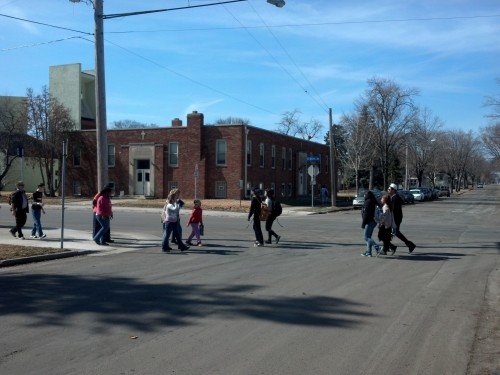
[At right: Snelling Avenue sidewalks. Photo by Bill Lindeke.]Snelling Avenue is one of the busiest streets in Minnesota, but it’s also one of the most overlooked: narrow sidewalks, aging buildings, and the steady stream of traffic filled with drivers that never seem to notice the rich diversity of the neighborhood around them.This summer, the Midway Murals project, which one a coveted Knight Arts Grant last year, will try to change that. Jonathan Oppenheimer, who wrote the grant for the murals project, is trying to bring together neighbors, business owners, and skilled public artists to bridge both the physical barrier of Snelling’s high-speed traffic and the cultural barriers around different immigrant and non-immigrant communities. The project, which just reached its goal of raising $22,000 from the community,I met Oppenheimer at the Midway Murals official launch at the Turf Club last month, and recently asked him a few questions about goals of the innovative public art project. Snelling Avenue is undergoing a big construction project this summer that will widen the sidewalks and attempt to calm traffic north of University Avenue and around Interstate 94. Continue Reading

Who’s got a ticket to ride on private Zip Rail?

While a private entity calling itself the North American High Speed Rail Group LLC has declared itself the private organization that’s going to raise capital and build the Zip Rail, a nonstop high speed rail line between the Twin Cities and Rochester, the group has been reluctant to share much about its corporate structure or backers.In an email exchange with Bluestem Prairie, the group’s Chief Strategy Officer Wendy Meadley declined to share information via email about the group’s corporate structure, the CEO’s bio, and the group’s plan to elevate the Zip Rail tracks to accommodate agriculture.  “At this time we are not publicly displaying the type of information you are requesting, but we are happy to respond,” Meadley wrote.We’ve done a bit of research, hoping to learn more. This is what we’ve come across so far.CEO: Joe SperberThe Rochester Post Bulletin’s Heather Carlson reported in Long road ahead for private rail developer:During an interview after the meeting, North American’s CEO and president, Joe Sperber, said the company believes it can do something that has never been done in the United States before —privately build and operate a high-speed rail system. The key to making the plan a success is that it would not rely simply on the rail. Instead, Sperber said the project would including economic development tied into the project.Who is Joe Sperber?  He appears to be a resident of Stillwater who was CEO of HexFuel.  Finance and Commerce reported in HexFuel gets state grant for Hastings facility:Maplewood-based startup HexFuel is getting a $740,000 grant from the Minnesota Job Creation Fund to help with a new manufacturing facility in Hastings that is expected to employ 150 people within three years, according to a Department of Employment and Economic Development news release.HexFuel makes a device that can be installed on diesel engines to make them more efficient. The BoostBox H2 breaks down water into hydrogen and oxygen and uses the gases to improve combustion, which increases fuel efficiency, reduces emissions and enhances performance.The company is investing $10 million to open a plant for manufacturing the devices. Continue Reading

Hospital workers picket Allina hospitals, calling for safe staffing levels

  Nearly 1,000 members of SEIU Healthcare Minnesota and supporters walked an informational picket line yesterday at Abbott-Northwestern Hospital, calling for safer staffing levels. “I’m here for our patients’ quality care as well as for health and safety for my co-workers,” said one of the picketers, Kalsang Dickey, Richfield, who has worked as a nursing assistant at Abbott Northwestern for 15 years.Contract negotiations are underway for about 3,000 hospital workers at Abbott-Northwestern and seven other hospitals owned by Allina Health: Buffalo, Mercy, Owatonna, St. Francis, United, Unity, and Phillips Eye Institute. The workers’ contract expired February 28.“Allina has cut staff at every hospital in the last three years, but we are still working the same or more hours and it means we are constantly understaffed,” Dickey said. “It’s hard for us to take care of patients.”Dickey works in the Mother Baby Center at Abbott-Northwestern and said sometimes only one nursing assistant is scheduled for the night shift. “If we have more nursing assistants, we can do a better job taking care of our patients’ needs.”SEIU Healthcare members also raised concerns about Allina proposals to subcontract hospital jobs and the impact on workers and patients.“If Allina executives subcontract hospital jobs like Dietary and Environmental Services to the lowest bidder, I think there will be higher turnover, less training, lower standards, and all of that will harm patient care,” warned Dawn Akkaya, SEIU Healthcare member who for 16 years has worked as nursing assistant and patient assistant coordinator at Abbott-Northwestern. Continue Reading

We Can Make 28th Avenue Better for People

Driving 28th Avenue from 38th Street to Minnehaha Parkway in south Minneapolis is a pleasure, a little too much so. Traffic is relatively light compared to so many busy streets in the city, the speed limit is 30 MPH, the road surface was repaved last year and is nice and smooth. The only likely place you have to stop is the signal at 42nd Street, but even there you have close to 50/50 odds of a green light. There is the occasional cyclist trying to cross at the Minnehaha Creek crosswalk. Otherwise 28th Avenue is clear sailing. Continue Reading

Backers push for vote on driver’s licenses for undocumented immigrants

Maria Negreros says she risks breaking the law each day to drive her children to preschool.Jovita Morales told lawmakers that in August 2007 it took hours to reach her two children who had been inside a bus that fell along with the Interstate 35W bridge into the Mississippi River.Anna Serrano wants to see her parents — owners of a new restaurant — to be able to get behind the wheel legally and stop relying on others for rides.All testified Wednesday during an informational hearing of the House Transportation Policy and Finance Committee packed with supporters lobbying for a vote on legislation that would make driver’s licenses available to the state’s thousands of undocumented immigrants.All testified Wednesday during an informational hearing of the House Transportation Policy and Finance Committee packed with supporters lobbying for a vote on legislation that would make driver’s licenses available to the state’s thousands of undocumented immigrants.“I want my parents to drive safely to work without worrying about being pulled over,” said Serrano, an 18-year-old college student from Willmar who emigrated with her parents from Mexico as a small child.Sponsored by Rep. Rod Hamilton (R-Mountain Lake), HF97 would eliminate the need for proof of lawful residency in the United States to obtain a driver’s license or state identification card, something the sixth-term lawmaker and a diverse coalition of supporters said would mean more insured drivers and safer Minnesota roads.No vote was taken on the bill, nor on identical legislation sponsored by Rep. Karen Clark (DFL-Mpls), HF98. A pair of Senate committees have already approved a companion sponsored by Sen. Bobby Joe Champion (DFL-Mpls). SF224 now awaits action by the Senate Rules and Administration Committee.‘Bigger than a license’Immigrant rights advocates packed a State Office Building committee room for the afternoon hearing, as well as an overflow space where they listened to live audio. While it’s an issue typically fraught with politics, Hamilton told the committee that driver’s licenses for undocumented immigrants is a good idea for a simple reason.“We would have an individual who would go through trainings, would receive a license, then purchase car insurance and drive on our roads,” he said.But following more than an hour of emotional testimony from a list of backers that included immigrants and the children of immigrants, supporters representing business interests and labor groups, police departments and the church, Hamilton acknowledged the issue of letting undocumented immigrants drive legally on the state’s roads is about more than that, too.“If you listen to the testimony closely, it’ll boil down to one thing,” he said. “The Declaration of Independence, and the moral belief that it is a right; that we’re born equal to pursue life, liberty and the pursuit of happiness. Continue Reading

Franklin Avenue, a Past and Future Native Home: An Interview with NACDI’s Andy Hestness

[Image at right: Rendering of the coming Anpetu Was’te cultural market on Franklin Avenue.] Franklin Avenue was once the border of Minneapolis, marking the edge of the city. Before that it was home to the Dakota people, and since the 1950’s post-“relocation era”, it is the site of the Little Earth community, the country’s only Indian-preference affordable housing site. But Franklin Avenue, which is controlled by Hennepin County, is also one of the most danerously designed streets in the city, home to a disproportionate amount of bicycle and pedestrian accidents. In particular, the corner of Franklin, Riverside, and Hiawatha, around the light rail station, has long been a dark, unpleasant place for people to walk and divded communities around. Transforming Franklin from a dangerous eyesore into a welcoming home for the surrounding Native community is one of the top priorities for Andy Hestness, vice president of the Native American Community Development Institute (NACDI), which runs the All My Relations gallery on Franklin Avenue and works as an intermediary for the Twin Cities Native Amerian people. We caught up with him last week to talk about how Native American’s are starting to challenge and transform how sideawlks, buses, and bikes work in and around Franklin Avenue, Minneapolis’ most neglected busy street. Continue Reading

House passes lower minimum wage for tipped employees

Some waiters and other tipped workers could earn a wage lower than the state minimum, under a bill the House passed 78-55 late Monday.HF1027, sponsored by Rep. Pat Garofalo (R-Farmington), would set a minimum wage of $8 an hour for workers whose combined tips and wages come to $12 an hour or more during a one-week pay period.Lowering the wage would preserve waiter jobs at restaurants offering full table service, Garofalo said. “Right now, businesses that are doing table dining, we are providing a regulatory incentive for them to move to fast-casual.”[Watch the floor debate]The proposed lower-tier wage is a dollar less than the new $9 an hour minimum that goes into effect Aug. 1, 2015, as part of a law enacted last year stipulating a series of wage increases. Employees whose tips amount to less than $4 an hour during a work week would make the higher minimum wage. The bill would repeal a part of current statute that prohibits the counting of employee tips toward the minimum wage. The bill now goes to the Senate, where Sen. Gary Dahms (R-Redwood Falls) is the sponsor. Rep. Jason Metsa (DFL-Virginia) called the bill “wage theft” and said Republican backers of Garofalo’s minimum-wage bill were adopting Walmart’s “rollback” pricing policy.“Freezing wages for waiters and waitresses will not make our economy stronger,” said Rep. Ryan Winkler (DFL-Golden Valley), calling the bill “a penalty on people who earn tips for their hard work.”Rep. Abigail Whelan (R-Anoka), citing her own experience as a barista as well as the service-industry work experience of her mother and sister, said the bill would help struggling restaurants and “keep as many people employed as possible.” After misguided minimum-wage increases, Rep. Glenn Gruenhagen (R-Glencoe) said HF1027 is “a step back in the right direction.”The House adopted Garofalo’s delete-all amendment 77-56. Continue Reading

Franklin Avenue to be repaved and improved for bikes and pedestrians

Paving and improvements to Franklin Avenue just west of trunk Highway 280 will cause street closures and other traffic disruptions this summer. St. Anthony Park Community Council member Brad Engelmann said it will be worth the trouble. The council met with city officials in early March and reacted with enthusiasm to the plan, which Engelmann said will make the street friendlier to pedestrians and bikes and help draw the neighborhood together. “They included nearly all the elements we look for in a street plan,” said Engelmann, who co-chairs the community council’s transportation committee. Continue Reading