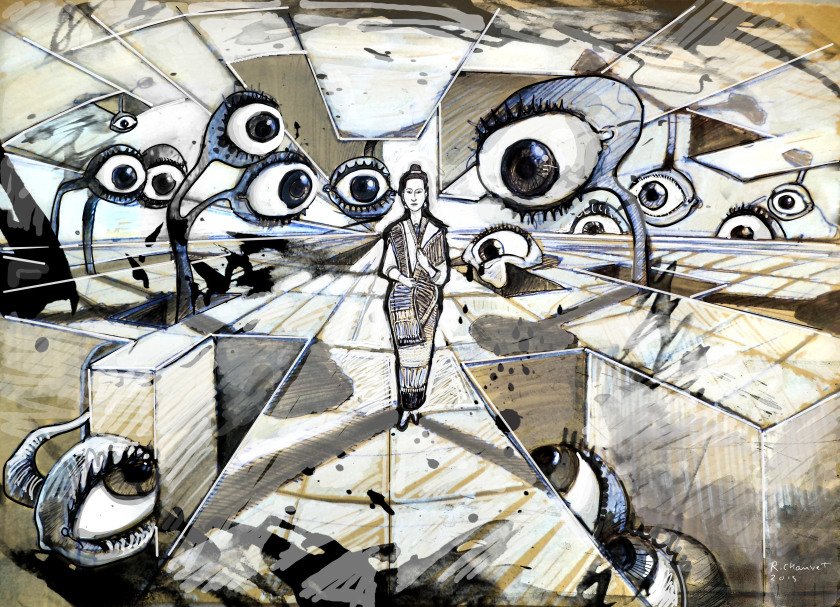
Art is powerful. For Indigenous communities, art is medicine with incredible healing properties. It is a way to create beauty in the messy process of decolonization. It is also a means to educate, inspire and enliven Indigenous activist movements.Minneapolis is no stranger to Indigenous activism, so the “Art of Resistance” exhibition opening on the American Indian Cultural Corridor’s All My Relations Gallery complemented the rich activist history in the Twin Cities. The traveling exhibit reflect over 30 years of environmental justice work of Honor the Earth, a national Native-led organization based in White Earth, Minn. Continue Reading
Last month, MinnPost’s Ron Meador outlined climate change’s likely impact on Minnesota over the course of the coming century. Meador’s article, and the study to which it referred, adds a sobering close-to-home detail to our collective knowledge about the risks associated with climate change.Meador’s article, and others like it, should spur us to action. To date, governments and others at national and local levels have offered a variety of fix-it plans. These plans include increasing efficiency standards of cars, moving to renewable energy sources, designing carbon capture models, geoengineering, and implementation of new “green” construction standards, among other related suggestions.Markedly absent in mainstream conversations are suggestions that Americans simply consume less. Ideas that do circulate about lifestyle change tend to be either “back to the land” proposals or framed in the language of “giving people options”: bicycle lanes give people the option to get out of their cars; condos provide snazzy options for young people and empty nesters. Continue Reading
Sherrie Fernandez-Williams was a child of few words. That’s surprising since words are now her stock-in-trade. “I was slow to speak,” says the author of the new memoir, “Soft.” “I used to create an imaginary world in my room, and I actually came to story before I came to words.” Her mother, a single parent raising eight children in a housing project in the Brooklyn section of New York City, was pretty happy that her youngest child was content to play in silence. But Fernandez-Williams is no longer silent. She discovered the joy of words as a third-grader when she was assigned to write a short composition. Continue Reading
Lao science fiction is making its mark! This weekend in Bloomington, award-winning Lao American playwright and poet Saymoukda Vongsay will be one of the guests of honor at the MarsCon convention, presenting “Kung Fu Zombies vs. Shaman Warrior.”In her presentation, she will discuss the often taboo subject of mental illness. She notes that for many communities it is often explained as demonic possession. Beliefs like this stem from centuries of folklore about demons, ghosts, monsters, and witch doctors. Continue Reading
Two weeks ago, the Atlantic published a short (and facile) post called “the Miracle of Minneapolis” that (as is the way of media circles in insecure places) launched itself right onto the forefront of the Twin Cities social media scene. And, with good reason, the article re-kindledconversations about racial disparities that have been going on for years. Before I dive into my argument, I want to outline two crucial caveats. First, I love that we’re discussing racial disparities with increasing frequency these days. We have ignored the way that our cities have created wealth only for some (white) people, and made it almost impossible for others. The Fair Housing Act was only passed in the 60s, which isn’t very long ago, and we need to always remember how our cities treat people differently depending on race, class, and culture. Continue Reading
“I think that decriminalizing recreational use would benefit our people greatly since so many of us use it and many have been incarcerated for possessing it. The tribes certainly could gain by better controlling how it exists within our communities as well as financially with sales and possible taxation … We have retained aboriginal rights to utilize medicines within our communities the way we see fit.”Martin Reinhardt, Professor at Northern Michigan UniversityIt’s time to reconsider the regulation of marijuana and hemp. With the Pineole Pomo Tribe of California initiating the first tribal commercial marijuana grow operation and the Department of Justice’s announcement that it would not prosecute for marijuana or hemp, the door has been opened to look at the regulatory scheme. This December, Justice Department Director Monty Wilkinson announced, “The eight priorities in the Cole memorandum will guide United States Attorneys’ marijuana enforcement efforts in Indian Country, including in the event that sovereign Indian nations seek to legalize the cultivation or use of marijuana in Indian Country.”In turn, the Pomo tribe, which is located in Mendicino County, one of the largest marijuana growing counties in the country, announced a commercial venture with two partners, Colorado-based United Cannabis and Kansas-based FoxBarry Farms. The 250-member tribe announced that it will grow thousands of plants for the medical marijuana business on its 99-acre reservation.What’s the catch? There are a lot of them, especially in any states which have not yet legalized marijuana. Continue Reading
University professors and researchers are joining the call for City of Bloomington prosecutor Sandra Johnson to drop charges against organizers of a “black lives matter” protest at the Mall of America in December. The protest was in response to highly publicized police violence against blacks in Ferguson, Missouri and New York City as well as some cases in Minnesota.117 university professors and researchers based mostly in the Twin Cities metro, but some from greater Minnesota signed an open letter calling the plan to charge the organizers “political persecution.”“We are deeply disappointed in the City of Bloomington’s decision to use its considerable power to actually add to the obstacles that are blocking the movement toward a better, more peaceful, and more just society. We urge the City of Bloomington to drop all charges against those who participated in the recent peaceful protest at the Mall of America.” (Full text of the letter is below)The letter comes a day after more than 100 faith leaders signed a similar open letter.Eleven people will appear in court on March 10th for their arraignment on charges ranging from trespassing to disorderly conduct for their attendance at the peaceful demonstration which included nearly 3,000 individuals on December 20, 2014 at the Mall of America.Bloomington City Attorney Johnson issued her own open letter on Tuesday responding to the faith leaders. In it she said “the criminal justice system must look at the conduct not the content of the messages behind the illegal conduct. To approach protest or demonstration cases any other way would result in viewpoint discrimination based upon the popularity of the message with the prosecutor and with the community. Continue Reading
One can already see the Minnesota Republican political narrative for 2016 and it is not pretty for the Democrats. Simply put the narrative is that the DFL is out of touch with middle class Minnesota, they are the party of gridlock, and GOP will defend the middle class and stop the bickering. How did all this happen? The strength of the DFL narrative in 2010 and even though most of the 2013-14 session was its defense of the middle and working class. They had a great narrative: an increased minimum wage, tax increases on the wealthy and cuts for the middle class, more money for K-12, and the Women’s Economic Security Act. This is a terrific “We are on your side message.” But somewhere along the way to the 2014 elections the Minnesota DFL lost their message and the battle for images and symbols. Spending on a new state senate office building did not help and the messaging on taxes and spending fell flat, costing the DFL the House in 2014. Now the DFL are in trouble. Dayton’s push for commissioners’ pay raises was simply politically dumb. After years where most Americans if not Minnesotans have not seen pay increases, arguing for commissioners’ raises when they already make two to three times the median family income in Minnesota was not smart. Nor were defenses of it by some DFL commentators that these individuals deserved raises or else government would not be able to recruit or hold talented administrators. It sounded greedy…like private sector business CEOs who whine they do not make enough. But then it got worse. The Dayton-Bakk fight did not look good. It painted a party as dysfunctional, undermining another narrative that the DFL had for the last two years–they delivered on their promises. And then the deal to address the raises was brokered by Kurt Daubt–the GOP Speaker of the House. His intervention sets up a narrative that the DFL cannot govern alone and that what is needed is unified Republican control of the legislature. Moreover the deal he did broker did not take the pay raises off the table–it merely postponed them until later this year–even closer to the 2016 elections. And then this past week the State Auditor sharply criticized the mismanagement of MNSure. Yes it has insured many more Minnesotans yet its managed was flawed and it needs to be fixed. Finally, while no one doubts we need to spend billions more on infrastructure and that the Republican proposal to spend the non-existent surplus on roads and bridges is an insufficient smoke and mirrors idea, the DFL have not messaged their proposed tax increases well. So think about 2016 and the issues Republicans will use. The Senate office building will be nearly done, standing as a monument to government excess; pay raises for commissioners while the middle class struggle; tax increases for infrastructure; health care mismanagement; and possibly a feuding DFL that cannot work together. Together they paint a picture of Democrats as out of touch with middle class Minnesotans and as a party that potentially cannot get anything done (aided by Republicans who now have an incentive to drive the state into a budget impasse or shut down again and then blame it on the DFL). This is a 2016 Minnesota replay of what the national Republicans did in 2014 when the ran against Obama and the Senate Democrats. What is perplexing is how the DFL lost control of its narrative again. In the larger scheme of things they are probably do way more to help middle class Minnesota than the Republicans are, but they are simply terrible at messaging and one wonders if they can improve their ability to communicate and understand how these issues play beyond their metro base. – [See original post at: http://schultzstake.blogspot.com/2015/02/how-minnesota-dfl-lost-their-narrative.html#sthash.okyzJ8ed.dpuf] Continue Reading
The City of Bloomington’s insistence on prosecuting organizers of a “Black Lives Matter” protest at the Mall of America is getting more pushback from Minnesota’s religious leaders.A letter signed by more than 100 faith leaders asks City Attorney Sandra Johnson to have a community-wide dialog about race instead of prosecuting people.“The energy you have put into this aggressive prosecution needs to be redirected to a community-wide effort toward open dialogue between our justice system and those who do not receive equal and fair treatment and protection from our current system,” says the letter. “We would like to meet with you at your earliest convenience to discuss these matters.”Eleven people are charged with crimes ranging from trespassing to disorderly conduct for their attendance at the peaceful demonstration which included nearly 3,000 individuals on December 20, 2014 at the Mall of America. The protest was part of a larger nationwide demonstration reacting to police violence against African-Americans.This is the second letter faith leaders have sent to the city. The previous letter was signed by 41 clergy and also asked for the city to stop its prosecutions and invited the city to charge them too. Full text of the letterBlack Lives Matter Minneapolis Faith Leaders Letter of SupportDear Sandra Johnson,We, the undersigned, members of the clergy in the city of Bloomington, write to express our support of the Black Lives Matter movement. As a matter of background, on January 20, 2015, individuals working with the Black Lives Matter Minneapolis group were invited to present to the Bloomington Conference of Evangelical Lutheran Church in America and Minneapolis Area Synod at our monthly gathering, at which some of the undersigned were present. A representative from the synod office was also in attendance.We did not know what to expect when we invited this group to meet with us. Continue Reading