
Brown Bag with MinnPost Reporter and Recount Expert Jay Weiner, Wednesday 12/15
|
Please join us at noon on Wednesday, December 15 at the East Lake Public Library, 2727 E.
Twin Cities Daily Planet (https://www.tcdailyplanet.net/author/jeremy-iggers/page/21/)

Jeremy Iggers recently retired as executive director of the Twin Cities Media Alliance. His newest project is a website called www. GlobalTwinCities.com. He lives in south Minneapolis with his wife Carol and two cats.
Please join us at noon on Wednesday, December 15 at the East Lake Public Library, 2727 E.

I have cut back dramatically on meat consumption over the last few months, but last week was my niece Tess’s last week in town, so we decided to go on a meat binge together. Continue Reading
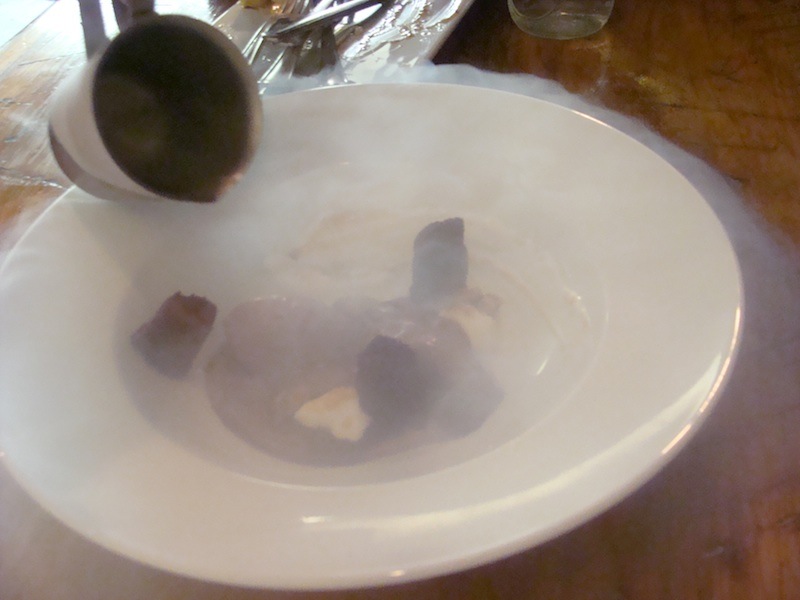
For my birthday, Carol offered to take me out to dinner anywhere I wanted to go, and I chose Travail Kitchen and Amusements, the new restaurant and wine bar in Robbinsdale. Continue Reading
FBI agents raided six homes in Minneapolis and two in Chicago today, apparently looking for links to terrorist activity.

The City of Delano in Wright County is a fairly typical Minnesota community. With a population just more than 5,000, its per capita tax base and average household income is close to the average for all Minnesota cities. Its per capita expenditures are also close to the statewide average. And like nearly every other Minnesota city, it has experienced large cuts in revenue from the state and large property tax increases over the last eight years.The following analysis will focus on Delano’s “revenue base.” As defined in state law (Minnesota Statutes 2009, 477A.011, subdivision 27), the revenue base is the sum of city property taxes plus local government aid (LGA) and market value credits (MVC). Revenue base is a commonly used proxy of city spending and is frequently used as a basis for apportioning aid cuts and setting property tax levy limits.Since 2002, the state aid and credit portion of Delano’s revenue base has fallen from approximately $198 per capita in constant 2010 dollars* to zero in 2010. Figure 1 shows the steady erosion in the revenue that the State of Minnesota shares with the City of Delano.State policymakers decided to resolve a disproportionate share of ongoing state budget deficits through large state aid cuts to local governments. In fact, cities and other local governments have endured bigger cuts since 2002 than state government, as a percentage of total revenue.Property tax increases in Delano were not sufficient to offset the decline in state aid from 2002 to 2010; as a result, the real per capita revenue base of Delano declined at the same time that city property taxes climbed, as illustrated in figure 2.**Delano’s $171 per capita property tax increase was not sufficient to offset the $198 per capita state aid cut. As a result, Delano’s revenue base declined by $28 per capita (6.1 percent) from 2002 to 2010.Delano’s trends roughly resemble those of all Minnesota cities, shown in figure 3. As a result of state aid cuts, real per capita revenues of cities have fallen at the same time that property taxes have shot up.State aid cuts have put local elected officials in the unenviable position of having to raise property taxes and the same time they are cutting city budgets. To confirm this, ask former Delano Council Member Tom Emmer. In 2003, then-Council Member Emmer voted for a 16 percent property tax increase. According to Minnesota Public Radio, Council meeting notes quote then-Council Member Emmer criticizing state policymakers for forcing local governments to raise property taxes.Last Spring, Emmer–now a state representative and gubernatorial candidate–elaborated on the property tax increase that he voted for in 2003. According to MPR, Rep. Emmer said the property tax increase was necessary to replace lost state aid dollars. Emmer said “I voted to fill the hole. I didn’t do any new spending. Nothing.”Indeed, it would be unfair to blame Council Member Emmer for the 16 percent property tax increase that he supported back in 2003. After all, the analysis presented above supports his contention that the increase in property taxes was not going to pay for more city spending, but to backfill a hole left in the city’s budget as a result of large aid cuts that Governor Pawlenty pushed through the state legislature.While Council Member Emmer should not be faulted, Rep. Emmer certainly can and should be. While in the House of Representatives, a compliant Emmer went along with Pawlenty aid cuts that forced Minnesota’s local governments to approve both property tax increases and budget cuts–just as Emmer himself was compelled to do back in 2003.Now gubernatorial candidate Emmer is telling us that he wants to continue the policy of cutting state aids and credits. And he would have us believe that today’s local elected officials will not do the same thing that he did back in 2003: increase property taxes to recoup at least a portion of lost state aid.Given that the per capita spending of Minnesota cities and the per pupil revenue of Minnesota school districts are already below the national average, there can be no doubt that local elected officials will be compelled to replace a significant portion of future aid cuts with still more property tax increases. If you don’t believe us, just ask Delano City Council Member Tom Emmer.*The inflation adjustment here is based on the implicit price deflator for state and local government purchases, which is the appropriate measure of inflation for state and local governments.**The Delano information presented in figure 2 is part of a multi-city analysis conducted in conjunction with release of Minnesota 2020 Property Tax Report: 2002-2010. Click here for an online supplement to the report with similar information for all Minnesota cities with a population over 5,000. Continue Reading
Please join us this Wednesday, September 22 at noon the East Lake Public Library, 2727 E. Lake St., Minneapolis, for this month’s Brown Bag Lunch conversation.

Photo: Destiny Cafe
I don’t get to University Ave. in St. Paul as often as I would like, but every time I do, I discover something new and interesting.
Last week, after reading reports that Krua Thailand would soon close, I decided to head over for one last meal at this better-than-average Thai restaurant. Continue Reading
Please join us at noon on Wednesday, August 25 for our Brown Bag Lunch at the East Lake Public Library, 2727 E. Lake St., Minneapolis, with Star Tribune restaurant critic Rick Nelson. (Okay, that’s a different Rick Nelson in the photo. Rick the critic doesn’t allow his picture to be published because he tries to remain incognito when he visits restaurants.)Rick has been a restaurant critic and food writer at the Minneapolis Star Tribune since 1998. He was a restaurant critic at the Twin Cities Reader from 1993 to 1997 and a food writer at the St. Paul Pioneer Press from 1997 to 1998. Continue Reading
If you have never donated to the Twin Cities Media Alliance before, now is the time. Every dollar you give helps us earn a $75,000 matching grant from the Challenge Fund for Journalism. (Just click on GiveMN.org.) We were deeply honored to be the only citizen journalism project to be chosen for this award, alongside such outstanding projects as the Columbia Journalism Review and the Chicago Reporter, but now we have to earn it.We give you more than ever before: award-winning journalism, including more professionally edited original reporting by citizen journalists than any other local news website in America. coverage of under-reported stories and under-covered communities that you can’t find anywhere else. we empower Twin Citizens from diverse backgrounds and communities through citizen journalism classes and media skills workshops. Continue Reading
