Growing up on her family’s farm in Uganda decades ago, Harriet Oyera couldn’t have dreamed she would one day grow squash and eggplant in a community garden she started on vacant ground in north Min
Even the title is politically charged. As Welfare Reform 2.0 inches its way through the Legislature, it’s hard to imagine Gov. Mark Dayton signing legislation that puts up so many obstacles for low-income families seeking government help.The DFL governor has not spoken publicly about the Republican plan – and his spokesperson says he doesn’t plan to, for now – but his commissioner for the Department of Human Services has now denounced it in a letter to state lawmakers.Dayton may be waiting to see how far the legislation goes before jumping into another fight with GOP legislators, especially as no significant action has been taken yet in the Senate, but Commissioner Lucinda Jesson isn’t holding back.Community Sketchbook focuses on the economic and social challenges facing communities, especially low-income communities and communities of color, and how people are trying to address them. It is made possible by support from the John S. and James L. Knight Foundation, The Minneapolis Foundation, and some Minneapolis Foundation donor advisors.Community Sketchbook articles may be republished or distributed, in print or online, with credit to MinnPost and the foundations.In her March 1 letter to key House Republican committee chairmen Rep. Jim Abeler of Anoka and Steve Gottwalt of St. Cloud and to Senate Health and Human Services Committee chairman David Hann, R-Eden Prairie, and 13 other legislators, Jesson decries “at least a dozen bills” adding new “regulatory burdens” for low-income families receiving economic assistance from the Minnesota Family Investment Program (MFIP) and /or General Assistance (GA).Says Jesson: “While we applaud and fully support efforts to reduce fraud in these programs, we cannot support policies that create unique new regulatory burdens on low income families in economic assistance programs, ultimately undermining their work effort and putting more children in poverty.’’Republicans counter that the legislation is “intended to tighten up” the assistance programs and that eliminating waste and fraud translates into more money for the poor.“This is really about the integrity of dollars for people in need,’’ Gottwalt told me recently. “Minnesotans want to help the people truly in need.’’But Jesson says the majority of families receiving assistance “do not fit a pattern of fraud, abuse and misuse.’’ Rather, she says, they are responsible adults trying to care for their families and “achieve self sufficiency.’’Taking on GOP early in session“The memo is pretty unprecedented in tone and timing,’’ says Jessica L. Webster, staff attorney for the Legal Services Advocacy Project, one of many advocates for the poor. Continue Reading
Recently issued federal poverty guidelines establish the 2012 definition of poverty in America.Bottom line, it’s easier this year than last for families to qualify as poor and thus be eligible for state and federal government assistance programs, at least from the standpoint of income.The down side? The U.S. Census last year reported an 11 percent increase in the cost of living in Minneapolis.This year a hypothetical family of one adult and two children making an annual income of $19,090 or less is now officially poor, compared to the 2011 definition of poor for that family being $18,530.Community Sketchbook focuses on the economic and social challenges facing communities, especially low-income communities and communities of color, and how people are trying to address them. It is made possible by support from the John S. and James L. Knight Foundation, The Minneapolis Foundation, and some Minneapolis Foundation donor advisors.Community Sketchbook articles may be republished or distributed, in print or online, with credit to MinnPost and the foundations.To put that in perspective, realize it figures out to one adult earner working full time for $9.17 an hour — about the cost of three tall lattes from Starbucks.Further, for a family of four, one or two parents and children, the poverty guideline announced late last month sets an annual income of $23,050. Last year it was $22,350.The federal definition establishes eligibility rules for federal public assistance programs, like TANF (Temporary Assistance for Needy Families), which replaced AFDC (Aid to Families with Dependent Children) in 1997. TANF money goes to the states to help pay for food and housing and other basic needs for the poor.MFIP, the Minnesota Family Investment Program, is Minnesota’s version of TANF.The U.S. guidelines serve as a benchmark for the states in determining who qualifies for their public assistance programs. In most states, if families exceed the poverty level income they lose their benefits.Current Minnesota law, however, allows families to earn up to 115 percent of poverty and still receive cash benefits through MFIP.But a proposed bill now before the House Health and Human Services Reform Committee would cut off benefits such as MFIP at 100 percent of poverty, explains Jessica L. Webster, staff attorney for the Legal Services Advocacy Project.She and other advocates for the poor oppose such a measure.Webster recalls that when MFIP was piloted in 1994 to 1997 persons were allowed to earn up to 140 percent of the poverty guideline. Continue Reading
Once again researchers at the Institute on Race and Poverty at the University of Minnesota have crunched data showing that charter schools as a whole underperform comparable traditional public schools and are more segregated.Community Sketchbook focuses on the economic and social challenges facing communities, especially low-income communities and communities of color, and how people are trying to address them. It is made possible by support from the John S. and James L. Knight Foundation, The Minneapolis Foundation, and some Minneapolis Foundation donor advisors.Community Sketchbook articles may be republished or distributed, in print or online, with credit to MinnPost and the foundations.That means, according to the latest “Failed Promises” study by Myron Orfield and Tom Luce, that Twin Cities charter schools aren’t delivering promised academic gains in spite of the fact that a high proportion of charters are essentially single-race schools.Grouping students by race or ethnic background has been touted by some as a sort of gold ring, the attainment of which would lead to higher academic performance as well as to closing the academic-achievement gap between races.(Source: Minnesota Department of Education)But the study released today by the Minneapolis institute finds that when controlling for factors such as poverty, students in charter elementary schools score 7.5 percentage points lower for math and 4.4 percentage points lower for reading than students in schools run by public school districtsA high proportion of the charters are also “essentially single-race schools,’’ the report says. For instance, in 2010 to 2011, 89 percent of black charter students attended segregated schools, up from 2000 to 2001. “Hispanic, Asian and Native American students were also roughly twice as likely to be in segregated settings than their traditional school counterparts in 2010-2011,’’ the study reports.Segregation in Charter Schools(Click here for interactive map)“The high rates of racial and economic segregation matter because research shows that students do worse in segregated school environments than in integrated settings,’’ said Luce, research director at the institute. The report analyzes Minnesota Department of Education data.The percentage of schools that are integrated is increasing among traditional schools operated by school districts, according to this study.The study shows “that charter schools are not closing the achievement gap; they may be making it wider by increasing segregation,” stresses Orfield, director at the institute and a longtime proponent of integrated schools.The full study, which also addresses management problems of charter schools, is here.Orfield’s last study on charter schools came out in 2008 with similar results.‘Truth is more complex’ “Which is better, district or charter, is like saying which gets better gas mileage, the rented car or the leased car,’’ responded Joe Nathan, director of the Center for School Change at Macalester College in St. Continue Reading
Supporters call it necessary. Opponents call it harmful. And the poor call the human services legislation making its way through the Legislature plain wrong.“This is basically criminalizing being poor,’’ Ebony Harris, a mother of four from North Minneapolis hotly declared to the House Health and Human Services Reform Committee Wednesday about proposed legislation that would significantly change the lives of Minnesota’s poor but save taxpayers money.Though mostly calm voices — legislators and the folks who’ve spent their careers advocating for those without — dominated the session, by the time the two-hour hearing on the clutch of proposals dubbed “Welfare Reform 2.0’’ wound down, the words “mean-spirited,” “offensive,” “demeaning,’’ “stereotyping” and “poor-bashing” hung in the air.Community Sketchbook focuses on the economic and social challenges facing communities, especially low-income communities and communities of color, and how people are trying to address them. It is made possible by support from the John S. and James L. Knight Foundation, The Minneapolis Foundation, and some Minneapolis Foundation donor advisors.Community Sketchbook articles may be republished or distributed, in print or online, with credit to MinnPost and the foundations.And then, after DFL Rep. Larry Hosch from St. Joseph tried unsuccessfully to table proposals that would restrict needs benefits on several fronts, frustration ignited.Voices rose in anger. Continue Reading
On the heels of a recent MinnPost story about a statewide public information campaign to inform Minnesotans about who is eligible for Food Support benefits , I received an intriguing email from Janet Lewis Muth, who works with the poor in Rice County, just south of Lakeville.Such a campaign is well and fine, she told me, except more of a challenge in her area, where the Rice County social services office is so far behind in their paperwork that a family or individual already on food support “can expect to lose their benefits for four to six weeks” when it comes time to renew their benefits by showing evidence they still qualify.Mike Emerfoll, 42, of Northfield, for instance, who cannot work because of medical problems, had to wait two months for reinstatement because of the backlog.Community Sketchbook focuses on the economic and social challenges facing communities, especially low-income communities and communities of color, and how people are trying to address them. It is made possible by support from the John S. and James L. Knight Foundation, The Minneapolis Foundation, and some Minneapolis Foundation donor advisors.Community Sketchbook articles may be republished or distributed, in print or online, with credit to MinnPost and the foundations.“It’s been going on for far too long,’’ says Muth, coordinator of Growing Up Healthy, who recalled how last summer she helped a Somali woman with six children find food to break their fast during Ramadan.“We’ve got a lot of people scared and hurting as a result of some paperwork backlogs’’ in the Rice County Social Services Department, agrees Jim Blaha, executive director of the Community Action Center of Northfield, a non-profit providing emergency food and clothes and other services to the poor.Some families, because they miss application deadlines or have incomplete paperwork, make a mistake on their application or for some other reason have had to wait three months or more to receive benefits from the county that stretches from Northfield south to Faribault and Medford. Benefits applicants also complain of unanswered telephone messages and long telephone waits when calling the county social services office.Counties all over the state administer programs such as the Minnesota Family Investment Program (MFIP), the Supplemental Nutrition Assistance Program (SNAP) and health care aid to the poor but don’t appear to be having the same problems as Rice County, according to folks at the state Human Services Department.Right: Jim BlahaBecause of the payout delays in Rice County the Community Action Center helped feed 40 to 50 households in January alone, Blaha says. Among those were the families of David Tap and of Mike Emerfoll.Job lossTap, who came to the United States in the mid 1990s from South Sudan, recently lost his job at a packaging company. His wife, Tabatha Kor, is a nurse’s aide but her salary isn’t enough to support the couple and their two young children.There was a misunderstanding, Tap says, that with his job loss he was receiving unemployment benefits, which he isn’t. Continue Reading
Sitting cross-legged on the floor Saturday at Family Academy in the Northside Achievement Zone, six moms and their children sing a song that could signal a sea change for some north Minneapolis fam
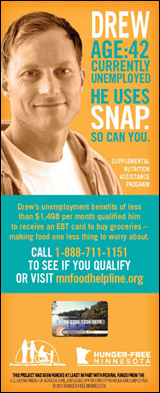
One poster in a new campaign to end hunger in Minnesota features a smiling Caucasian man dressed in t-shirt and sweatshirt. It reads, in part: “Drew Age: 42, Currently Unemployed. He uses SNAP. So can you.”More than 500,000 Minnesotans receive benefits through the federal Supplemental Nutrition Assistance Program, formerly known as Food Stamps, with disproportionate numbers of African-Americans and Indians.Community Sketchbook focuses on the economic and social challenges facing communities, especially low-income communities and communities of color, and how people are trying to address them. It is made possible by support from the John S. and James L. Knight Foundation, The Minneapolis Foundation, and some Minneapolis Foundation donor advisors.Community Sketchbook articles may be republished or distributed, in print or online, with credit to MinnPost and the foundations.But the need, buoyed in part by the economic recession, is significantly greater and broader. Continue Reading
There’s an effort afoot in southeast Minnesota that could have 12 counties collaborating on their delivery of human services.The idea, now in the second stage of exploration, would be to coordinate some departments such as IT, finance and quality assurance as well as to centralize the administration of programs that are largely electronic already, such as child support enforcement and child care licensing.Community Sketchbook focuses on the economic and social challenges facing communities, especially low-income communities and communities of color, and how people are trying to address them. It is made possible by support from the John S. and James L. Knight Foundation, The Minneapolis Foundation, and some Minneapolis Foundation donor advisors.Community Sketchbook articles may be republished or distributed, in print or online, with credit to MinnPost and the foundations.The rationale: to improve services and save money.”…Collaborating we can deliver the needed higher level of services to residents at a lower cost to taxpayers,” says Ted Siefert, Goodhue County Commissioner and co-chair of the project’s steering committee.As Paul Fleissner, director of community services for Olmsted County and based in Rochester, explains it, “Since 2003 we’ve been taking budget cuts. At the same time our [client] numbers have been growing rapidly, especially as the economy grew worse.”A steering committee comprised of representatives from the 12 counties and the Minnesota Department of Human Services has been discussing the effort for more than two years and has developed a blueprint [PDF] for how it would work and which services the counties would be willing to share.Right: Paul Fleissner (Photo: co.olmsted.mn.us)The 12 counties are: Dodge, Fillmore, Freeborn, Goodhue, Houston, Mower, Olmsted, Rice, Steele, Wabasha, Waseca and Winona.In this second step of the process the committee has chosen Accenture, a management consulting and technology services company, to devise operating and implementation plans as well as to estimate service delivery improvements, cost savings and any job losses.”It’s obvious our work will change if we go to this model,” Fleissner acknowledges, but adds that counties have already gone through down-sizing and need current staff capacity to serve large client bases.The project could lead to a virtual human-services center for consumers requiring certain services.A website and app could be created for people living in all these counties that would link them to an information and resource center with a variety of capabilities, Fleissner says. Those in need of food, for instance, would find help ranging from a list of nearby emergency food shelves offered by faith-based communities or non-profits to how to apply for SNAP, the state food support program.But other services, such as investigation of a child protection report, would continue to require face-to-face fieldwork, Fleissner says.The Accenture report, due in April, will go to the 12 county boards for review and each county will decide whether to sign on.Praising the possibility of such a regional collaboration, Erin Sullivan Sutton says she thinks the effort will serve people better as well. She is assistant commissioner of the state Department of Human Services.”We’re looking at how best to serve people in their communities. Continue Reading
Julie Landsman is a white teacher who talks openly and thoughtfully about the elephant in the classroom: race, and its affect on children’s learning.And though she’s been devoting a good chunk of her time to writing and teaching about how to level that playing field ever since she left her classroom in the Minneapolis schools 10 years ago, she acknowledges she’s a little pessimistic about narrowing the academic achievement gap between white kids and children of color.Especially now.Community Sketchbook focuses on the economic and social challenges facing communities, especially low-income communities and communities of color, and how people are trying to address them. It is made possible by support from the John S. and James L. Knight Foundation, The Minneapolis Foundation, and some Minneapolis Foundation donor advisors.Community Sketchbook articles may be republished or distributed, in print or online, with credit to MinnPost and the foundations.”It feels like there has been a concerted effort to demonize public school teachers,” the author of “A White Teacher Talks About Race” and other similar books told me.Teachers are being blamed, she says, for the divide despite the fact that students of color are often held back by societal racism, poverty, language, culture and what she calls white privilege.”It is very difficult to make changes. Race and poverty intersect and neighborhoods are different. Some schools have 20 to 40 different languages coming into the building, which I think is great but requires more resources,” the diversity consultant says.Landsman, will speak about such issues Friday (Jan.27) at an event organized by the Achievement Gap Committee, a group convened five years ago by Don Fraser, former mayor of Minneapolis, to address the academic divide. The gathering starts at noon at House of Hope Presbyterian Church, 797 Summit Ave. Continue Reading