December 21-25 — If Cincinnati and Los Angeles gave birth to an African metropolis with hills and palm trees it could be this place. Until now, the only places I have been outside of the United States are Mexico and Canada. In my mind this beautiful and complex location has more in common with Mexico than with Canada. Continue Reading
Remembering my encounter with Kifle Selassie, I am hearing whispering waters from an ancient African well. It’s full of a history and cultural wisdom from deep in the Earth. Its waters are those which the African Diaspora is urgently and, too often unconsciously, hungry for and of which the larger Western world is oblivious, contemptuous or covetous. It’s a water whose element connects all the human species… another kind of “Holy Water” sometimes full of fire, ultimately healing… come to the river. The best of who we are is often manifested in those waters. That is where our souls touch in that blinding universal force and we kiss the sky and water all at once, full moon and countless constellations shimmering, swirling and turning. Come to the river people. Continue Reading
Fendika put on a great show at the Cedar Cultural Club on Wednesday, July 10, getting the large crowd dancing and jumping and spinning all over the place. Before I went to the show I had never seen Fendika except for a video off the net. But I will plan to go anytime they come to the Twin Cities because I know it will be a great show that will make me feel like I have seen a band.Last night’s show began with a set from the three instruments which were unique; four drums which looked like they might be handmade (played by Misale Legesse), a masengo, which is a violin-style instrument (played by Endris Hassen who played the single horsehair string with his fingers), and Seleshe Damessae made music with the krar, best described as a type of six-stringed lyre. The music they made was quite wondrous, and that would have been enough for a fine concert. But that is not their style. Soon out came Nardos Tesfaw, the singer who upped the level a notch with her fine clear voice and occasional trilling cry.But the energy level at the Cedar went nuclear when Zenash Tsegaye and Melaku Belay came out and engaged the people with their kinetic-energy dancing that set everyone in motion, whether age three or in their 80s. Continue Reading
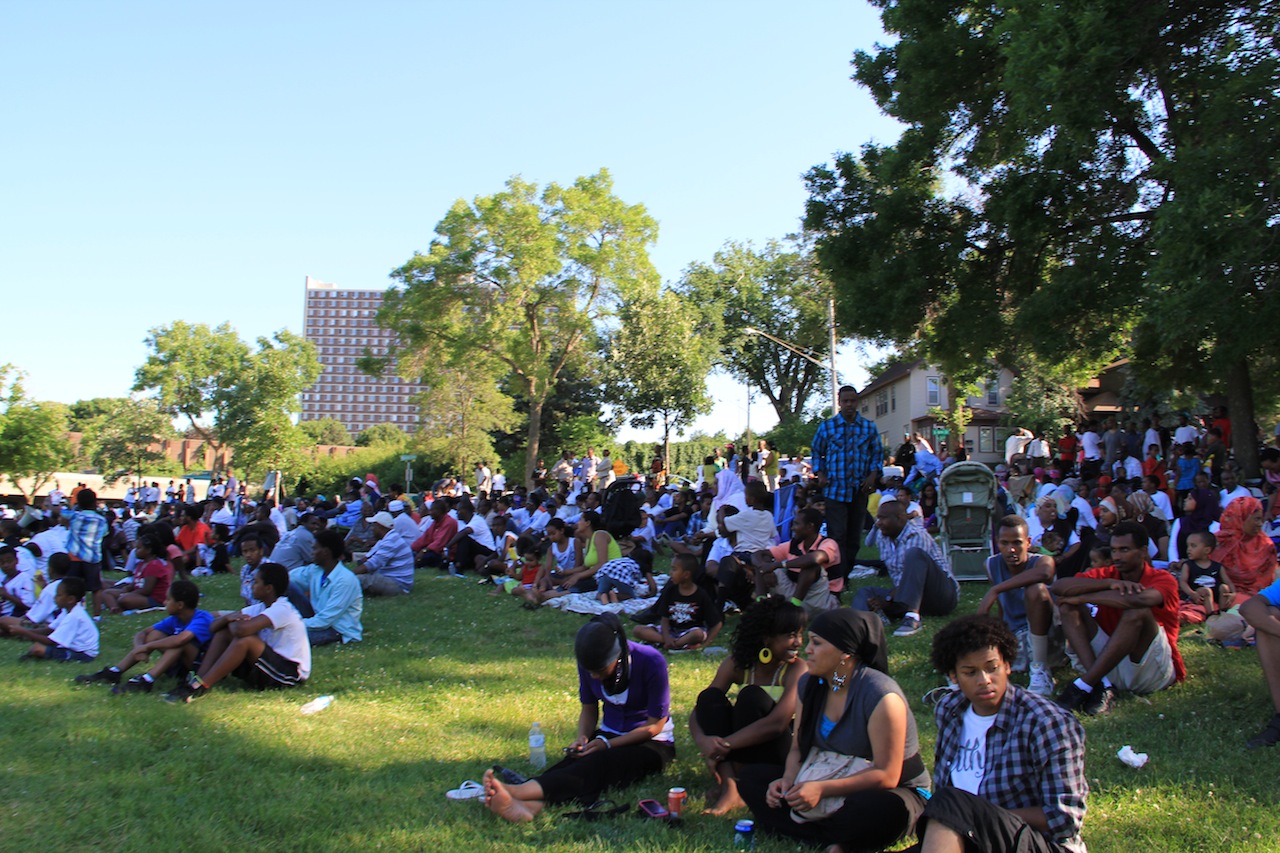
Every year on the Fourth of July, Minneapolis’ Riverside Park turns into party central for the Twin Cities Oromo community. They’ve gathered there for about 18 years, said Hassen Hussein, executive director of the Oromo Community of Minnesota. The St. Paul-based nonprofit provides social services to ease the transition of Oromo refugees from the Horn of Africa, and also works to educate the Twin Cities about the Oromo culture.Because you can’t reserve space at Riverside Park, Hussein and a group of volunteers start setting up tents, grills, and sports equipment at 4 a.m. The party goes on till 10 p.m. “How many people come depends on the weather,” said Hussein. He estimates that there are more than 30,000 Oromo in the Twin Cities, which some say makes it the largest Oromo population outside of Africa, earning the nickname “Little Oromia.” Continue Reading
Earlier this month, when many people were welcoming spring by celebrating Cinco de Mayo, others in Minnesota were celebrating Fasika, or the Ethiopian Easter. For this month’s stop on the tour Around the World in the Twin Cities, we headed across the Atlantic to Africa by visiting the Ethiopian restaurant Fasika at 510 North Snelling Avenue in St. Paul.United Foodies of Minnesota group member Nick Maryns carved a passport stamp of the Ethiopian flag for the outing. The star in the center of the flag symbolizes diversity and unity. It was an appropriate sentiment for Stop #4 on the tour. Continue Reading
The little Ethiopian restaurant hidden away inside the Shabelle Grocery used to be one of the best-kept secrets in the Seward neighborhood—until recently, there was no sign outside to indicate that Shabelle was more than just a grocery store. Finally, last week, they put a sign in the window announcing their new $8.99 lunch buffet, served Monday to Thursday from 11:30 a.m. to 2 p.m.This is not one of those 100-item strip mall mega-buffets. When I visited, there were only about half a dozen items to choose from, mostly vegetarian: red lentils, yellow split peas and stewed black-eyed peas, collard greens, linguine in a beefy tomato sauce, seasoned rice, a Greek salad and injera, the traditional spongy sourdough flat bread. What struck me was how fresh and flavorful everything tasted.There’s lots more on the a la carte menu, ranging from kitfo (Ethiopia’s version of steak tartare) and rice with goat meat (both $10); Middle Eastern dishes like felafel, gyros, and chicken kabobs; and even a Buffalo chicken wrap and a hamburger (most items $5.99). The breakfast menu includes foule (refried seasoned fava beans, $6), scrambled eggs ($4.99), sambousas (stuffed pastry triangles, 50 cents apiece), and fatira (pita bread cooked with eggs, green peppers, onions in olive oil, $5).Also read Ethiopian flavors spice up Shabelle Grocery and restaurant in Minneapolis (Stephanie Fox) Continue Reading
Mikyas Woldemichael is a 22-year-old Ethiopian American who isn’t afraid to follow his dreams. The University of Minnesota student is the founder of Ra’ey Youth Soccer Organization, which support kids in Addis Ababa, Ethiopia in training and improving their soccer skills.He started Ra’ey, which stands for “better vision” in Amharic, a year ago when he went to Addis Ababa, Ethiopia to volunteer for Ethiopia Reads. His goal with Ra’ey is to help kids who live in poverty by getting them physically active, involved in their community, and focused on academics. “I don’t want them just hanging out on the street all day and night,” he said. It all started when Woldemichael observed how passionate the youth in his neighborhood, Haya Kilo, were about soccer. But they lacked the resources to properly train and play. All they had – as most children in Ethiopia do – were makeshift soccer balls made of plastic bags handstuffed with scraps of paper and cloth, he said.“I had some soccer balls I gave them. So they asked if I could give them money to buy them matching shirts. Continue Reading
Abdur Omer, co-owner of Shabelle, the little Ethiopian grocery store and restaurant on Franklin Avenue, opened his store 13 years ago after moving to Minnesota to be near friends. He first moved to Washington, D.C. from Ethiopia in the 1980s and it was there, just a couple of years before he arrived, where I first became aware of Ethiopian cuisine. The city’s many Ethiopian restaurants were popular with the many Ethiopian cab drivers, and although I was only an Iowan cabdriver, I’d grab the same take-out as my fellow cabbies, nibbling on dinner as I trolled for fares. I loved the fragrant stews and the bread it was served on. They were unlike any cuisine I’d tried.Omer is still passionate about the food of his home country. Continue Reading
Ethiopia suddenly has a new president. The longtime leader of the nation, Meles Zenawi died earlier this week after an unspecified illness. The Ethiopian parliament held an emergency session on Wednesday to select the country’s new prime minister.