The Hub grand opening: Pedal powered party

It was perfect weather on Friday for the grand opening of The Hub, the new mini-store that has moved in next to Spokes in Seward.The store was several years in the making according to Jason Tanzman, the director at Cycles for Change, and was the work of The Hub, Cycles for Change, Seward Neighborhood Group, and Seward ReDesign.The shop will work closely with Spokes, selling used bikes that were donated to Spokes and have been repaired, with some of the proceeds going back to the non-profit. They will also have parts available for purchase during open shop times at Spokes.Expect to find commuter-friendly parts and accessories, lights, helmets, fenders, locks, and small parts such as cables, housing, and brake pads at the store.Why the collaboration? Josh Weichsel, Hub store manager, explained, “I think that we were a natural partnership because we share the same ideals. We both want to encourage cycling as a viable form of transportation and we both see cycling as a great means of building community. We also have a wealth of experience in retail bike shop management which allows us to advise on technical matters.”Since the Hub shares the building with Spokes they will not be repairing bikes. Continue Reading

Greenway plans support Minneapolis biking, summer opening set for new Dinkytown bike path

Minneapolis is known for its bike-friendliness, but some think the Dinkytown area could take it to the next level.MN Daily Editor’s Note: A new bike path for the Dinkytown area will open this summer.Construction will begin this May on a bikeway along the Granary Corridor, a gravelly swath of railroad that runs below Dinkytown. The new path will connect the Mississippi River to TCF Bank Stadium, but University of Minnesota and city officials are hoping for a lusher, more developed greenway to eventually fill the strip.Minneapolis Public Works studied development options for the old railroad tracks last year after the University expressed interest in building a road there, said Ignacio San Martin, director of the Metropolitan Design Center, which helped with the study.“Doing so was going to cost an enormous amount of money,” said San Martin, who is also a professor at the University. “I said, ‘give me half of that, and we can do a greenway corridor.’”The idea for a greenway beneath Dinkytown came from students in San Martin’s graduate urban design course. The project eventually made it into an area plan San Martin created with the University District Alliance.“It’s one of those projects that’s in front of you all the time — you know we cross the river, we cross the bridge,” he said. “It looks like someone would like to say ‘We should do something with this.’”The greenway would bring business, housing, entertainment and a farmer’s market into the trench, alongside a bike path and potentially a trolley route, San Martin said.Cyclists are pushing for more protected bike paths, said Soren Jensen, executive director of the Midtown Greenway Coalition, and a new greenway would make cycling more attractive.“A lot of people out there would be more encouraged to bike … if they had safer, more protected bikeways,” he said.Separate bike paths also spur economic growth, Jensen said. Continue Reading

Saint Paul’s Nice Ride failure shows need for downtown bike lanes

I saw my first NiceRider this week, an Asian student crossing the Wasington Avenue bridge on the University of Minnesota campus. It seems that, barring massive snowstorms forcing the bright green bikes to scuttle back to their hibernation caves, the Nice Ride season is upon us. They’re even expanding again, adding 24 new stations along the river and in South Minneapolis. Continue Reading

Crime on the Midtown Greenway

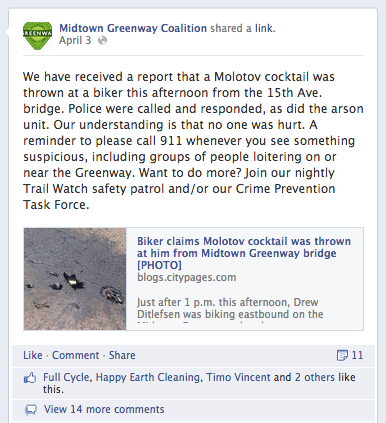
So… have you heard the one about the biker who nearly got hit by a Molotov cocktail on the Midtown Greenway? Nope, that’s not a joke–it’s a story that’s been circulating since last week, quickly surpassing the boundaries of the bicycling community and making its way into the mainstream media. MPR reported that Drew Ditlefsen “was riding on the below-grade portion of the Greenway that runs on an old railroad bed below the street in the Midtown area. He said someone threw the makeshift firebomb at him from the 15th Avenue overpass. He said the bottle narrowly missed him, hit the pavement and burst into flames.” Unfortunately, the Greenway is no stranger to crime. Continue Reading

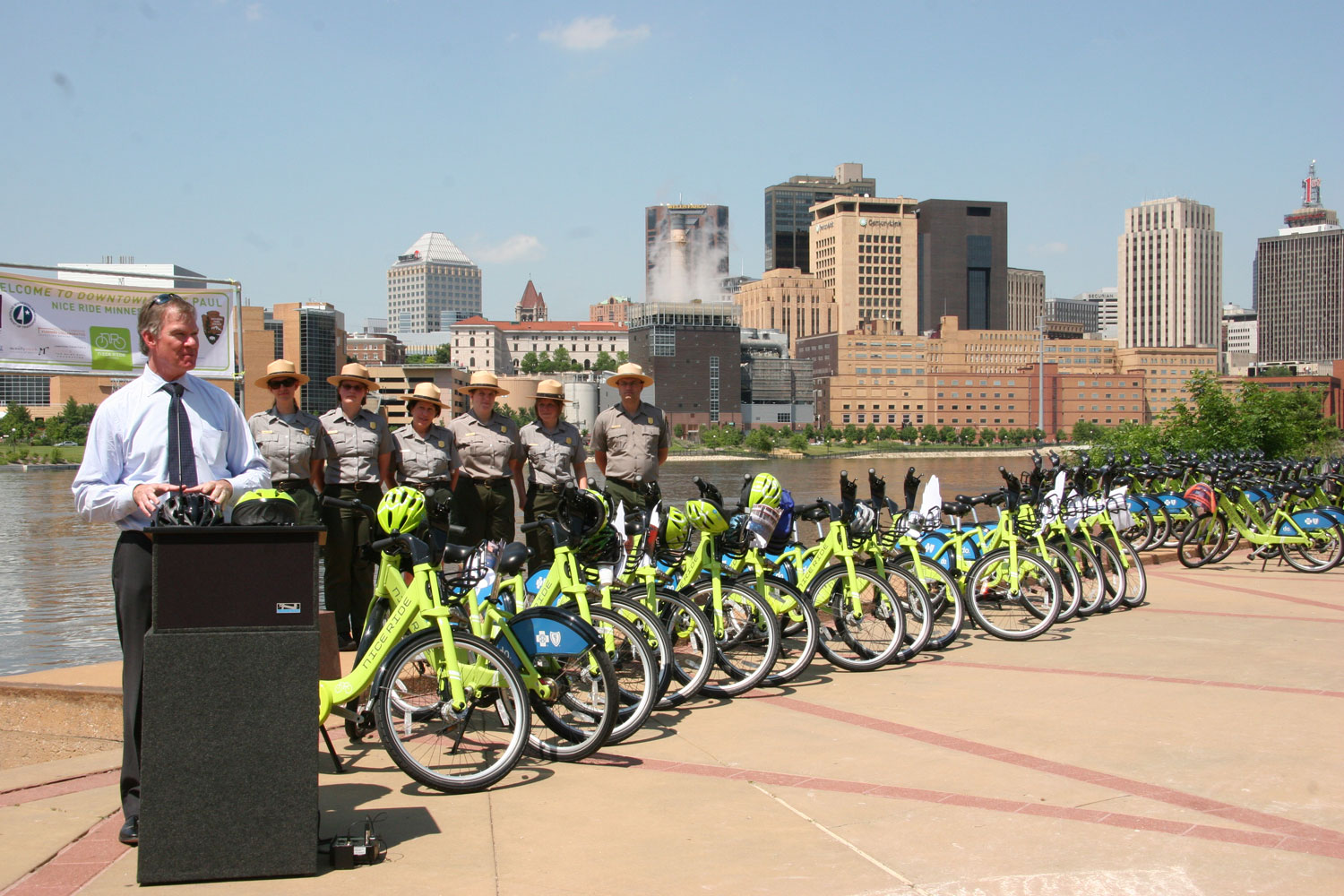
Nice Ride bikes: Ready to roll

It really is spring! We just got word that by the end of the day today all of the Nice Ride bikes will be out and ready to go for a spin.There are a few stations in our community where you can rent a bike:Franklin & 28th Ave25th Street & 33rd AveEast Lake Street & 36th AveMidtown YWCA22nd Ave S & Franklin Ave (upcoming)You can find all of the stations and how many bikes are currently available by checking out the Nice Ride map or Spotcycle.New Stations Look for new bike stations at Minnehaha Falls Park, Lake Street, and Hiawatha Ave this May.How it WorksNice Ride is best for short trips. For instance, if your ride is shorter than 30 minutes there aren’t trip fees. We think it would be a great way to use a bike to get from point A to B, and then not have to worry about a bike when you get to where you’re going.To participate, you’ll need to subscribe to the Nice Ride service ($65 per year) and then there are trip fees depending on how long you need the bike.Do you use Nice Ride? What do you think? Continue Reading

30 Days of Biking kicks off at Minnehaha Falls

30 Days of Biking is a movement that started in Minneapolis and uses the connective power of social media to make a sometimes solo venture – riding a bike – not such an individual event.“It makes you realize that there’s this entire community of people who are supporting you,” Stephenson told Minnesota Public Radio. “For people who aren’t used to biking every day, it’s a bunch of people – invisible people — essentially around the world who are saying ‘you can do it. We support you. We’re there with you.’”How to participate? Pledge to ride your bike – any distance – every day during the month of April. Continue Reading

The non-motorized bottleneck: 15th Avenue SE, Minneapolis

After reading Prescott Morrill’s great article on the continual growth of the Minneapolis bicycling population, I was initially shocked at certain count levels in specific areas. The counts in the Bike Walk Twin Cities study were within a 2-hour time period during evening rush (4pm – 6pm), and occurred in a week timeframe in mid-September. Some places with high demand, such as the Franklin Avenue bridge, had gradually healthy & growing numbers, whereas 20th Avenue near Riverside Plaza had essentially the same amount. But, initially, I was extremely surprised to see that 15th Avenue SE north of the U of M campus had the highest bike count number, the highest non-motorized count number, and contained one of the largest percent growth values within the entire city. At first, I was surprised that these values surpassed such high profile places such as the Hennepin Avenue Bridge or the Midtown Greenway, but after thinking about it, the numbers made complete sense. Continue Reading

Bike lane or cycle track for Minnehaha Ave in Minneapolis: What do you want to see?

We hate to spring it on you like this, but if you didn’t know, Minnehaha Avenue between 46th Street S. and Lake Street is slated for reconstruction beginning in 2014.One of the bigger decisions that needs to be made is determining the type of bike facility to install – bike lanes or a cycle track. Since the number of bicyclists is growing in our neighborhood and the city has set a goal of becoming a more bike-friendly city, we wanted to see if there were data available about what type of path bicyclists preferred and if one facility was safer than another.Currently there are two options for Minnehaha Ave – a bike lane in traffic, or an offset cycle track. Minneapolis has one cycle track already at 1st Ave N (downtown).We were in luck. In a recent bicycle count done by the city, volunteers also recorded where cyclists rode – whether it was on a sidewalk or path, or on the street.The findings are interesting. When a separate path is available (a sidewalk or bike path), 90% of bicyclists will use the path instead of riding on the street. Continue Reading