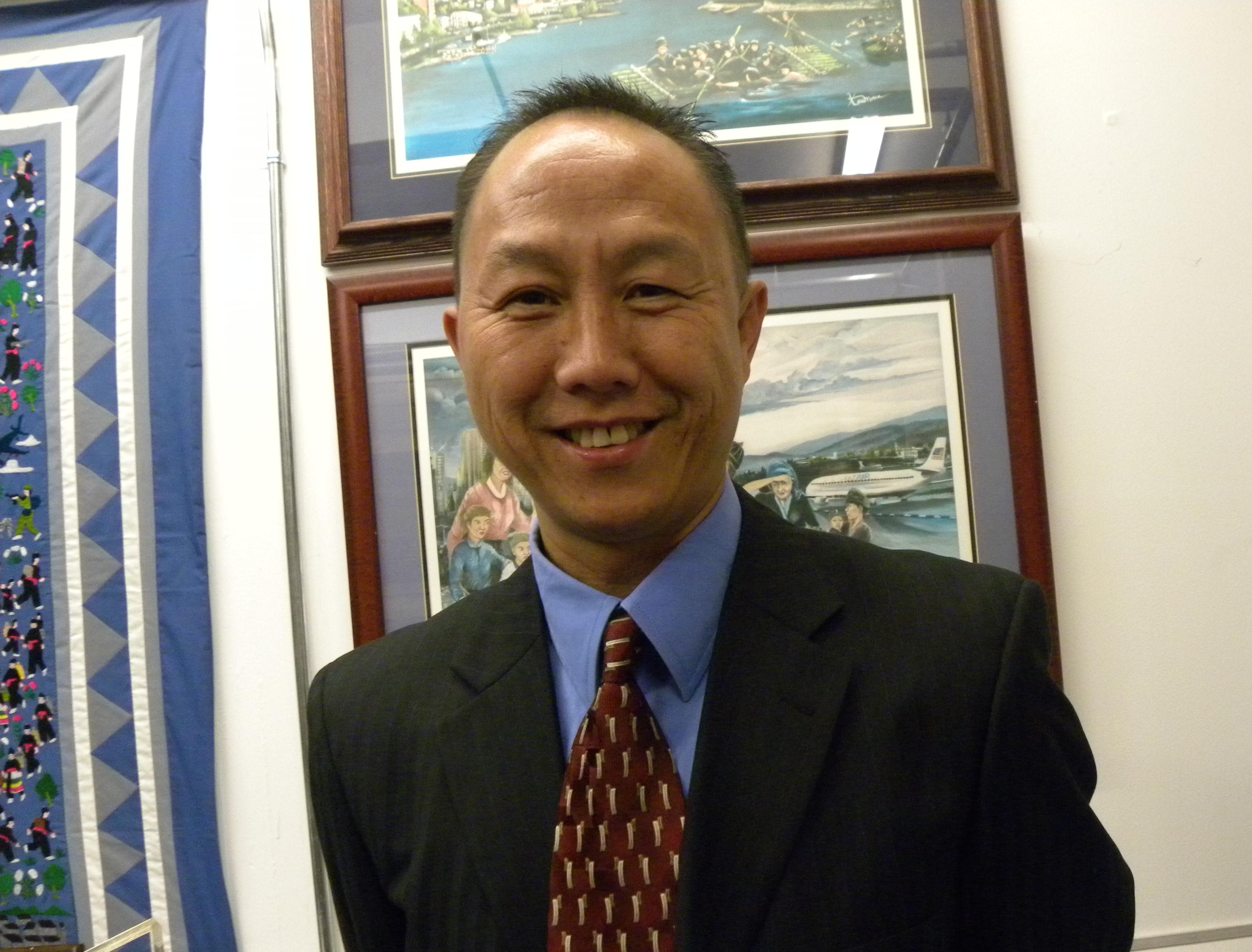
MN VOICES | Toua Xiong, Immigrant of the Year
|
Minnesotans’ penchant for farmer’s markets surges to the surface each spring.
Twin Cities Daily Planet (https://www.tcdailyplanet.net/category/special-sections/minnesota-voices/page/7/)
Interviews with interesting Minnesotans
Minnesotans’ penchant for farmer’s markets surges to the surface each spring.

Immigrants have always discovered, then defined, Northeast Minneapolis. Still, in a neighborhood that boasts of its ethnic heritage, Majdi Wadi is mythic. For more than 15 years Northeast residents have flocked to his Holy Land bakery and deli on Central near Lowry for hummus, cheese, olives, dates, nuts, pita, olive oil, and an array of delicacies, unknown to many locals, but treasured fare for the Muslim community.

Char and Judy Madigan, aka “The Twins,” don’t play baseball, live in pricey digs, or sign $184 million contracts. The Madigan twins are twin sisters by birth and Sisters of St. Joseph by vocation. For those who are homeless, immigrants, in need of food, health care, justice or a port in life’s storms, Judy and Char Madigan are the Twins.The Madigan Twins agreed to meet for a chat about our mutual alma mater, St. Joseph’s Academy (SJA), longtime flagship of Twin Cities-area Catholic girls’ schools. Opened by the Sisters of St. Joseph (CSJs) in 1851, the Academy (as it is still known) closed its gates in 1971. SJA graduates and the spirit of SJA live on! The Madigan Twins, SJA ’55, took time to reflect on their high school experience and their lives as Sisters of St. Continue Reading

“There is no such thing as races,” Dr. Herbert Perkins said. “There is only one human race.”
This ideal and the fight for social justice have become the life work of Dr. Perkins and Margery Otto. “[Combating racism] has been a lifelong passion,” Dr. Perkins said, speaking for both himself and Otto. And to their delight, they were honored for their work when The St. Paul Foundation named them co-recipients of the Facing Races Ambassadors Award. “Having that affirmation, having that social approval…knowing that others appreciate the work we are doing [is encouraging].” Continue Reading
“I think everyone feels that they want to make where they live a better place.” In this matter-of-fact tone, Billie Young explained her life-long history of community involvement. Never content to just sit at home and do nothing, Young’s commitment to working to improve the community around her seems almost as natural as breathing.
Last July in Albuquerque a tall, thin, noisy woman walked through the hotel glass doors, hollered my name, hollered the name of someone else, hugged a man, and hugged me, all the while doing that Indian nose nod thing to everyone in sight.Minnie Two Shoes had arrived at her umpteenth Native American Journalists Association conference, and worked the crowd with the energy of a small nuclear bomb. At a commemorative luncheon that weekend celebrating NAJA’s 25th anniversary, Minnie received praise for her work as a founding NAJA member. During her rapid-fire comments to the audience, she used words like “snarky” and “snaggin'” and we laughed. How we laughed. When Minnie entered any room in the world, laughter walked in with her, sat down and stayed.Minnie Two Shoes, irreverent, extraordinarily intelligent and hilarious, died in Minneapolis on April 9 from cancer. Continue Reading

Dr. Eric Jolly’s eyes still showed his fatigue from a whirlwind work trip to Germany, but when it came time for him to show off some of his favorite things in the museum, the Science Museum of Minnesota president promptly perked up and transformed into teacher mode. He giddily zoomed through the Cell Lab, where children can don lab coats, gloves and goggles to study their saliva’s enzymes. Then he raced through the basement-level vault, where volunteers and scientists probe ancient fossils, and where other carefully cataloged treasures wait in metal cabinets to be explored. Jolly enjoys taking special guests through the vault, which sports shelves of prehistoric pottery and dozens of nearly six-foot-long hunting spears stored upright against one wall. Though their shafts were mottled with age, the sharp tips looked as if they could still easily pierce the flesh of a charging beast. “The Secret Service did not appreciate that I brought (former First Lady Laura Bush) near those,” he admitted, glancing toward the weapons. Continue Reading

Poet and novelist Diane Glancy says her work gives a voice to those who cannot speak for themselves: Sacajawea, the Cherokee who walked the Trail of Tears in 1831, the Ghost Dancers who held out hope that a messiah would help them get back what they had lost. Her role as a writer, she said, is “to portray the human experience.”
The human voices in Glancy’s poems, essays, novels, plays and now films are usually Native American or people like herself, those who come from a mixed European and Indian ancestry. The Macalester College professor retired last year, after 18 years teaching writing and Native American literature. She recently moved to Kansas City, her hometown, to be near her daughter and grandchildren. Born in 1941, Glancy’s father was Cherokee; her mother was of English/German descent. Continue Reading
First impressions are crucial, which is why when Katie Stephens Spangler started her own Irish dance school at 23, she knew she needed the right name. “I always knew rince (rink ah) meant dance in Gaelic,” said Stephens Spangler. After a little research she found the perfect phrase to compliment it-na chroi (nah Kree), or of the heart. On February 27, Rince na Chroi celebrated its seventh anniversary with its annual “From Our Stage to Your Heart” performance. Now, in the midst of preparing her dancers for the hectic St. Continue Reading

Lebanese-American writer Kathryn Haddad co-founded Mizna in 1999, when artists like her had no place to tell their stories. “There was a frustration with the fact that the Arab-American voice wasn’t being heard in a multicultural kind of scene,” she said. “Nobody even was aware of it, or even if you tried to bring it up, they didn’t even know what I was talking about.” Today the nonprofit Mizna, located in northeast Minneapolis, sustains a literary journal with national readership and hosts regular arts events. That Haddad and her colleagues started Mizna before 9/11 – after which many outsiders became more interested in Arab and Muslim culture – is an important distinction to note, she said. Continue Reading