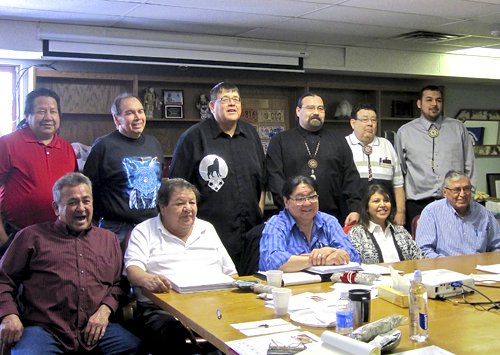
RED LAKE, Minn. – Although the subject was not on the printed agenda for the Red Lake Tribal Council at the regularly scheduled monthly meeting on Jan. 13, recent acts by the federal government concerning Indian tribes, hemp and marijuana prompted several tribes to explore the feasibility of growing medical marijuana and industrial hemp.Red Lake Chairman Darrell G. Seki, Sr., added the agenda item shortly after the call to order. He said he felt the federal ruling should at least be discussed. Seki cited several tribes that are looking deeper into the issue and mentioned fewer yet that were actually taking action.Immediately, Red Lake citizen and Gardening Tech at Red Lake Traditional Foods David Manuel asked to address those assembled and spoke of the economic advantages to getting involved with at least industrial hemp and possibly medical marijuana. Continue Reading
Minnesota House Speaker Kurt Daudt says one of the reasons Minnesota’s predicted budget surplus has increased is higher economic confidence since Republicans won a majority in Minnesota’s House last November. The state revenue forecast released today showed Minnesota will have a $1.86 billion surplus, an $832 million dollar increase from the last forecast. State revenues go up mostly because of increased sales tax revenue and income tax revenue.“Part of this economic confidence is there is balance restored in state government,” Daudt told reporters.Pioneer Press reporter Rachel Stassen-Berger almost immediately pressed Daudt if he “could reiterate that theory… the theory that this forecast is good because Republicans now have the House and there is balance restored to the Capitol? Tell me more about that.”Daudt responded that Minnesota Democrats lost the House because the revenue forecast in November (also a surplus) showed that the policies Democrats put in place the last two years “didn’t help Minnesota’s families and didn’t help Minnesota’s economy.”Daudt said the increase in this latest forecast is mostly because gas prices are low “But I think Minnesota’s economy also understands that we don’t have a runaway government that when we didn’t need to raise any taxes put in place one of the largest increases in state history.”Governor Mark Dayton with Democratic majority in both the House and Senate raised the taxes on the top 2 percent of earners in Minnesota. Dayton was re-elected by a large majority.“I think that people have confidence in that balance has been restored in state government,” said Daudt.More reporter questions and video of the exchange Another reporter asks if Republicans are claiming credit for the portion of the surplus that happened after they took office. Continue Reading
[You can see the original post here: http://streets.mn/2015/02/27/downtown-east-commons-is-a-blank-slate-except-for-the-vikings-and-the-traffic/]On Tuesday night, a healthy crowd of local downtown residents and other interested parties gathered in the rustic lobby of the Mill City Museum for the first of several public meetings about the forthcoming Downtown East Commons park. It was a fun atmosphere, with the palpable enthusiasm that comes with the chance to shape big changes in the place where you live. There were also cookies.There were two purposes to the meeting. The first was to give locals the chance to hear from the landscape architecture firm chosen by the city, Hargreaves Associates. The presentation given by Hargreaves’ President Mary Margaret Jones was well received, and it’s clear that the city has made an able hire. Continue Reading
[See original post here: http://www.bluestemprairie.com/bluestemprairie/2015/02/mall-of-america-where-civil-liberties-go-to-buy.html]Bluestem’s editor has been to the Mall of America three times in her life: once to shop in the mid-1990s, once to stop by a bookstore where a friend of a friend worked, and a final time to meet a former student for lunch as he was on his way to Hazelton.Thus, we can’t honestly say we’re boycotting a place we don’t patronize to begin with. Had we enough money for reckless consumer spending, we’d indulge our tastes locally, with purchases of pasture-raised pork or beef raised by family farmers and prints by prairie photographers.Two stories underscore the liberty-loving nature of our shopping preferences, both centered on MOA. First, the complaints brought up against people involved in the pre-Christmas Black Lives Matter protests. Just three days ago, Minnesota Public Radio’s Emily Kaiser looked at that issue in Black Lives Matter: The legal issues behind MOA protest:Black Lives Matter and local civil rights groups have denounced the charges, suggesting their participants are being unfairly singled out. The city attorney is also seeking restitution for the cost of policing the event.”I think the charges and the nature and number of charges being brought are disturbing,” said Bruce Nestor, attorney and member of the Black Lives Matter legal team on MPR News. Continue Reading
While looking around for some data for another project, I ran into Minneapolis Health Department’s Reports. There’s a lot of great data there, but not all of it is necessarily in amazing condition for people to build off of. One data set, entitled Minneapolis Birth Data, caught my attention. Locked away in mostly tabular PDFs are a lot of interesting numbers that tell you how Minneapolis’ neighborhoods fare by way of birth statistics: with a demographic overview of mothers’ race, age, education, marital status; what trimester they began prenatal care (if at all); how adequate that care was; what their baby’s birth weight was; and whether the birth was premature.After extracting some of the data, I made a map of the report from 2009-2011. In map form, the data is both shocking, and sadly not surprising when you know about the racial and socio-economic demographics of Minneapolis’ neighborhoods. A familiar pattern emerges, where the whitest and richest neighborhoods have a better overall access to prenatal care (West Calhoun, for instance, had 43 kids between the survey period of 2009-2011, and100% are listed as receiving adequate care. Continue Reading
State Rep. Erin Murphy (DFL-St. Paul), says she is disappointed that Rep. Pat Garofalo (R-Farmington) has introduced bill that would reduce minimum wage to $8 an hour for for workers who earn an average of more than $12 hourly with tips. The bill will have its first hearing Monday in the House Job Growth & Energy Affordability Policy and Finance Committee. You can watch a live stream of the hearing starting at 12:45 p.m. on The UpTake. Murphy says she hopes the bill will be defeated in committee and not reach the House floor, but realizes that Republicans will probably pass the bill. She says she hopes the Senate or Governor Dayton will prevent the “tip penalty” from being signed into law. Continue Reading
Five local members of Jewish Voice for Peace, a national campaign for Palestinian justice in Israel, are featured on the new edition of Democratic Visions, the political issues program I produce out of the southwest suburbs. The JVP members were panelists at a December 13th forum at the Southdale Library in Edina. Video clips of the forum combined with additional perspective shared later by lead panelist Andy Berman arc into highly personal stories about being Jewish and coming to reject Israel’s political, economic and military actions towards Gaza, the West Bank and Palestinians. Berman began the forum with this statement: “I suspect that a common theme we’ll be hearing today is that our solidarity with the Palestinian people and all our work for peace and justice, is deeply rooted in our Jewish identity.” Panelist Marc Trius was born in Russia but grew up and was educated in Haifa, Israel. He speaks poignantly of situations that turned him into a critic of the Israel government and its defense force with personal anecdotes; one of them is about a picnic held in a park where once stood Palestinian homes. Marisa Katz grew up in Georgia “with a proud Zionist family history and background.” Katz attended Jewish summer camps and as a high school student took a study trip to Israel. She says that she found Israel fascinating but came to feel that the visit was less about education and more about recruiting future citizens. And then, during college in Ohio, Katz recounts that she began to read and discuss other perspectives. Ilana Rossoff grew up in New Jersey. Her father is a Reformed Rabbi. She says that she began asking why reported wartime body counts for Israel were significantly lower than those for its enemies in each conflict. Andy Berman and Allan Malkis have long lived in Minnesota but grew up in New York City. Each tells how he has measured the devotion of their respective families to the Jewish traditions of working for social justice and peace against the record of Israel in the mid east. House Speaker John Boehner’s invitation to Israeli Prime Minister Benjamin Netanyahu to address Congress was made after the Jewish Voice for Peace MN forum in Edina. As Washington’s pro/con posturing sparked by the March 3 Netanyahu-Boehner tag team show becomes amplified by mainstream media, Democratic Visions is providing these 5 small but resonant voices a broader reach. Click here to link to the 23-minute long Democratic Visions presentation which is an edited representation of the 90 minute forum. The complete, on-line video presentation is available here on Vimeo at Bill Sorem Videos. VIEWING DEMOCRATIC VISIONSDemocratic Visions can be seen on several Twin Cities cable systems and on the Democratic Visions YouTube channel.Eden Prairie, Richfield, Minnetonka, Edina and Hopkins Comcast Channel 15 – Sundays 9 p.m., Mondays 10 p.m., Wednesdays 5:30 p.m., Saturdays 2 p.m.Bloomington – BCAT Channel 16 — Tuesdays at 2:00 p.m. & 10:00 p.m.; Fridays at 9:30 p.m.; Saturdays at 7:30 a.m. & 2:30 p.m.Minneapolis – MTN Channel 16 — Sundays at 8:30 p.m., Mondays 3:30 a.m., 9:30 a.m., 2:30 p.m. Program is streamed at the MTN website during cablecasts.Champlin, Anoka,Ramsey, Andover – QCTV Channel 15 — Fridays 8 a.m.,Saturdays 6:00 a.m., 10,30 a.m.,10:30 p.m. Segments and full half hours of Democratic Visions are archived on YouTube – www.youtube.com/user/DemocraticVisions/Democratic Visions is independently produced by Eden Prairie, Minnetonka and Edina volunteers at the Bloomington Community Access TV. The community cable access program is not funded, endorsed or supported by any political party or political action committee. Continue Reading
A deal apparently brokered between House Republican leaders, Senate Democratic leaders and Governor Dayton will allow the governor to raise the pay of his commissioners without legislative approval
Brandon Boat and Tane Danger are taking the script out of politics.The duo leads the Theater of Public Policy, an improv group that combines skits and interviews with local leaders and politicians, combining serious issues with comedy.“What we try to focus on is using humor to pick apart an issue or a conversation that you wouldn’t have been able to do if you were just having a regular conversation,” said Danger, a University of Minnesota public affairs student. “It’s definitely not parodying or lampooning a particular issue or guest.”Before the group’s spring season kicks off later this month at Bryant Lake Bowl Theater, they gave a free show on campus Wednesday night at the Humphrey School of Public Affairs.Wednesday’s show, which included two state House representatives, discussed Minnesota politics including the urban-rural divide, police body cameras and the University tuition freeze.The company’s shows consist of four parts. A host interviews the guest for about 15 minutes. Next, troupe members act out skits based on the information given in the interview. The event continues with questions from the audience about the topic, followed by another round of improv.Often, the skits illustrate implications of the discussed policy or its surrounding conflict. Continue Reading
In state politics, there’s nothing new about tensions between rural Minnesota and the Twin Cities metropolitan area. Hard feelings between the two geographic regions have been simmering for decades, especially as demographic trends reveal the contrasts between a growing and diversifying Twin Cities and declining populations in many of Minnesota’s rural counties. But there’s been a renewed emphasis on those divides, mixed with a fresh political dynamic: Republicans reclaimed control of the state House last fall by grabbing 10 out of 11 seats from Democrats in Greater Minnesota districts. With a $1 billion budget surplus in play, Republicans now want to shift the focus of funding and policy work to areas outside of the Twin Cities, which they say were forgotten or ignored by the DFL majorities over the last two years. “I have a feeling with the election results of the last election, everyone’s going to have a focus on Greater Minnesota,” Republican House Speaker Kurt Daudt said on one of the first days of session. “We felt like the last two years, Greater Minnesota really got left behind. I don’t want Minneapolis and Saint Paul or the suburbs to feel like they’re left behind, but we do need to understand that the dynamics of the metro area and Greater Minnesota are different.”Not surprisingly, House Democrats take offense with that characterization. Continue Reading