[PHOTOS] #BlackLivesMatter momentum continues, protesters march on downtown Minneapolis

Over a thousand artists and activists gathered in downtown Minneapolis on Dec. 13 to rally and march in solidarity with the national #BlackLivesMatter movement that aims to highlight the lack of equality and accountability in police dealings with the black community in the United States.The march, organized by a group called the Million Artist Movement, began with a rally at the Hennepin County Government Center, where artists, activists and other leaders from the black community spoke to the crowd about taking action by approaching their elected officials to demand change. The crowd also performed a die-in, lying down in honor of fallen black Americans at the hands of police, and by reading off names of black individuals whose lives were taken by police officers.The march headed west down 6th from the Government Center to Nicollet Mall.Recently, activists pressured the Minneapolis City Council to reverse their vote on a city budget that would cut racial equity programs by about $150,000. Protesters also shut down I-35W two weeks ago for a few hours, garnering national attention.Local activists also plan to hold another rally at the Mall of America on Dec. 20.Coverage of issues and events that affect Central Corridor neighborhoods and communities is funded in part by a grant from Central Corridor Funders Collaborative. Continue Reading

Torture done in our name

The long-secret “torture report” from the Senate Select Committee on Intelligence is out. Sort of. The full report, still classified, is 6700 pages of “comprehensive and excruciating detail.” What we got on December 9 was a mere 525 pages of Findings and Conclusions and Executive Summary. Even with lots of names and details neatly blacked out, this gut-twisting account shines an unforgiving light on evil done in our name. Continue Reading

[PHOTOS] #BlackLivesMatter protesters halt 35W traffic: “We’re ready for change”

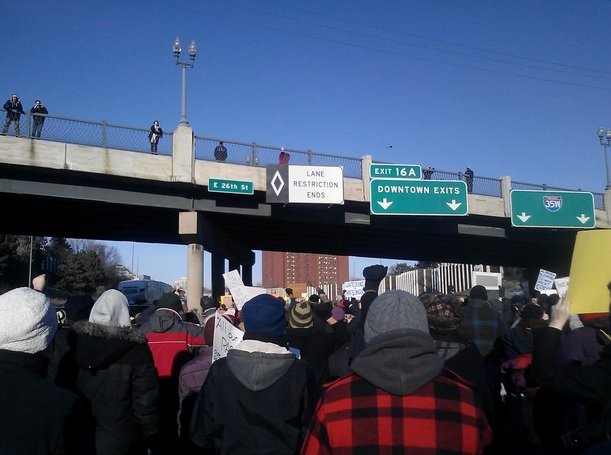
The largest highway in Minneapolis was brought to a standstill on Dec. 4 after protestors marched down a two-mile stretch of I-35W from Uptown to downtown Minneapolis to rally against several recent, high-profile cases of police brutality and racial inequality in the United States.For more than an hour, northbound I-35W was reduced to foot traffic, with cars backed-up for miles behind the barricade of police cars separating protestors from oncoming traffic.Read more TC Daily Planet coverage of police misconduct issues.Related story: Protesters shut down 35W over Pantaleo non-indictment, not fast foodThursday’s “Black Lives Matter” protest was part of a national movement to denounce police brutality, racial inequality and a lack of accountability, sparked most recently by the decision to withhold charging police officers responsible for the deaths of two unarmed black men in New York and Ferguson, Missouri.Around 200 protesters joined the march from Uptown to Minneapolis City Hall.“People are tired of the opposition, people are tired of police not being held accountable and we’re deciding to take a stand,” said Nekima Levy-Pounds while walking down the onramp near 34th Avenue toward the main stretch of I-35W.“We’re ready for change. It’s time for change now,” the University of St. Thomas Law School professor added.Protest organizer Michael McDowell said the group’s goal for Thursday’s protest was to create change and “not just looking to get a bunch of media.”The protesters’ goals include a structural audit of the Minneapolis Police Department, quarterly progress reports to the community on racial diversity issues and police misconduct in the city, and body cameras on officers. The group presented them to Minneapolis Mayor Betsy Hodges in an open letter published in the Star Tribune in September.Hodges, who spoke at a fast food labor rally on 33rd and Nicollet Avenue earlier that day, did not attend the Black Lives Matter protest stating she was unaware of the second protest until she had already arrived. Continue Reading

Protesters shut down 35W over Pantaleo non-indictment, not fast food

If the Storify story doesn’t appear, refresh your browser.Read more TC Daily Planet coverage of police misconduct issues.Related story: [PHOTOS] #BlackLivesMatter protesters halt 35W traffic: “We’re ready for change”[<a href=”//storify.com/tcdailyplanet/blacklivesmatter-protest-in-minneapolis-shuts-dow” target=”_blank”>View the story “Protesters shut down 35W over Pantaleo non-indictment” on Storify</a>]Coverage of issues and events that affect Central Corridor neighborhoods and communities is funded in part by a grant from Central Corridor Funders Collaborative. Continue Reading

Reflections of New Minnesotans: Immigration reform and criminalization in the wake of #Ferguson

This week’s guest is Emilia Gonzales Avalos. The discussion continues to explore President Obama’s recent executive order on immigration. How does the order figure into the criminalization of people of color? What does the Ferguson grand jury’s decision not to indict former officer Darren Wilson for the killing of Mike Brown mean for immigrant communities?

Continue Reading

Hundreds block Lake and Minnehaha, non-indictment protest grows to thousands

If the Storify story doesn’t appear, refresh your browser. [<a href=”//storify.com/tcdailyplanet/hundreds-block-lake-and-minnehaha-protest-lack-of” target=”_blank”>View the story “Hundreds block Lake and Minnehaha, protest lack of indictment” on Storify</a>] Continue Reading

America did not learn from the Kerner Report, history repeats itself in Ferguson

“The police are not merely a ‘spark’ factor. To some Negroes police have come to symbolize white power, white racism and white repression. And the fact is that many police do reflect and express these white attitudes. The atmosphere of hostility and cynicism is reinforced by a widespread belief among Negroes in the existence of police brutality and in a ‘double standard’ of justice and protection—one for Negroes and one for whites.” – Excerpt from the 1968 report, informally known as the Kerner Report, issued by the National Advisory Commission on Civil Disorders (also known as the Kerner Commission).The grand jury’s decision not to indict Officer Darren Wilson for the shooting death of Michael Brown spurred protests, looting, and businesses set on fire. It was a scene reminiscent of the 1960s. Continue Reading