TCE lawsuit inches on, Southeast Como organizes outreach

While Southeast Como neighborhood residents’ concerns about harmful vapors in their homes continue to linger, a lawsuit against General Mills is moving forward.On Friday, the U.S. District Court for the District of Minnesota heard the case against General Mills, in which a few neighborhood residents claim the company put locals’ health and the value of their homes at risk by dumping TCE, also known as trichloroethylene, in the area for 15 years.At Friday’s hearing, General Mills argued that it was not the only company that previously dumped toxins in the neighborhood, noting that the site was an industrial area when the company occupied it in the mid-1900s.The residents’ lawyers said at the hearing they aren’t looking to prove that the company’s dumping was the only source of the TCE pollution, but instead that it was the main source.The three residents are seeking a class-action lawsuit, which would unite all residents who live in the affected area with the same claim. If approved, the lawsuit could include nearly 400 homes, and residents would have the option to opt out.The case’s judge, U.S. District Judge Donovan Frank, will make the decision of classifying the case as a class-action lawsuit, along with choosing which homes are included in the case, based on expert testimonies.The decision will come in 60 days, he said at Friday’s hearing.If the case doesn’t receive class-action certification, residents wishing to sue will need to pursue individual lawsuits. But Michael Hayes, a lawyer representing the residents, said that option would be too expensive for most residents.Additionally, General Mills asked that the judge dismiss two expert testimonies on Friday, citing that their methods of research on the area were “unreliable.”Though the residents will continue with the case, Frank encouraged both sides to settle outside of court.“Let’s find a way to save time and money without the court,” he said at the hearing.Neighborhood leaders hear resident concerns Nearly a year after the state’s department of health and the Minnesota Pollution Control Agency sent letters to Southeast Como residents informing them of the potentially harmful vapor intrusions in their homes, permanent cleanup efforts haven’t started.Ward 2 City Councilman Cam Gordon, who represents parts of the University area and Southeast Como neighborhood, said residents have continuously expressed concerns about their health and the value of their homes and are asking when permanent cleanup will begin.“[Residents] want to see the big solution, where they actually get rid of [TCE vapors] permanently,” he said.Last week, the Southeast Como Improvement Association held its first TCEducate lecture series in hopes of increasing residents’ knowledge about the issues surrounding the TCE contamination.SECIA neighborhood coordinator Ricardo McCurley said the lecture series will cover topics like cleanup tactics and the legal process of class-action lawsuits.He said the discussions aim to help educate residents and make them feel more comfortable about the situation.“Something like this that is affecting your home, your health [and] the health of your loved ones is a very difficult thing to talk about,” McCurley said.SECIA will hold its next lecture late next month.The Minnesota Pollution Control Agency is currently reviewing General Mills’ plan to clean the area and find the source of TCE. The working plan, which includes opportunities for residents’ input, doesn’t include cleanup strategies until late 2015.McCurley said SECIA wants residents to have sufficient information about the work plan so that they can make educated comments on it. Continue Reading

Photo essay captures bizarre phenomenon of college move-in week

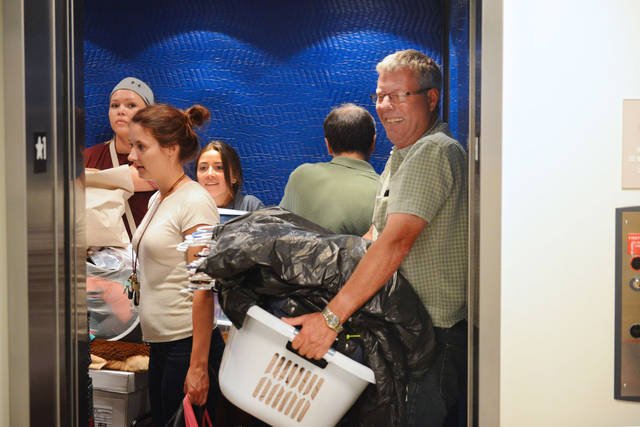
Last week photographer Wendy Schreier witnessed something many college students overlook entirely. Her latest photo essay captures the bizarre phenomenon of move-in week.Originally from Northeast Minneapolis, Schreier moved to the Marcy Holmes neighborhood last April and was astounded by just how much furniture, clothing and general household items littered the streets and curbsides last week as University of Minnesota students moved into their new homes.“It was just a funny transition to see because I grew up in Northeast and lived in Roseville for a really long time,” Shreier said. “And unless you live in this neighborhood you don’t know that this happens, and it’s crazy. The whole neighborhood moved at once.”Schreier said she became frustrated with how much seemed to be going to waste despite seeing several signs for university programs aimed at recycling old furniture and reusable household items. So, she set out on foot and documented the discarded couches, mattresses and televisions in a photo essay she titled Left Behind – A neighborhood moves.But not all those items went to the dump.Last year, Pack & Give Back recycled almost 70,000 pounds of household items from students living on and around campus, said sustainability coordinator for University Services Stacey White. The University of Minnesota program, which works with the city of Minneapolis, collects reusable household items in Marcy Holmes, Southeast Como, Prospect Park and Cedar-Riverside neighborhoods, and then redistributes them for free to students who can use them.The program collects the discarded items before the city collects its trash, White said, but not all the items can be used. Continue Reading

Six reasons why Hmong Americans should vote this year

Historically, the Hmong community has had one of the lowest voter turnouts, but with outreach campaigns there have been considerable advances made in increasing a Hmong voting bloc in Minnesota.While Hmong Americans have faced cultural perceptions that voting makes no difference in the past, the Hmong population in Minnesota has the potential to make a large impact on elections this year, and could greatly benefit the Hmong community, given high voter turnout. So, here are six reasons why Hmong Minnesotans should vote this election year. 1. Minnesota is home to the second largest Hmong population in the U.S.It’s no secret that Minnesota has a large Hmong population.According to 2010 census data, 66,181 Hmong Americans reside in Minnesota, putting the state second behind California for largest Hmong population in the United States. That also means there’s a large potential for the Hmong community in Minnesota to be an important voter bloc for local politicians, but the keyword above is “home.”The Hmong narrative has majorly been about their involvement in the Vietnam War with the C.I.A. and repatriation of refugees to Laos or Vietnam. This common narrative has shaped the structure of Hmong organizations, clans, culture, and leadership in the U.S.But despite the strong connection to Laos and Vietnam, especially from elders and leaders, the Hmong community in Minnesota is here to stay; it is now their home.Recent college graduate Selue Kazoua Yang said she believes that voting is very much a part of the past struggles of the Hmong community. Continue Reading

R and R for all, at home or under the stars

I’m a Minnesotan, I suppose, since I’ve been here longer than anywhere I’ve ever lived before. And as a Minnesotan, I camp. If I were to assign a taxonomic rank to my camping it would be: Princess. Not quite of the species Glamping — oh no, I’m still too much of a Midwesterner for that, but certainly no direct relation to the Roughing Itfamily either. Continue Reading

OPINION | Working on renters’ issues in Lyndale

Working on renters’ issues in Lyndale called to me through the lens of an educator. I live for the challenges and little victories I experience every day at our community school not because I have patience and hope but because continuity is on my side. When a family gains understanding of the ins and outs of our school, when teachers are able to collaborate about the skills and needs of a child as they progress to the next grade level, when we are able to construct a shared foundation of knowledge as educators and students, we have the advantage of successful learning relationships.

Continue Reading

Forum on affordable housing held at Pillsbury

The Minneapolis Commission on Civil Rights hosted a public forum on affordable housing at Pillsbury House on Wednesday, Aug. 27. Nekima Levy-Pounds, professor at the University of St. Thomas School of Law, moderated a panel discussion by specialists in the field from government agencies and nonprofits.

Continue Reading