It’s been four years since owners of the Thunderbird iron mine near Virginia, Minn., told state officials they will have to move Hwy. 53 out of the way to allow expansion of their taconite extraction operation. The state is supposed to relocate the so-called Main Street of the Iron Range by 2017 under terms of a 1960 easement agreement, but the Department of Transportation announced last week that it almost certainly can’t meet the deadline. Continue Reading
Midsummer sunrays beamed on Monday as University of Minnesota researchers let a swarm of buzzing honeybees loose, allowing them to forage nearby fields before returning to the experiment’s site on the St. Paul campus.
Governor Mark Dayton says he is still waiting for more damage assessment of Minnesota’s flooding to decide if he needs to call a special session of the legislature. This [past] week the Federal Emergency Management Agency (FEMA) [was] in Minnesota looking at the damage and many counties still haven’t estimated how much it will cost to repair the damage since they are still fighting the floods.
I can’t help thinking about the easiest, cheapest, action to mitigate climate change: plant trees.We would lose 10,000 inner city trees with the proposed Southwest Light Rail Transit shallow tunnels plan through the Cedar Lake Park and Kenilworth bike trails. In the current but ever-morphing Met Council plan only 480 “significant” trees would be cut—the largest trees.The other almost 90 percent of the vegetation is “not significant.” In Met Council/Hennepin County Commission SWLRT development plans, not all trees or people count equally.The Equity SellMartin Sabo, retired 14-term Minneapolis congressman, called a rare press conference (6/19/14) to comment on the propaganda pitch for the SWLRT. They tried “to sell it for a while that this is something that did great things for the North Side, which I thought was just despicable and, frankly, so blatantly untrue it was laughable. It wasn’t designed for that.” The SWLRT was designed “to provide time-saving one-seat rides to people living in suburbs and exurbs,” former state Senator Julie Sabo wrote in Minn Post (4/2/14). Continue Reading
Gail O’Hare posted at 7:00pm, Jun 28:Over the past two nights, lilies along the side of our house have been savaged by something. What’s going on? This has NEVER happened before, and those treasured lilies have bloomed there for at least 15 years. Neither rabbits nor deer ever touched them. There does seem to be a multitude of aggressive chipmunks (a contradiction in terms? Continue Reading
Minnesota’s Environmental Quality Board (EQB), and it’s Climate Change Subcommittee, held a meeting on June 18, 2014.“The mission of the Environmental Quality Board is to lead Minnesota environmental policy by responding to key issues, providing appropriate review and coordination, serving as a public forum and developing long-range strategies to enhance Minnesota’s environmental quality. The Environmental Quality Board consists of a Governor’s representative (by law the board chair), nine state agency heads and five citizen members. Minnesota Statutes, Chapters 103A, 103B, 116C, 116D and 116G (Statutes and Rules of the EQB)”The EQB is supposed to address environmental issues that are “cross cutting” in the sense of involving the turf of more than one executive agency. Thus, it is made up of the heads of the Pollution Control Agency, Department of Natural Resources, Department of Agriculture, Department of Employment and Economic Development, Department of Health, and so on. It is not clear if the “citizen” members play a substantial role, or if they are tokens. Members and contact info listed here.So, this body is essentially the heads of the executive (controlled by the governor) agencies and represents Governor Mark Dayton’s agendas.Several years ago, the Minnesota Chamber of Commerce and other darkside interests decided to get rid of the EQB, or at least pull its teeth by getting rid of the staff and gutting the environmental review process. (It seems to be a basic darkside objective to prevent the State of Minnesota from being able to address environmental problems effectively.) Governor Dayton went along with this agenda, and the EQB staff was mostly gotten rid of. There was push back, and it seems to have been decided that at least minimal staff are needed. So the EQB again has a staff, but this staff is located in the MPCA and seems to lack the independence it once had. Contact information for the staff.There are also “tech reps” from the agencies whose role is not entirely clear. Contact information for tech reps.For some more background see Comments on the “Minnesota Environment and Energy Report Card,” and “Governor Dayton Moves to Simplify Minnesota’s Environmental Review Process.”Frac Sand miningWhen frac sand (“silica sand”) mining reared an ugly head in Southeastern Minnesota, people went to the EQB for help. They asked in proper form for a “Generic Environmental Impact Statement,” to evaluate the consequences of letting this industry loose in Minnesota. Comments were heard at many meetings from citizens, industry reps, and state agencies. The board members listened politely but nothing happened.Eventually, the citizens were shuffled off to the Legislature, their GEIS petition forgotten. Continue Reading
With the recent downpours across Minnesota, it may feel like water is an unlimited resource in the Land of 10,000 Lakes. However, even record-breaking rainfall will not solve the problem of depleting groundwater, which continues to threaten the state’s water supply. Continue Reading
Recently the city of Minneapolis proposed a ban on styrofoam containers. The logical part of my brain says this is a positive development and our council should be hailed for a move that will be great for the environment and put our city among the leaders in the nation around this issue. The illogical part of my brain, on the other hand… well that part of my brain looks out my front porch every day and sees a city-owned house at 2101 26th Avenue North. It’s tornado-damaged and by outward appearances looks to be a perfectly salvageable house. Or at least it WAS. The shredded blue tarp remnants on the roof indicate exactly how long the city has left this property to deteriorate. At this point, there’s no telling how much water damage has occurred in the year and a half that time, neglect, and a city that hasn’t sufficiently valued its housing stock have let this slide. Continue Reading
ByAnna Claussen, Jim Kleinschmit and Tara Ritter (Think Forward) |
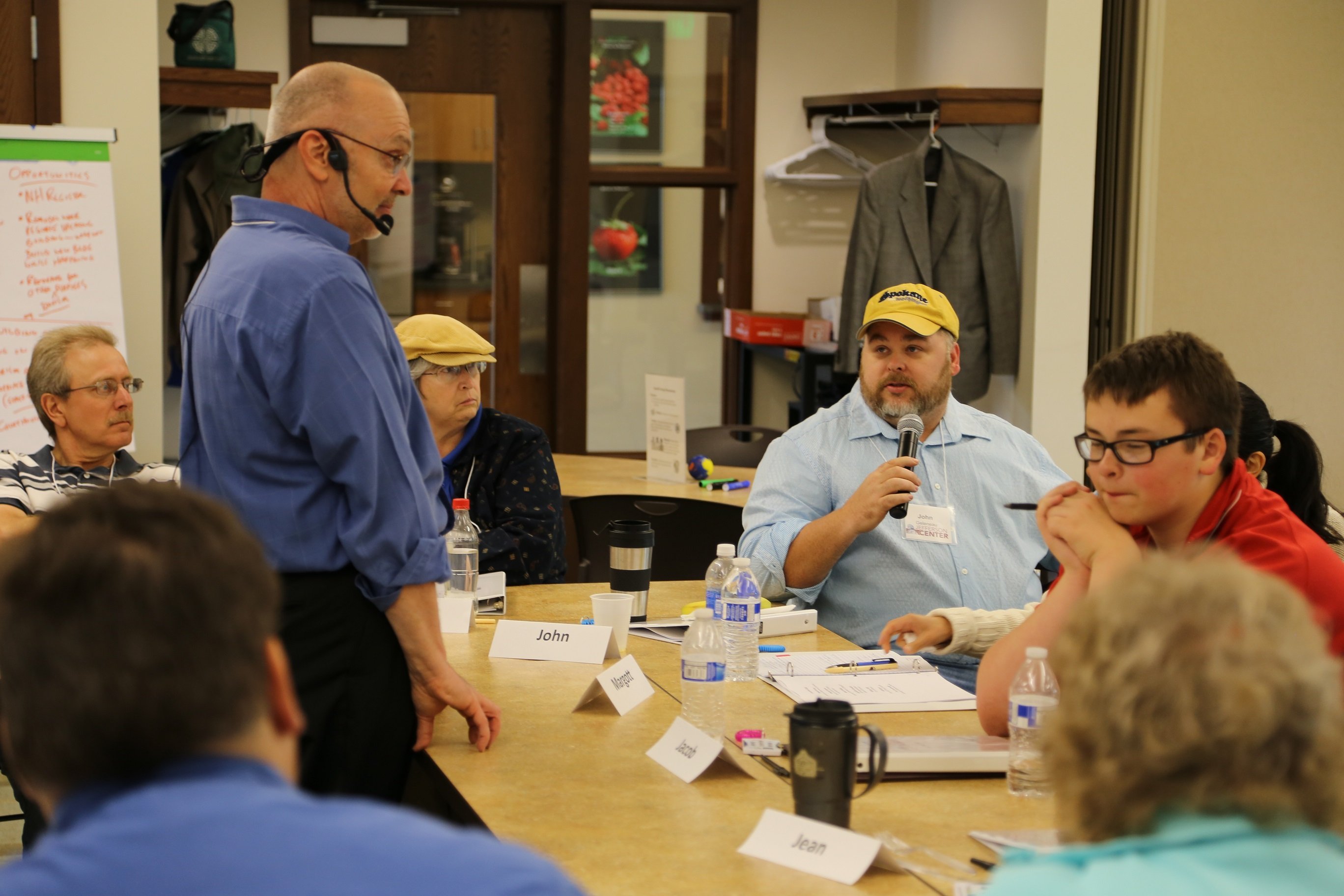
Extreme weather brought on by climate change will affect each community differently. Rural communities face particular challenges, as they often have higher transportation and energy costs, and their economy is frequently linked to agriculture—a sector directly impacted by a changing climate. But as we learned at the first Rural Climate Dialogue held in Morris, Minn., last week there are effective community-level options to respond to these climate concerns—as well as important opportunities for rural communities to be part of the climate solution. Continue Reading