Mostly, when I write these posts for this column I write about art and the local art scene because that’s what I know and it’s where the bulk of my career is centered. But since I also write frequently and my career as a writer has taken off so quickly, I want to focus on writing about writing for a bit.I always wanted to be a writer, just like I always wanted to be an artist. I filled notebook after notebook with dreamlike stories and color crayon pictures and my parents were so proud that they kept every single one of those notebooks—to both my flattery and embarrassment. Like most people I didn’t realize I could do the thing I always wanted to do until I was actually doing it (for free at that time). There is something a little frightening about waking up to your dreams in the moment; it’s like another facet of your identity suddenly blooms and you are surrounded by this new field of beautiful flowers that you didn’t know were there until they finally breached the surface soil. Continue Reading
“Not a lot of folks expected a Lao American poet on stage,” said Lao American award-winning writer, Bryan Thao Worra, who sat on a panel among some sci-fi greats at San Diego Comic-Con this past weekend. Continue Reading
Children and gardening is a match made in heaven. They are both about starting small, growing, depending on others, and finally turning into something very special. Still, not every parent, grandparent or care provider has a green thumb. Nor does everyone have a backyard primed for planting. And some of us have little gardening wisdom to impart. Still, we have stories to share, tons of resources and glorious books to read with kids. Virtual gardening is a great option. Continue Reading
For some bibliophiles Spout Press is known less for a unique title list than for a great annual fundraiser. The eleventh annual Spoutstock extravaganza is set for Thursday, July 25, 2013. Again this year it’s at Mario’s Keller Bar, 2300 University Avenue NE in Northeast Minneapolis. Continue Reading
A couple of weeks ago, I wrote a post for WCCO about the treasure troves at the University of Minnesota libraries. It’s quite amazing what they have on hand over there–huge collections of children’s materials, GLBTQ publications, Minnesota literary artifacts, immigrant history, arts and theater documents, some pretty funny wartime era publications warning young men about the risks of consorting with loose women, all kinds of things you wouldn’t necessarily think of. Continue Reading
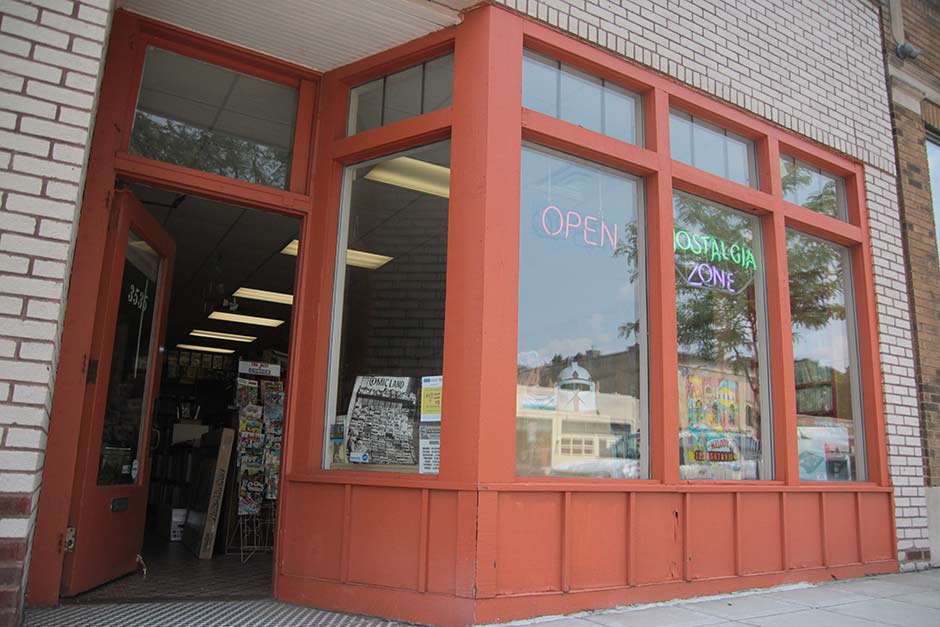
The comic book shop Nostalgia Zone recently moved to its new location on East Lake Street, after a spending a year just around the corner. The new location has given the shop room to expand its offerings and has provided more space for customers to browse. We talked with Dave from Nostalgia Zone to learn more about the shop.MB: You’ve been selling comics in Minneapolis for more than 20 years. Were there other iterations of Nostalgia Zone? Or has it been the same shop for more than 20 years?Dave: We used to be the other half of Comic Book College in Uptown until the two owners split the business in two in the 90′s at which point we took on the name Nostalgia Zone. Continue Reading
Out for a bike ride one sunny day in the year 2000, Penny A. Petersen and her husband, Ted Tucker, discovered a beautiful building that looked strangely out of place to Petersen, an authority on Minneapolis neighborhood and architectural history.She described it as “a handsome, three-story, Richardsonian Romanesque building” more appropriate to an exclusive upscale residential neighborhood than the historically grubby railroad yard, mill district, and saloon-laden Washington Avenue that once surrounded it.Petersen looked up the building permits and discovered that one electrical permit described the building at 212 South 11th Avenue as a sporting house and another called it a house of ill fame—both euphemisms for brothels.That was her first surprise: Minneapolis openly permitted the construction of a bordello in 1890.There was no surprise at learning that, after “a purity crusade,” three madams were sent to Stillwater State Prison. Petersen’s second surprise came when she learned of their pardons—signed by Gov. John S. Pillsbury and endorsed by the Minneapolis mayor, 13 aldermen, 10 of the jurors, “a majority of the officers” of Minneapolis and Hennepin County, and a municipal judge. Pillsbury had initially supported the purity crusade that put them in prison in the first place.Sending prominent madams to prison became a political mistake in Minneapolis, Petersen said in a recent interview.When major players in the sex industry were imprisoned, prostitution spread from the more clearly defined red-light districts and public houses into the public streets of the entire city, she said—and the city lost income from their regular fines and court appearances.Petersen discovered that, although prostitution was illegal, the madams appeared in court once a month, paid their regular fines, and returned to work for the month. Sometimes newspaper coverage even provided addresses of the brothels.In 13 years of research, Petersen found many other brothels and other surprises leading to her book Minneapolis Madams: The Lost History of Prostitution on the Riverfront, published this summer by the University of Minnesota Press.About 300 people attended a book-release party on June 27 at the Mill City Museum, which sold out the about 90 copies the museum store had in stock, said David Stevens, the museum’s public program coordinator.“We will never look at Minneapolis or the riverfront in quite the same way again; for that, we thank you,” Stevens said, introducing Petersen. “It’s a special thrill because this book has been a long time coming.”In a half-hour presentation followed by questions, Petersen showed maps and pictures of the three main red-light districts in Minneapolis from the 1870s through 1910 and discussed a range of issues from morality to politics and business.She avoided current issues about legalization of prostitution, saying that her knowledge ends with the official closing of the brothels around 1910. She also does not know the current very different use of the 212 building. Continue Reading
On June 18, the Minnesota Pro (as opposed to student) chapter of the Society of Professional Journalists held its annual Page One Awards. I was pleased to receive the award for Best Independent News Blog for this very blog, and I thought it would be appropriate to use my first post-ceremony post to recognize some people and organizations that deserve awards for their accomplishments on the new frontier of journalism—arts journalism in particular. They may not all consider themselves journalists, and they may not all consider themselves professionals, but they’re all contributing tremendously to keeping people informed and entertained in jobs (typically online) where there aren’t Pulitzer, or even Page One, categories…yet.These are entirely subjective “awards,” and, yes, many of the recipients are my friends. Call that a conflict of interest if you will, but (a) I’m inventing these awards, so I get to make up the rules, and (b) it’s not like those professional journalists who give each other awards aren’t all friends too. At some point, everybody knows everybody and that’s just the way it is. Continue Reading
“I thought that some day either someone needs to do a film about me, or I have to write about this,” said Phil Vandervaart. He was explaining how his work as a sign painter has been for love, rather than for money.The two are featured in the recently-published book Sign Painters by Faythe Levine and Sam Macon, as well as a film by the same name.If you live in the Twin Cities, you’ve seen the work of Phil and Forrest. Many of the iconic images and shop signs you’ll find around town are their work, including the portrait of F. Scott Fitzgerald on the Fitzgerald Theater.Phil has painted signs for 500 storefronts, done 25 Hollywood movies, and hundreds of rock videos. His hand can be found all over the West Bank. He said, “I did everything on the West Bank for 20 years, and I did 50 signs there and there are only 20 buildings, I used to just do them over and over again.” Forrest has been a sign painter for ten years, and has painted other notable places such as The Blue Door Longfellow, Forage, and the May Day Cafe.E’s Emporium is one of the many signs that Phil has painted for businesses along Minnehaha Avenue. Continue Reading