Obsidian Arts spotlights cutting-edge black visual culture

“I’m white and I have a lot to learn about black art,” I wrote in February, “but I believe I could contribute valuable insight to Obsidian Arts in an advisory capacity.” That was how I found myself sitting in a conference room at Pillsbury House last week, joining a conversation as part of the nonprofit arts organization’s newly-formed advisory panel.The seed of Obsidian Arts, I learned, was planted in 1994 when the artist John Biggers was commissioned to create a mural—with 17 emerging artists—on a North Minneapolis freeway wall. The mural was torn down for construction in 2001, just a few months after the artist’s death, but the community organization that had come together as part of the mural’s creation was going strong, taking the name Obsidian Arts in 2003 with a mission to promote and examine African-American visual culture in all its forms: painting, drawing, photography, sculpture, fashion, design, dance, and more.The organization’s many innovative exhibits and programs have included shows inspired by protest, gumbo (yes, the stew), Afro-futurism, ideas of God, sagging clothes, and the beloved Minneapolis ZIP code of 55407. Obsidian Arts has also become well-known for the national and international tours it organizes to visit landmark sites of African history and black visual culture around the world.Just learning about the busy organization’s work was enough for one night; the panel will reconvene soon to discuss ways that Obsidian Arts can continue to grow and to engage diverse new audiences in the ongoing story of African-American art and visual culture.Also read “Obsidian Arts shares richness of black art with the community” (Susan Budig, 2006), “Black culture is right ‘under our nose'” (Jimmy Stroud, 2008), and “Afro Art Trippin’: Obsidian Arts broadens local perspectives on black culture” (Makula Dunbar, 2012). Continue Reading
What to say (and not to say) on social media when tragedy strikes?

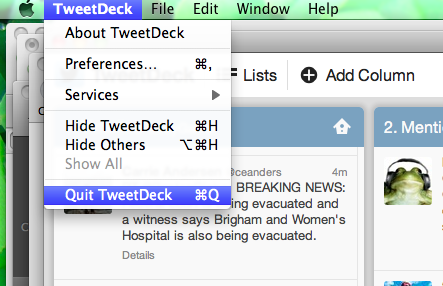
Like many people across the country, I was at work on Monday when the Boston Marathon was hit by a deadly attack. The nation’s attention was riveted on the tragic scene unfolding in Copley Square. There was nothing we could do except watch, hope that the worst was over, and…talk. Talk on Twitter, talk on Facebook, talk on Tumblr.Many expressed condolences. Others voiced anger. Continue Reading

Khary Jackson’s “Any Psalm You Want”: Moving multicultural mantras

I spend a lot of time thinking about how creative writing will adapt to, with, and through the move from print to digital—but with Khary Jackson’s Any Psalm You Want, I was presented with a book of poetry that feels fresh and contemporary despite being printed on old-fashioned paper (that is, on any paper at all).Jackson is a Minneapolis artist whose career illustrates how freely one can move in our supportive literary community among the roles of “poet” and “performer.” The poems in Any Psalm are unmistakably from the pen of a man accustomed to live performance, but they live up to the mandate of the publisher (Texas-based Write Bloody) that their authors craft work that “soars on the page.”Among the many remarkable qualities of this book is the variety of the work—in both substance and texture. Poems range from the prose-like to the completely free, and vault across references ranging from classical mythology to Natalee Holloway. Jackson breaks boundaries and bends rules without being ostentatiously post-modern; the book’s press release cites similarities to Saul Williams, Pablo Neruda, and Langston Hughes, and it’s hard to imagine that the bard of the Harlem Renaissance wouldn’t recognize and appreciate the verve with which Jackson is using his African-American voice in the 21st century.Jackson’s poems are often high-concept, with titles that frame and telegraph their contents (“George Gershwin Writes Janis Joplin After Hearing Her Version of ‘Summertime,'” “From Leadbelly to Kurt Cobain”). Even within such tight frameworks, though, Jackson consistently surprises and engages. Continue Reading

Q: Who IS that? A: Emily “Piefinger” Weiss, flavorful food writer

Name: Emily WeissTwitter: @piefingersWebsite: “It’s sort of boring but my professional portfolio flavors.me/emilyweiss is much more updated than my personal site Piefinger.net, which is essentially defunct. You can find me on Twitter @Piefingers where I always feel like I should be talking about food, but I mostly talk about TV. I’d like to explain that I got the nickname Piefinger when I was working in a boxcar diner in Towanda, Pennsylvania. We baked like four or five fruit pies every morning and this older lady who was a regular—and very shrewd critic—came in, ordered a piece of peach blueberry, and demanded to know who made it. When I timidly admitted it was me, she carefully inspected my hands before declaring that I had ‘the pie finger.’ It was so weird and gross and begrudgingly complimentary that it stuck, but I regret it whenever I have to spell out my email address at a store register.” What’s your job?”I write the food and restaurants column The Dish for City Pages and regularly contribute pieces to The Growler. Continue Reading

“The Dakota Prisoner of War Letters”: Clifford Canku and Michael Simon illuminate a dark corner of Minnesota history

After seeing Django Unchained, I wrote about how slow Minnesota has been to see the plank in its own eye when casting judgment on the cruel history of slavery in the south. Dakota and other Native inhabitants of our land were treated brutally during westward expansion, and that treatment precipitated the deadly Dakota War of 1862—perhaps the darkest moment in our state’s history.That sad history has been steadily coming to light, and the Minnesota Historical Society Press is making an important contribution to that process with the publication of The Dakota Prisoner of War Letters (Dakota Kaskapi Okicize Wowapi), a compilation of 50 letters written from the Iowa prison camp where 270 Dakota men were imprisoned from the war’s end until they were freed by President Andrew Johnson three years later. The letters are presented both in the original Dakota and in English translation.For all its historical importance, this is not a starter volume for those who know little of the war. Its greatest value—both to historians and to the causal reader—is in illuminating the complexity of these men’s lives. Neither blameless victims nor evil criminals, these were men who were caught in a terrible situation and who did what they felt they had to do for their families and communities.The letters contain much evidence of regret, which is natural since almost all of them were written to a missionary—Stephen R. Riggs—who was in contact with U.S. authorities and had some sway in influencing the men’s fates. Continue Reading

Challenge America: National Endowment for the Arts offers a “Fast Track” for arts projects reaching underserved populations

If you’re working for or with a small or mid-sized arts organization and you’ve been looking for funding to make your programming more accessible to underserved audiences, the National Endowment for the Arts (NEA) wants to hear from you.The NEA’s Challenge America Fast Track (CAFT) program offers $10,000 grants to organizations reaching out to underserved populations: “those whose opportunities to experience the arts are limited by geography, ethnicity, economics, or disability.” The fine print: the grant must be matched with the same amount from other sources.Examples of projects that have received CAFT grants in the past include “a multidisciplinary piece incorporating South Indian classical (Carnatic) and Chinese music traditions” (API Cultural Center in Oakland, California); “a multidisciplinary series of performances, film screenings, and workshops” (Sociedad Latina in Roxbury, Massachusetts); and the New York Arab and South Asian Film Festival.More information is available at the NEA’s website; an April 3 webinar is recommended for organizations interested in applying. The application deadline is May 23. Continue Reading

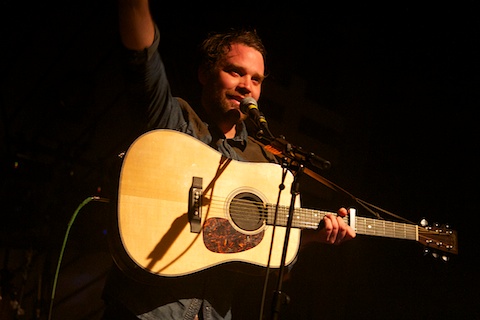
MUSIC REVIEW | Frightened Rabbit loosen up at the Varsity Theater

According to Sasha Frere-Jones, Neil Diamond’s voice has two settings: less Neil and more Neil. Something similar could be said of Scott Hutchison, frontman of the Scottish band Frightened Rabbit—his thickly accented keen can be less poignant or more poignant, but it’s always poignant. The band’s March 21 show at the Varsity Theater, though, had a “Song Sung Blue” quality to it. The songs were sad, but the mood was buoyant.Almost all of the songs Hutchison writes for his band are on the dark side of moody, but the darkest—and by far the best—of Frightened Rabbit’s albums is The Midnight Organ Fight (2008), a classic breakup album that’s thick with double-edged lyrics and arresting textures. The other three are all good—including the newest, 2013’s Pedestrian Verse—but with Organ, Hutchison guaranteed that he’ll be including the same set of wrenching songs on every show of every tour for the rest of his life.The fact that he can still invest so much emotion into his performances of those songs—at the Varsity, a solo “Poke” was especially powerful—is testament to his talent and professionalism. Continue Reading

“Spring Breakers”: A generational landmark, or just the best spring break movie ever?

If Harmony Korine’s Spring Breakers is nothing more than the greatest spring break movie ever made, the film makes its own case for that as a noble achievement. In its virtuoso opening act, Spring Breakers paints the spring break road trip as one of the great American journeys, along with the wagon ride west and the shot into space. Korine’s engrossingly itchy style, with jump cuts layered back-and-forth on each other so that scenes and soundtracks overlap, blends with Skrillex’s score to dramatize the restlessness of four college women (Selena Gomez, Vanessa Hudgens, Ashley Benson, and Korine’s wife Rachel) who fund their spring break escape by robbing a restaurant. The girls’ crime is born of listlessness, and those who have seen the trailer might be surprised to learn that the spring breakers start their crime spree entirely of their own volition—though they later encounter dangerous men, they don’t need those guys for inspiration. An alternate title for the film might be Caril Ann Fugate Unchained. The film’s headlong embrace of the spring break mystique—buff guys holding topless women up for keg stands, then licking coke off the girls’ taut stomachs and taking their time about it, everything sun and smiles and gleeful debauchery—is so unapologetic that it either defies critique or contains its own critique, depending on how you’re inclined to see it. Even before they leave their dorm, the eponymous quartet are in high heat, doing sweaty somersaults in their lingerie and piling their dirt-streaked bodies atop each other in beds covered with cash.Once the spring breakers get to St. Petersburg, Korine deftly shifts gears and lands the girls in a jail cell, sober and hating it. Continue Reading

University of Minnesota Senior Fashion Show GIFs, Part 3

On February 16, graduating seniors in the University of Minnesota’s apparel design program showcased their best work in a fashion show. Here are GIFs of four designers’ work, with descriptions from the show program.Mai Yang: “Her collection consists of classic silhouettes and tailoring techniques paired with beautiful fabrics, such as gold brocades and Chantilly lace in order to embody luxury.”Lucie Jane Mulligan: “For this evening collection, Lucie Jane drew inspiration from the Irish coastline, with its hard structured cliffs and smooth flowing waves.”Rika Van Heerde: “This collection was inspired by images that present themselves at first as romantic, feminine and poetic. However, with a lingering look, the haunting details of the images reveal a darker side to the viewer, these images are simultaneously strikingly beautiful and deeply disquieting.”Khampasith Davison: “Khampasith’s senior line focuses on a bridal party inspired by organic forms and their lavishness of artwork, architecture, and interior decorations of the Baroque period.”See other collections from this show: Part 1 and Part 2.Coverage of issues and events affecting Central Corridor communities is funded in part by a grant from the Central Corridor Funders Collaborative. Continue Reading