Bemidji incorporates Ojibwe into city’s signs and daily life

Tourists visiting Bemidji this summer may pick up a few words of a “foreign” language.That’s because the first city on the Mississippi River way north in Minnesota may be the only town off a reservation trying to incorporate the area’s indigenous Ojibwe language into daily life.All over town Ojibwe language signs are posted right alongside English language labels, and for a just cause. The signage is part of a broader effort to preserve the language spoken by an estimated 60,000 persons across areas of the northern United States and into Canada as well as to bridge cultural divides between whites and American Indians.Words such as “boozhoo,’’ an Ojibwe word for “welcome” and many other Native American terms crop up around town, in an appliance store, the local hospital, the convention center, a local coffee shop, and this spring in the public schools.Community Sketchbook focuses on the economic and social challenges facing communities, especially low-income communities and communities of color, and how people are trying to address them. It is made possible by support from the John S. and James L. Knight Foundation, The Minneapolis Foundation, and some Minneapolis Foundation donor advisors.Community Sketchbook articles may be republished or distributed, in print or online, with credit to MinnPost and the foundations.It’s a symbol of respect and you can do it for practically nothing, but “it speaks volumes,’’ says Bemidji resident Michael Meuers, who with Rachelle Houle kick-started Bemidji’s Ojibwe Language Project, an off shoot of Shared Vision, a Bemidji group working for friendlier relations between American Indians and the majority culture.“There is a pride when Indian people come into downtown and they see their language on these doors,’’ says Meuers.“It’s a welcoming invite when I go into a business in Bemidji and see that sign on the door,’’ agrees Lorna LaGue, who lives on the White Earth reservation 70 miles away, works for the Indian Health Service and sits on a state board working to revitalize Dakota and Ojibwe languages in the state.150 establishmentsStarted a few years ago, the project now involves more than 150 establishments.Recently, the last of about 200 burgundy and white Ojibwe language signs produced in Bemidji High School machine-tool classes went up in public schools throughout the district where American Indian enrollment is 18.5 percent. Bemidji lies in the midst of White Earth, Red Lake and Leech Lake Indian reservations.Now, in schools there are Ojibwe as well as English language signs. The health office is also “aakoziiwigamigoons.”A cafeteria sign says “wisiniiwagmig.’’High school principal Brian Stefanich says the effort shows that school is a safe and welcoming place for all cultures.“I think it will benefit all of our students. Continue Reading
Farming programs help immigrants get out of poverty

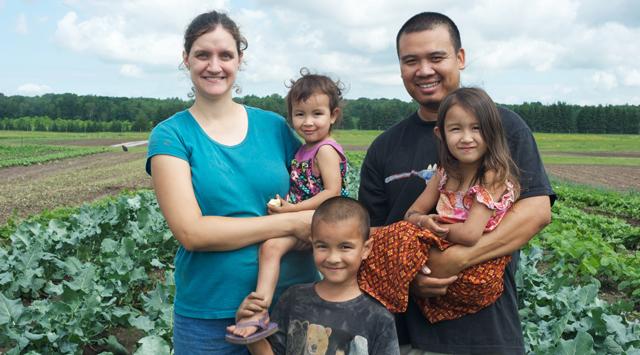
He was born in mountainous Cambodia and dreamed of owning a farm. She was born to the far-reaching plains of the Midwest and flourished in an urban setting of coffee shops and poetry readings.Now, immigrant Proeun and Amy Doeun are married, have four children, a herd of goats and 85 chickens as well as their own 40-acre farm in Rush City. That’s thanks in large part to the Minnesota Food Association, a farm entrepreneurship program she calls “our alma mater.’’That program is but one of many to be highlighted at an upcoming national conference with a title as long and as self-explanatory as many a non-fiction book.Community Sketchbook focuses on the economic and social challenges facing communities, especially low-income communities and communities of color, and how people are trying to address them. It is made possible by support from the John S. and James L. Knight Foundation, The Minneapolis Foundation, and some Minneapolis Foundation donor advisors.Community Sketchbook articleMinnesota 2020s may be republished or distributed, in print or online, with credit to MinnPost and the foundations.“Grassroots and Groundwork: Working Together to Reduce Poverty and Build Prosperity” will showcase both tested and emerging models for helping low-income as well as immigrant and refugee populations to get out and stay out of poverty, planners say. More than 400 people are expected to attend the event sponsored by the Northwest Area Foundation June 6- 8 at Mystic Lake Casino Hotel in Prior Lake.“We believe all communities can prosper,’’ says Kevin Walker, president and CEO of the foundation.Presenters from around the country, including Oregon, Seattle, Philadelphia and the Twin Cities, will talk about programs working to stamp out hunger and poverty. Continue Reading

Big welfare cuts stripped from human services legislation

Advocates for the poor are relieved following passage by Minnesota lawmakers of legislation approving $18 million in funding for the state’s Health and Human Services program.Most significantly, financial support for the Minnesota Family Investment Program (MFIP) to low-income families with children will not be cut.The legislation, approved by the House and Senate Tuesday, arrived on the desk of Mark Dayton late afternoon Wednesday. He is expected to sign it into law.Absent from the Omnibus Health and Human Services Finance bill, which passed with overwhelming bi-partisan support, are measures proposed earlier in the session that would have harmed children, advocates say.Community Sketchbook focuses on the economic and social challenges facing communities, especially low-income communities and communities of color, and how people are trying to address them. It is made possible by support from the John S. and James L. Knight Foundation, The Minneapolis Foundation, and some Minneapolis Foundation donor advisors.Community Sketchbook articleMinnesota 2020s may be republished or distributed, in print or online, with credit to MinnPost and the foundations.Rep. Kurt Daudt, R-Crown, and some other legislators “really worked with us in getting those really nasty cuts taken out,” praised Katherine Wagoner, executive director of Affirmative Options Coalition, a statewide coalition of more than 50 organizations battling poverty.Among earlier House bills were a number of measures dubbed Welfare Reform 2.0 which would have noticeably reduced MFIP benefits.Says Rep. Jim Abeler, R-Anoka, and House sponsor of the omnibus bill’s passage: “We had $18.1 million to spend and spent it very carefully. We agreed with the governor on his priorities.’’ Abeler is chairman of the House Health and Human Services Finance Committee.“It is as good as it could be with the level of spending,’’ says Sen. Tony Lourey, DFL-Kerrick, minority lead on the Senate Health and Human Services Committee.In the Republican-controlled Legislature, the Senate approved the bill 64-0; the House it passed 128-2.That consensus contrasts with earlier contentious committee hearings and bills that in early March prompted a stern memo from Dayton’s Human Services Commissioner, Lucinda Jesson. She denounced Republican legislators for “at least a dozen bills” that would have added new “regulatory burdens” for low-income families.But the new legislation will also bring changes.One measure, authored by Daudt, will allow qualifying low-income residents to use their electronic benefit transfer cards (EBT) cards only in Minnesota and surrounding states to pay for food and shelter. Continue Reading

Givens Black Books program brings African-American literature into homes

When her daughter was 13, way back in the ‘70s, Nothando Zulu wanted her to read the work of a respected black author writing about an African-American girl dealing with the challenges of life.She wanted her to prize black literature for both its beauty and its lessons.So she special-ordered books written by Rosa Guy, one of the founders of The Harlem Writers’ Guild.“To me it’s important for African Americans to read about folks who are succeeding, who are living their lives and may not have had the best of beginnings,’’ explains Zulu.Community Sketchbook focuses on the economic and social challenges facing communities, especially low-income communities and communities of color, and how people are trying to address them. It is made possible by support from the John S. and James L. Knight Foundation, The Minneapolis Foundation, and some Minneapolis Foundation donor advisors.Community Sketchbook articleMinnesota 2020s may be republished or distributed, in print or online, with credit to MinnPost and the foundations.Now 67 and a professional storyteller, Zulu is one of a growing number of people and programs interested in bringing African-American literature into the homes of children and adults throughout the Twin Cities. Their goals: appreciating the art of African-Americans, better understanding the black experience and narrowing the academic achievement gap.Discussion leaderThe north Minneapolis woman is a discussion leader for the second annual Givens Black Books: Community Reading campaign involving 1,000 people meeting in libraries and schools around the Twin Cities to discuss African-American literature. The campaign, sponsored by the Givens Foundation for African American Literature, culminates with a Literary Luncheon April 21 and a keynote talk by Walter Mosley, a best-selling and award-wining black author of 37 books. The event is sponsored in part by the Delta Sigma Theta Sorority, Inc., Minneapolis St. Continue Reading

Trayvon Martin case puts focus on citizen crime-prevention programs

A computer programmer for Wells Fargo, John Bartholomew doesn’t own a gun; in fact he says he’s never even shot one and certainly wouldn’t carry one, even though for going-on 18 years he’s been a Neighborhood Watch captain in White Bear Township.“If there was a problem and I needed to look at night, I’d carry a flashlight and a cell phone with speed dial to the sheriff’s office. You never intervene. You never confront,’’ says Bartholomew, 63.The shooting in late February of a 17-year-old African-American male in Sanford, Fla., by a 28-year-old Hispanic-American male on crime watch in his gated residential community has sparked a national conversation on race, gun laws and, not least, citizen crime-prevention programs.Community Sketchbook focuses on the economic and social challenges facing communities, especially low-income communities and communities of color, and how people are trying to address them. It is made possible by support from the John S. and James L. Knight Foundation, The Minneapolis Foundation, and some Minneapolis Foundation donor advisors.Community Sketchbook articleMinnesota 2020s may be republished or distributed, in print or online, with credit to MinnPost and the foundations.“He was, in my estimation, stepping out of bounds with what he did,’’ says Bartholomew about George Zimmerman, who shot and killed unarmed Trayvon Martin.In crime watch programs here and around the nation, citizen volunteers are trained to be on the lookout for criminal or suspicious activity in the areas around their homes and businesses, and then report it to law enforcement.Proponents say neighborhood watch programs like those around the Twin Cities and the state are about building community as well as helping ensure public safety, a way of enlisting ordinary citizens to be “eyes and ears’’ for law enforcement — not armed enforcers.Others could argue the program encourages trigger-happy citizens to take the law into their own hands.“How it’s been twisted, supposedly you’ve got a vigilante…as a patrolman. That’s not the focus of Neighborhood watch,’’ says Randy Gustafson, public information officer for the Ramsey County Sheriff’s Department, which runs a Neighborhood Watch program for seven East Metro suburban cities, including White Bear Township.‘Community working together’Instead the program – started 40 years ago by the National Sheriffs’ Association, numbering 22,000 watch groups nationally and now introducing its own app —  is “community working together” and “neighbors helping neighbors,” Gustafson says. Continue Reading

Identifying who’s poor in Minnesota and why

Angela Baerthel wants off of public assistance, but that’s proved difficult. She was laid off her job in 2010 and even a small business effort hasn’t worked out. “I don’t want my kids to be on welfare,’’ she says.Renee Barron headed to college when her children started school, but a divorce and the Great Recession, threw her off balance. A recent four-year graduate of the University of Minnesota, she can’t find employment.Community Sketchbook focuses on the economic and social challenges facing communities, especially low-income communities and communities of color, and how people are trying to address them. It is made possible by support from the John S. and James L. Knight Foundation, The Minneapolis Foundation, and some Minneapolis Foundation donor advisors.Community Sketchbook articleMinnesota 2020s may be republished or distributed, in print or online, with credit to MinnPost and the foundations.“We went from middle class to low income, and it’s been a struggle ever since. What I see is a lot of people who don’t have jobs,’’ says Barron.Baerthel and Barron, whom I met Wednesday at Opportunity St. Continue Reading

University of Minnesota’s Chicano Studies department turns 40

You might say Louis Mendoza tells a higher-education story of birth, survival and hope.What he’s describing is the establishment 40 years ago of the Chicano Studies Department at the University of Minnesota, its efforts to hold steady against cold economic winds and its hope for the future.Now more than ever, argues Mendoza, associate vice provost in the university’s Office for Equity and Diversity, Latino people need to be represented in the classrooms as well as academic fields of study at universities and colleges around the country, as they are here in Minnesota.The story is in keeping with an event March 22 marking those four decades with a reception and round-table discussion among academics from California and the University of Minnesota.Community Sketchbook focuses on the economic and social challenges facing communities, especially low-income communities and communities of color, and how people are trying to address them. It is made possible by support from the John S. and James L. Knight Foundation, The Minneapolis Foundation, and some Minneapolis Foundation donor advisors.Community Sketchbook articleMinnesota 2020s may be republished or distributed, in print or online, with credit to MinnPost and the foundations.Their focus is on “Envisioning the Future of Chicano Studies” from 4 p.m. to 6 p.m. today at the fourth floor of the Wilson Library at the University of Minnesota. (It’s free and open to the public.)   Besides the social justice aspects of America educating all its people and closing the academic achievement gaps between whites and students of color, consider the demographics, urges Mendoza, also Chicano Studies department chair.Hispanics — which the U.S. Census uses as a broad category that includes Mexican-Americans — comprise the nation’s largest and fastest growing ethnic or race minority group in the country, more than 48.4 million people. Nationwide, that figures at about 16 percent of the U.S. population. In Minnesota it’s about 5 percent of the population. Continue Reading