Metropolitan Council water plan gets feedback; new plan addresses Twin Cities concerns

A new plan aimed at preserving water resources in the metro area is set to begin next month.A public hearing for the Metropolitan Council’s Water Resources Management Plan, which is part of a larger 30-year plan, called Thrive MSP 2040, was held Tuesday.The council will adopt the new water resources plan in April, and it will address treatment of waste water, as well as prescribe steps to protect surface water and conserve water supply, said Judy Sventek, Metropolitan Council’s manager of the water resources assessment.“It’s all of us working together to get that end goal of sustainable water resources,” Sventek said. “It’s a very high goal, and it’s going to take a while.”The full 2040 plan will also focus on transportation, housing and public parks in the city.The plan will serve as a blueprint to find the best use of infrastructure and resources, and it highlights Twin Cities areas that need funding, Ward 1 Minneapolis City Councilman Kevin Reich said.Patricia Nauman, executive director of Metro Cities, a community group tasked with overseeing the Metropolitan Council, said at the public hearing Tuesday that she is concerned the new water resources plan doesn’t define what the council’s role would be in its implementation.“Making sure that there is clarity around those roles will be very important,” she said at the hearing.City officials recently discussed the plan and prepared comments, which were approved at a Transportation and Public Works Committee meeting last week.Reich said the plan misjudged Minneapolis’ growth in the next 10 years.City researchers think population and development will increase in the Twin Cities in the future, which is contrary to the plan that says growth will occur outside the cities in suburbs, he said.Reich said misallocating resources to the suburbs instead of the city could lead to monetary losses for local governments.Lisa Cerney, director of surface water and sewers for Minneapolis Public Works said the new plan is centered on viewing issues related to the region’s water resources as a whole.This water plan focuses on cooperation between local governments and nonprofit organizations, Sventek said.The full City Council will prepare its feedback to the plan next week and submit it to the Metropolitan Council.[See original article here: http://www.mndaily.com/news/metro-state/2015/03/10/metropolitan-council-water-plan-gets-feedback] Continue Reading

Rights forum attacks racial income gap

Nearly 200 community members gathered at the Neighborhoods Organizing for Change office for a forum on workers’ rights in Minneapolis and throughout the state, including a need for earned sick and safe time, fair scheduling, a living wage, and ending wage theft on Saturday, February 28. “When I was working at McDonald’s, I had a baby and had to go back to work ten days later or lose my job–even though I had a C-section,” said Octancia Adams, an organizer with Neighborhoods Organizing for Change. “They wouldn’t give me paid time off. We need earned sick and safe time for all workers.”Rosa Garcia Perez, a cook at McDonald’s organizing with Centro de Trabajadores Unido en la Lucha (CTUL), spoke about the difficulties of raising a family in a low-wage job. “I have to work the overnight shift by myself–and sometimes I don’t even have time to go to the bathroom or drink water,” said Rosa. “I’m currently four months pregnant, so I need to do both of those things a lot. Continue Reading

Hiawatha/Hi-#55 Stoplight opinions wanted

Over the past few years, the City of Minneapolis and its partners made major investments in a new traffic signal management system and other equipment to slash wait times for vehicles along and crossing Hiawatha Avenue. Drivers who use Hiawatha know firsthand how traffic flow can be disrupted by the Metro Transit’s Blue Line. Nowhere else in the country can you find a fast (45 mph or faster) commuter train running parallel to a highway, forcing frequent stops to side street traffic along the way. Now, the City is reexamining traffic in light of those investments and changes to see if any additional improvements can be made.Traffic signal operation improvements along Hiawatha in 2013 included the addition of 160 in-pavement traffic detectors, the activation of a traffic signal control system that wasn’t available when the light-rail line started service in 2004 and a revision of traffic signal sequences. These investments drastically improved traffic flow with average delays decreased by 32 percent and the number of vehicles waiting two minutes or longer cut in half.This spring the City of Minneapolis will reexamine the systems to see if additional adjustments could further improve traffic signal operation affected by the Blue Line. Continue Reading

Getting to the Green Line: Seen through the Lens of a Wheelchair User

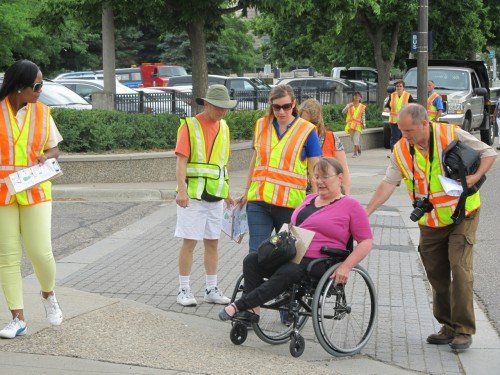
No, I’m not in a wheelchair, but I’ve spent time walking alongside people who are, as we tested out walking and rolling routes to a couple of the Green Line stations. For me, and others who walk every day, the wheelchair user’s view offers a new lens that focuses on the challenges facing people who must navigate the walking terrain on wheels to get to the light rail station, or to any other destination.Two cars block the ramp as Rick Cardenas makes his way to the sidewalk. Photo by Carol Swenson  Now the District Councils Collaborative of Saint Paul and Minneapolis (DCC) is preparing to release a new report on a 2014 Accessibility Survey that shines a light on a number of access issues that were not addressed in planning for the Green Line. Equally important, the report identifies improvements that can still be made, after the fact, for the Green Line. And it highlights issues that need to be considered as additional light rail lines are being planned.A woman confronts the challenge of getting across the light rail tracks with her walker. Continue Reading

Fed Should “Freeze Interest Rates, Involve Citizens” Says Neighborhoods Organizing For Change

Not everybody is benefiting equally from the economic recovery. A new report shows in Minnesota blacks are suffering disproportionally to whites when it comes to employment.Anthony Newby, Executive Director of Neighborhoods Organizing for Change (NOC), delivered a report of about the current economic state of people of color in Minnesota and specifically the current and possible role of the Federal Reserve Bank. The new report from the Center for Popular Democracy says since 2000, wages in Minnesota have declined by 4.5%, current unemployment rate for blacks is 10.9% vs a white rate of 2.8%.This is the link to the full report “Wall Street, Main Street, and Martin Luther King Jr. Boulevard:Why African Americans Must Not Be Left Out of the Federal Reserve’s Full-Employment Mandate”Newby argues that the Fed in addition to controlling interest rates, can control the rate of unemployment. He and Rev. Paul Slack, ISIAH President, ask that interest rates be kept at the current levels and that the Fed work to reduce unemployment.Why there is a Federal ReserveThe nation’s central bank, the Federal Reserve, was created on December 23, 1913, with the enactment of the Federal Reserve Act, largely in response to a series of financial panics. There had been strong resistance to a central bank since the founding of the nation. Continue Reading

Remittances are lifelines between many immigrants and family members’ survival in Somalia and other East African countries

A remittance is an electronic wire transfer of funds from one country to another. For decades, many immigrant residents of the United States kept family members alive through this way of getting money across borders. Fears that terror groups like ISIS or Al-Shabaab would find ways to divert remittances to a terrorist effort prompted the United States to close down all of the channels for funds, not just from here to Somali or Ethiopia, but also to England, Denmark, Sweden and other countries where East Africans’ relatives might be living. Following earlier efforts by Rep. Keith Ellison and other congressional leaders, channels were reestablished, but on February 6th, the only remaining US channel, the Merchant Bank of California closed its money services business clients’ accounts.A rally in late February by Somali/East African leaders, joined by local and statewide officials began exploring additional steps to be taken by Minnesota’s Congressional delegation to again reopen these channels. Ventura Village’s Sadik Warfa, who is also Deputy Director of the Global Somali Diaspora, located in the neighborhood, stated, “ Although it’s a federal issue and must be solved by federal action, we are going to do our part to meet and develop a united front and explore the next steps to be taken to resolve this crisis. Continue Reading

The more cyclists, the better; West Bank nonprofit gives locals a chance at bicycling

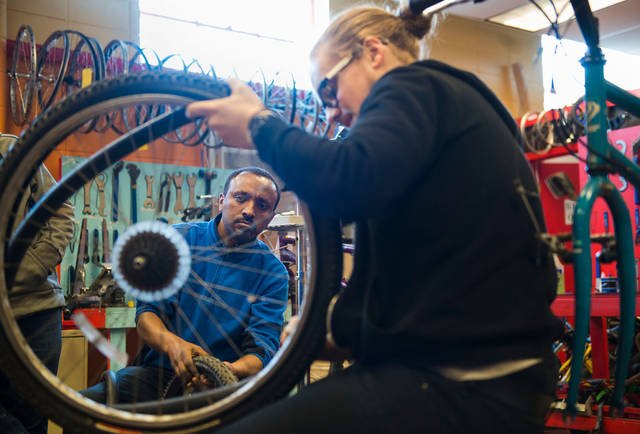
After a month of studying and repairing bicycles, two people will ride away from a small shop near the Cedar-Riverside neighborhood on free bikes.A mile south of the West Bank, the nonprofit SPOKES Bike Walk Connect center began its Earn-A-Bike program on Saturday. The program, now in its third year, consists of a four-week course aimed at getting community members who might not otherwise be able to afford a bike on two wheels.SPOKES attracts participants from around the Twin Cities area, including Cedar-Riverside residents and students from the University of Minnesota and Augsburg College.Program manager Ana Begej said Metro Transit makes substantial bicycle donations to the organization, which hosts multiple projects like the Earn-A-Bike program, bike-riding classes and open shop time.Brad Carlson, a volunteer with the group, punched a hole into a tire tube on Saturday so that Augsburg chemistry senior and fellow volunteer Ben Swanson could teach two students to repair it.Swanson said volunteering at SPOKES has helped him learn and dive into something outside of his area of expertise.“It opened up a world outside of chemistry for me,” he said.Swanson said he had planned to apply for graduate school and search for a job after he graduates this summer but now wants to ride a bike to Maine.Carlson said he tries spending as much time as he can in the little workspace, which is filled with hundreds of broken bikes.Before he was a volunteer, the program gave Carlson a mode of transportation after he overcame homelessness.“I come here, and I have a purpose,” he said.With grease-covered hands, Carlson described the different parts of a bicycle and what function each serves.One of the two students at Saturday’s program was Wondey Geta, 40, who traveled from Columbia Heights, Minn., to begin the monthslong process of earning his first bike in more than a decade, he said.“These guys are doing something that I’m drawn to,” he said, adding that he plans to volunteer with the center after he completes the four volunteer hours the program requires.University of Minnesota graduate Joshua Weichsel sat in the storefront of the Hub Bike Co-op Mini-Store, which rents space in the SPOKES building, to sell the organization’s repaired bikes on Saturday afternoon.Each bike sold at the Hub Mini-Store was repaired just a few feet away by SPOKES volunteers.Funds from the bike sales are split between the two organizations, Weichsel said. SPOKES gets 70 percent of each sale, while 30 percent goes to the Hub.Used bikes make up about 25 percent of SPOKES’ income, program manager Begej said.“Our goal isn’t to make money. It’s to serve an underserved area,” Weichsel said. “The more people on bikes, the better.” Continue Reading

Writing toward hope: How New Yorker Sherrie Fernandez-Williams found her voice in Minnesota

Sherrie Fernandez-Williams was a child of few words. That’s surprising since words are now her stock-in-trade. “I was slow to speak,” says the author of the new memoir, “Soft.” “I used to create an imaginary world in my room, and I actually came to story before I came to words.” Her mother, a single parent raising eight children in a housing project in the Brooklyn section of New York City, was pretty happy that her youngest child was content to play in silence. But Fernandez-Williams is no longer silent. She discovered the joy of words as a third-grader when she was assigned to write a short composition. Continue Reading

Sports Illustrated Swimsuit Issue: Why images and words matter

Hannah Davis is an athlete – a tennis champion and a volleyball player. But that’s not why she is on the cover of Sports Illustrated magazine’s March issue. It’s the annual swimsuit edition, and she’s the model. For years, women and some men have complained about the skimpy bikinis on the cover of the March Sports Illustrated. This year, many people are in an uproar about the scarcity of the bikini – there’s not much there. But it’s also about the pose. Continue Reading

City ordinance could increase fees for owners of third-tier properties

Minneapolis wants compliance from landlords with high-maintenance properties.The Minneapolis City Council is considering an ordinance this spring that could charge landlords with high-maintenance properties more to keep their licenses.Property owners say if the measure passes, they may have to increase tenants’ rent. The goal of the proposed ordinance is to charge rental property owners for the amount of time and resources they use from the city. The city’s Director of Regulatory Services Nuria Rivera-Vandermyde said the proposal would give property owners an economic incentive to take better care of their properties.City Council President Barb Johnson announced the proposal last month, and the council will hold a public hearing on the ordinance in April. Minneapolis rental properties are categorized into three tiers. The first tier comprises the city’s least complained about and inspected properties –the third tier are the most.Third-tier properties account for about 5 percent of Minneapolis properties, but Johnson said they require more of the department’s resources than those in the first or second tier. Continue Reading