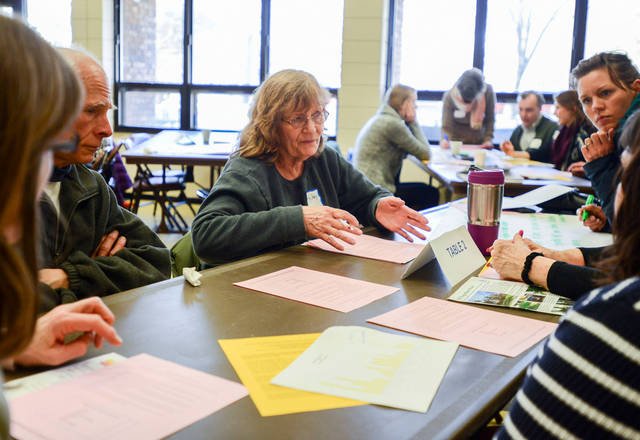
Food, farming, and football connected by research

For most Twin Cities residents it’s easy to overlook the close ties between the University of Minnesota and the state’s small towns. If you take a second to think about it though, the connection is clear. As a land grant university, they’re closely related through agricultural research, football, and a number of other fields of study.

Continue Reading

ART PHOTOS | Elements Fashion Show 2014: U of M students compete with their designs at the Weisman Art Museum

On Wednesday, April 23, 2014, the Weisman Art Museum hosted the Elements Design Competition and Runway Show for University of Minnesota fashion and design students. The theme for the show students had to follow “drew upon the landscapes, materials, textures, and traditions of Siberia, while also responding to the environmental questions the region raises,” as described by Weisman’s website. Students considered topics such as sustainable design, environmental issues, and labor support structures in the garment industry. They also took into consideration how garment production exploits or depletes resources, and what types of work conditions laborers experience while manufacturing garments. Coverage of issues and events that affect Central Corridor neighborhoods and communities is funded in part by a grant from Central Corridor Funders Collaborative. Continue Reading

When the University of Minnesota is involved, councilmember Jacob Frey isn’t shy

Jacob Frey has already made a noticeable mark on Minneapolis and the University of Minnesota, even though he’s been a City Council member for less than four months.Frey, who as Ward 3 City Councilman represents neighborhoods around the University, took office in January and said his new role has strengthened the city’s ties with the institution.This budding relationship is new and beneficial for the two stakeholders, he said. Although the partnership existed before, Frey said his time in office has deepened the connection, and University officials agree.Specifically, Frey said he’s kept a close eye on Dinkytown development, the Central Corridor light rail project, TCF Bank Stadium construction and crime prevention efforts around campus.University community relations director Jan Morlock said she talks with Frey’s office at least once a week about how the city and the University can work together more effectively — by increasing collaboration between University and Minneapolis police departments, for example.“There’s a realization by the city and the University that they’ve got to work together on a problem that affects both of them,” said Humphrey School of Public Affairs political science professor Larry Jacobs.Frey joined University administrators last Friday at a press conference addressing rowdy Dinkytown crowds after the previous night’s NCAA Frozen Four semifinal victory.Frey said he was pleased with how the city and University law enforcement officials responded to the incident, but he noted that hockey fans can celebrate without “beating the hell out of property.”Guiding changeDevelopment in the University area is another issue on Frey’s radar.The Venue, a new Dinkytown apartment complex, is set to open by fall 2014. Frey said he’s watching that project closely.“Dinkytown is hot,” he said. “There are developers who are chomping at the bit to do some impressive projects.”Frey fills one of the city’s three seats on the University District Alliance, a group of city, University and community leaders that meets to discuss the needs of campus-area neighborhoods.University-relevant transportation projects are also surfacing on the city level, including the light rail launching June 14.Once it opens, Frey said, the easy commute will make jobs downtown more attractive to students.The University area will see more changes this summer in preparation for the Minnesota Vikings’ arrival in the fall. The team will play at TCF Bank Stadium, which Frey said will benefit local businesses.Beyond the University, Frey has focused on desegregating neighborhoods by revamping city regulations to allow for a mix of housing stock.He’s also had a hand in financing a downtown park, changing city code to allow ridesharing companies to operate in Minneapolis and securing funds for a new school in the North Loop neighborhood.“I think Jacob brings a spirit of engagement,” Morlock said. Continue Reading

COMMUNITY VOICES | University of Minnesota faculty statement on the visit of Dr. Condoleezza Rice

[Editor’s note: This is the text of a petition/statement by University of Minnesota faculty members objecting to this week’s visit by Dr. Condoleezza Rice.] On April 17, 2014, former U.S. Secretary of State Condoleezza Rice will visit the University of Minnesota to give the Distinguished Carlson Lecture, an annual activity of the Humphrey School of Public Affairs, endowed by a private gift from the Carlson Foundation. This year, the lecture has an additional significance, as it is part of the series of events entitled, “Keeping Faith with a Legacy of Justice,” sponsored by the Hubert H. Humphrey School of Public Affairs in commemoration of the 50th anniversary of the American Civil Rights Act of 1964. As the flagship speaker for the main event of the series, Dr. Rice is explicitly being honored as a civil rights leader and being brought in to speak about civil rights given her purported leadership and expertise on American civil rights.We, the undersigned University of Minnesota faculty, are grateful to the Carlson Family for their past and current generosity. The Carlson family and Foundation have supported a variety of important projects on campus over the years, and have greatly enriched our environment.We have no objection to Dr. Rice visiting our campus. Indeed, as strong advocates of the right to free speech, we welcome anyone – including Dr. Rice – into our community to engage in an open exchange of ideas.In that very spirit of free expression, however, and in our commitment to the principles of truth and the common good that are inscribed above the entrance to Northrop Auditorium where Dr. Rice will speak, we object to the circumstances of this particular visit. Continue Reading