“Minnesota may be cold, but the hearts are warm,” said Priscilla Aung, one of the first Karen refugees to arrive in Minnesota more than ten years ago. Now, approximately 6,500 Karen live in the state, making St. Paul home to the fastest growing Karen population in the United States.The Karen are an ethnic group from the mountainous border region of Burma and Thailand, where they are the second largest ethnic group in each country. The community has suffered a tragic history of being persecuted by the Burmese military junta for over 60 years. Several hundred refugees from other ethnic groups in Burma, including the Kachin, Mon, and Shan, have also made Minnesota their home. Continue Reading
Nicolette, an Iraqi rock band, and Amwaaj, a traditional Arabic music ensemble, were among the new performers to grace the stage at this year’s Twin Cities World Refugee Day, a locally organized festival that celebrates the diverse array of cultures represented by over 100,000 refugees living in Minnesota. This year was also the first time that the event planning committee and volunteers collected stories from the attendees for the emcee to read aloud throughout the day.“We’ve just been asking people what their experience as a refugee has been, and what it has been like coming to Minnesota. It’s been interesting to see the commonalities and the variety of experiences,” planning committee member, Alexis Walstad, said. Walstad estimates around 800 to a 1,000 people came out for the festivities at Minnehaha Park on June 16. Besides the dancers, musicians, and spoken word artists on stage, 46 vendors from community health groups, resettlement agencies, and social service organizations set up tables to educate people about the resources available for them in the area. “Refugees are celebrating our lives. Continue Reading
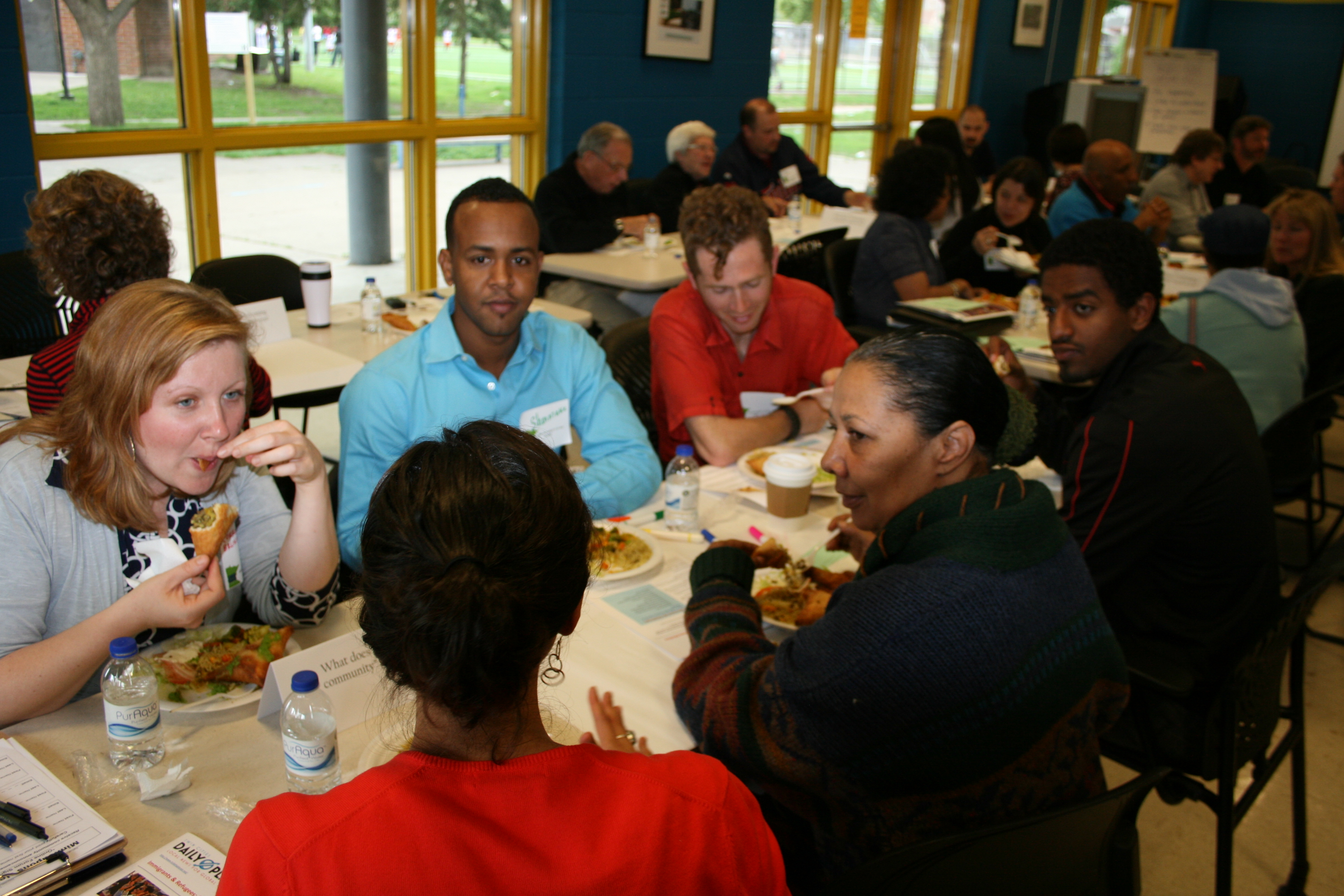
The community room at the Brian Coyle Center was full and the conversations animated. Aromas from a delicious array of dishes from nearby Sahara Restaurant wafted through the air.
How welcoming is Minnesota to newcomers? That’s the question being posed by The Advocates for Human Rights. This year and next, the Minneapolis-based nonprofit is monitoring, documenting, and assessing the experiences of immigrants and other key communities against international human rights standards. It’s part of a project called the One Voice Minnesota Network, an effort to build more welcoming communities statewide by providing tools and resources and promoting collaborations.
ST. PAUL [December, 2011]- All farmers juggle risk – weather extremes, rising production costs and the uncertainty of market prices all affect the bottom line. Hmong farmers have additional hurdles to enter the marketplace; instability from renting rather than owning land, and lack of capital and credit to secure financial resources for farm improvements or expansion.Free Speech ZoneThe Free Speech Zone offers a space for contributions from readers, without editing by the TC Daily Planet. This is an open forum for articles that otherwise might not find a place for publication, including news articles, opinion columns, announcements and even a few press releases.As Staff Attorney and Hmong Outreach Coordinator for the Farmers’ Legal Action Group (FLAG), a non-profit law center that provides legal services and support to farm families, Hli Xyooj has advocated for Hmong farmers since 2006. The transition from traditional farming practices to operating the farm as a commercial business is a difficult one for many of the farmers, says Xyooj. “The farmers came from subsistence farming which was their way of life – not a commercial business. Every day they knew what they had to do and went to the fields.” Hmong farmers have a familiar presence in farmers’ markets throughout Minnesota, but public markets are often flooded with the same products, thus reducing sales for any one farmer. Sales are further impacted by fluctuating demand and attendance at the market. So many farmers are produce rich, but cash poor – and without storage facilities, profits perish with the produce. When FLAG learned about the farmers’ barriers to success, they partnered with The Minnesota Project in 2011 to offer farmers assistance through training and connections to new markets. liHH FarFfFarmers that sought assistance varied widely in their communication and business skills. English as a second language, complex agriculture regulations, and selling their produce pose on-going challenges. But some Hmong farmers like Robert and Nancy Lee persisted and pioneered their way to new markets.The Lees live in Albertville, MN and rent farmland in neighboring St. Continue Reading
Recently retired Eden Prairie Schools Superintendent Melissa Krull was honored by scores of parents and professional colleagues on Saturday October 15th for her support of educational equity and integration. A small band of vocal parents — The Braxton Bullies — have opposed the EP School district’s re-alignment of grade school districts and other reforms. Some of them have been caustic, mean and anonymous in local newspapers; facebook presentations like “The Eden Prairie School Board Accountability” and bloggers like “The Activist Next Door.”But Dr. Krull remains highly admired by a large majority of residents including Eden Prairie’s large Somali Community.Free Speech ZoneThe Free Speech Zone offers a space for contributions from readers, without editing by the TC Daily Planet. This is an open forum for articles that otherwise might not find a place for publication, including news articles, opinion columns, announcements and even a few press releases. Continue Reading
Last week, the new census numbers were released and confirmed what most of us already knew: Minnesota’s population became more diverse between 2000 and 2010. Minorities now make up about one in every seven residents, up from about one in ten a decade ago. Nowhere is this diversity more evident than in the public schools, over a quarter of which now serve a majority of minority students. As our communities diversify, the achievement gap between white and minority students remains a critical shortcoming of our education system. Yet there is another gap that has not received the attention it deserves: the global competency gap. Continue Reading
I am saddened to hear of cities such as Lino Lakes enacting “English only” laws and I sincerely hope that other cities in Minnesota will not follow.As citizens of the twenty-first century and of the great state ofMinnesota, it is in our best interest that non-English speaking residents, citizens and visitors in our communities are able to interact with the local government. Local governments should foster that interaction.I call on my mayor R.T. Rybak to prevent similar legislation from ever happening in Minneapolis, governor Tim Pawlenty to prevent this from happening on a state level and our senators Amy Klobuchar and Al Franken to prevent similar laws from being enacted on a federal level.I am a proud Minnesotan and I hope that we can all come together to make sure that Minnesota supports all of the populations who help make our state a great place. Free Speech ZoneThe Free Speech Zone offers a space for contributions from readers, without editing by the TC Daily Planet. This is an open forum for articles that otherwise might not find a place for publication, including news articles, opinion columns, announcements and even a few press releases. Continue Reading
Jeff Reinert while not exactly a household name, should be. After all he’s got experience, vision, integrity and common sense. How do i know? His website says so. And those qualities were all but obvious the other night when Jeff himself saliently led the charge of the light brigade for Lino Lakes to BECOME THE FIRST, THAT’S RIGHT THE VERY FIRST Minnesota city to adopt English as it’s official language. But really going forward, we have a lot be thankful for.Free Speech ZoneThe Free Speech Zone offers a space for contributions from readers, without editing by the TC Daily Planet. Continue Reading
We’re hearing more about immigration reform again, always a heated topic, but one voice with big stakes in this is often excluded from the discussions: Laotian refugees.
Many of us arrived in the US as refugees from the war in our homeland 35 years ago.