State Representative Linda Slocum and Tim O’Brien discuss education, constitutional amendments and other issues on the current edition of Democratic Visions. DFLer Slocum represents sections of Richfield and Bloomington. Democratic Visions is produced for the entire metro region through DFL Senate District 48, Eden Prairie, Minnetonka.
With less than two weeks left, excitement is building for this year’s Northeast Middle School (NEMS) musical. The reason maybe that last year’s Alice in Wonderland, Jr.
Once again researchers at the Institute on Race and Poverty at the University of Minnesota have crunched data showing that charter schools as a whole underperform comparable traditional public schools and are more segregated.Community Sketchbook focuses on the economic and social challenges facing communities, especially low-income communities and communities of color, and how people are trying to address them. It is made possible by support from the John S. and James L. Knight Foundation, The Minneapolis Foundation, and some Minneapolis Foundation donor advisors.Community Sketchbook articles may be republished or distributed, in print or online, with credit to MinnPost and the foundations.That means, according to the latest “Failed Promises” study by Myron Orfield and Tom Luce, that Twin Cities charter schools aren’t delivering promised academic gains in spite of the fact that a high proportion of charters are essentially single-race schools.Grouping students by race or ethnic background has been touted by some as a sort of gold ring, the attainment of which would lead to higher academic performance as well as to closing the academic-achievement gap between races.(Source: Minnesota Department of Education)But the study released today by the Minneapolis institute finds that when controlling for factors such as poverty, students in charter elementary schools score 7.5 percentage points lower for math and 4.4 percentage points lower for reading than students in schools run by public school districtsA high proportion of the charters are also “essentially single-race schools,’’ the report says. For instance, in 2010 to 2011, 89 percent of black charter students attended segregated schools, up from 2000 to 2001. “Hispanic, Asian and Native American students were also roughly twice as likely to be in segregated settings than their traditional school counterparts in 2010-2011,’’ the study reports.Segregation in Charter Schools(Click here for interactive map)“The high rates of racial and economic segregation matter because research shows that students do worse in segregated school environments than in integrated settings,’’ said Luce, research director at the institute. The report analyzes Minnesota Department of Education data.The percentage of schools that are integrated is increasing among traditional schools operated by school districts, according to this study.The study shows “that charter schools are not closing the achievement gap; they may be making it wider by increasing segregation,” stresses Orfield, director at the institute and a longtime proponent of integrated schools.The full study, which also addresses management problems of charter schools, is here.Orfield’s last study on charter schools came out in 2008 with similar results.‘Truth is more complex’ “Which is better, district or charter, is like saying which gets better gas mileage, the rented car or the leased car,’’ responded Joe Nathan, director of the Center for School Change at Macalester College in St. Continue Reading
Is collaboration good or bad? While teacher contract negotiations between the Minneapolis Public Schools district (MPS) and the Minneapolis Federation of Teachers (MFT) have been dragging on forever, teachers and administrators are pretty darn respectful of each other, and agree on a number of issues. That doesn’t sit well with some critics, who think there’s too much collaboration and not enough conflict.Lynnell Mickelsen of Put Kids First criticizes what she characterizes as a close relationship between the two sides, saying that they’ve completely left out the “third voice” of people who want major changes, including changes in the current seniority system. “It takes collaboration to a whole other level. It’s not good for democracy,” she said.The problem, Mickelsen, is that, “MFT controls the majority of the board.” As evidence, she points to the action of some new board members who signed a letter last year on MFT letterhead. “Look at what this board did. Continue Reading
Some surprising, as well as some continuing themes emerged through contacting 35 Minnesota district and charter school leaders from urban, suburban and rural communities. They were asked what was their single most important recommendation to/request from the 2012 state legislature.Free Speech ZoneThe Free Speech Zone offers a space for contributions from readers, without editing by the TC Daily Planet. This is an open forum for articles that otherwise might not find a place for publication, including news articles, opinion columns, announcements and even a few press releases. The opinions expressed in the Free Speech Zone and Neighborhood Notes, as well as the opinions of bloggers, are their own and not necessarily the opinion of the TC Daily Planet.Five major themes emerged. 1. Despite years of adjustments, some strange things can still be found in Minnesota’s funding formula. Elk River Superintendent Mark Bezek pointed out that although substantial numbers of students in that district live in Anoka or Hennepin counties, the district loses several hundred thousand dollars a year because as of 1999, its administrative office was not located in the seven county metropolitan area. A Minnesota Senate education committee administrator confirmed this.2. Continue Reading
As we move toward 2012, here’s some good news about closing urban achievement gaps. Creative, hard working educators in Minneapolis and Cincinnati, in partnership with Cargill and the Bill and Melinda Gates Foundation, have produced major academic gains. Both district and charter public schools are involved. Here’s what happened.
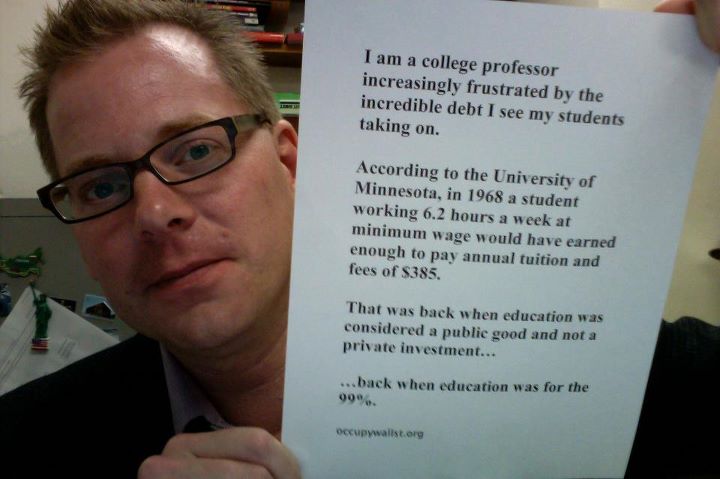
When David Davies, a professor of East Asian studies and anthropology at Hamline University in Saint Paul, typed three short sentences, printed them out and took a picture of him holding the sheet,
Recently I have been thinking about what it might be like if we all decided “not to know”; if we entered situations, discussions, negotiations, classrooms, not as experts but as investigators. I say this because after years of work in middle and high school teaching, in training teachers and holding discussions about race and equity, I have observed that those who seem to get the most out Continue Reading
About one-third of the state’s public school districts will be seeking voter support for school levy questions on the Tuesday, November 8 ballot.School advocates say the state legislature’s failure to adequately fund K-12 education gives local school districts little choice but to turn to levies tapping local property taxpayers’ wallets.And, because some levies pass and some levies fail, that means the needs of students in some districts will be met, while student needs in other districts will go wanting.“These are basic, essential levies that are needed to run the schools,” said Paul Mueller, vice president of Education Minnesota, the statewide teachers union. Mueller is a high school teacher in the Brooklyn Center school district.He also serves on the executive board of the Minneapolis Regional Labor Federation, which will be targeting selected school levies to help win voter approval.Mueller noted that his Brooklyn Center school district has voted down eight levies in recent years.He doesn’t fault voters during these challenging economic times, however.. The blame, he said, lies with the legislature: “The funding stream from the state of Minnesota is absolutely broken.”According to a recent Minnesota 2020 survey of Minnesota school district superintendents, 93 percent of those surveyed believe the current system is not working.The Minnesota State Constitution, Article 13, Section 1 reads, “…it is the duty of the legislature to establish a general and uniform system of public schools” and “the legislature shall make such provisions by taxation or otherwise as will secure a thorough and efficient system of public schools throughout the state.”State aid to schools, while increasing by some measures, has not kept up with inflation. “We have 14 percent less to spend on our students than we did in 2003,” Mueller said, citing recent studies.Some districts suffer from outdated textbooks, overcrowded classrooms, technology that is behind the times. Districts that have made up the gap in state funding with local levies are faring better.“Your personal zip code should not be determining the opportunities your child has when they go in those school room doors,” Mueller said. Continue Reading


.jpg)