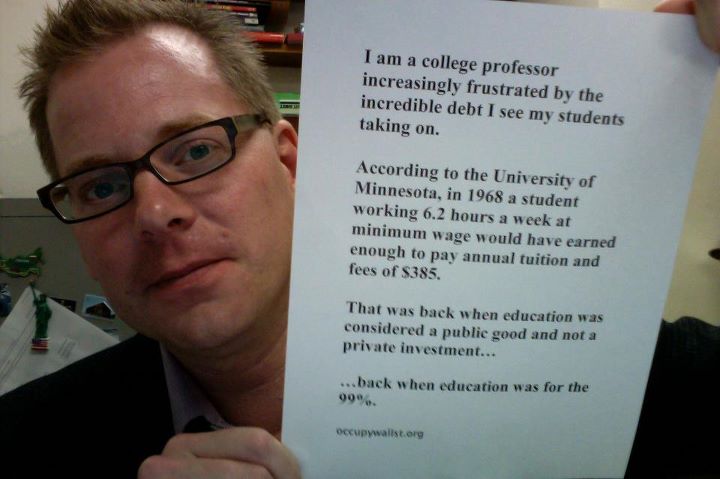
When David Davies, a professor of East Asian studies and anthropology at Hamline University in Saint Paul, typed three short sentences, printed them out and took a picture of him holding the sheet, he did not expect that he would become an internet sensation virtually overnight. He posted the image on Facebook and was stunned by how quickly and widely his message spread. Davies had definitely struck a nerve, as so many people were able to relate to his views and supported them by sharing the image with their friends.
“It was kind of crazy when I posted it,” Davies says. In the first two days, ten to fifteen people posted his photo to their profile, and on the third day the whole thing took off and went viral. “For one evening, every second somebody was sharing it or liking it,” Davies said.
“Every year I teach in my classes about the power of debt to force people into doing things,” Davies said. “If you borrow money, then the people that you borrow it from can have some influence over what you do in order to pay it back.” Having a large debt will, in most cases, lead to the student choosing a job that will pay off the most money, Davies says. This narrows down people’s post-college careers and ultimately their freedom. “The people who borrow the most have the least choice,” Davies said. “It is an inherent inequality in the system.”
“According to the University of Minnesota, in 1968 a student working 6.2 hours a week at minimum wage would have earned enough to pay annual tuition and fees of $385,” the print-out on Davies’ photo reads. Even though only about 10 percent of the U.S. population was going to college back then, the dominant idea was that education was a “public good.” In the past 30 to 40 years, however, the view has shifted to seeing it as a private investment. “I thought: Imagine if my students today could work 6.2 hours a week, pay for their tuition and not borrow that much money,” Davies said, adding that they would have “much more freedom to innovate, freedom to create new ideas, to think about interesting things, to be entrepreneurial. … ”
“The University of Minnesota now is basically for all practical reasons a private university. The percentage of public funding is below 50 percent. Our public university is … a private university … it is funded more privately than it is publicly”
Davies mentioned that on different sites reporting the story, people left comments along the lines of ‘your salary is the problem’. While reading through the comments, he realized that there were “some very angry people out there.” Some of them even began attacking him personally. “They have this idea that somehow professors make a lot of money, and that the problem is me … nothing could be further from the truth.” He said that there are many other reasons why education costs so much these days, such as technology, liability insurance or even a school’s athletics or entertainment programs. He believes that this is also in part due to students demanding “more amenities.”
“In my opinion, the expectations of higher education now are kind of distorted,” Davies said. He stated that the costs of education in itself are fairly low, and that all one would need are books, a classroom, light and heat in Minnesota. “At its base, education is actually very cheap … but when you add on administrative structure, student activities, sports, etc., you get layers and layers [of costs].”
Davies sees the reason for his message going viral as “very simple.” He imagines that it was mostly students and people who said “that resonates with me” who shared the image.
As of Tuesday, December 6, almost 2,600 people have shared the image and nearly 4,700 have clicked on the like-button.
Here is the link to Davies’s Facebook post.
Comment