COMMUNITY VOICES | Immigration reform: Shared humanity matters more than differences

Although I have not suffered the agony of navigating my way through this country’s broken immigration system, I have experienced the trauma that it causes by keeping people from the ones they love. It is something I think about as I follow the Fast for Families happening in Washington, D.C., and events across the country in support of commonsense immigration reform.I am an African-American. Born outside of Minneapolis to immigrant parents from Eritrea, I was well aware of the challenges of the immigrant experience, but it wasn’t until I told my parents about my work on SEIU’s immigration reform campaign that they related to me the details of my mother’s experience living as an undocumented worker for the first few years of my life.My mother entered the United States after fleeing Saudi Arabia; she was granted a visa to visit my father, who had arrived the year before as a refugee after working at a camp in Sudan. My parents were engaged in Eritrea but separated by the effects of war.By the time my sister and I were born, our mother’s visa had expired and she was facing deportation. In our culture, it’s nearly sinful to separate young children from their mother, so my parents were struggling with this choice: to keep their children from their mother and raise them in the country they sacrificed so much to reach, or to raise them away from their father in their war-torn homeland.My father–the very stubborn, but also incredibly smart man that he is–insisted that our family would not be separated. Continue Reading

Juxtaposition Arts, One Minneapolis One Read feature work of iconic black artist Gordon Parks and Brooklyn photographer Jamel Shabazz

Renowned international photographer Jamel Shabazz hosted an intergenerational, street photography workshop in the Twin Cities last week as part of the third annual community conversation for One Minneapolis One Read. This year, the citywide read teamed up with Juxtaposition Arts to host a residency with the Brooklyn photographer, lecturer and teacher of the visual arts.Every year, the community read program selects a book and hosts a community conversation to encourage citywide reading in Minneapolis. The book this year is A Choice of Weapons, written by the late Gordon Parks, an African American photographer, artist, filmmaker and writer. Parks is most known for his photography for Life magazine, and as director of the iconic 1970s film, Shaft.The crowd was fortunate to have the opportunity to listen to Robin P. Hickman, the great-niece of Parks, who spoke about his legacy and beyond, as well as his experience moving to St. Paul, Minnesota in 1928 at the age of 16, after his mother passed away.According to the One Minneapolis One Read website,  Parks’ autobiography tells how he “managed to escape the poverty and bigotry around him, and launch his distinguished career, by choosing the weapons given him by ‘a mother who placed love, dignity, and hard work over hatred’.”Hickman’s presentation was empowering, and it is clear Parks was an inspirational man. Continue Reading

COMMUNITY VOICES | East Side of St. Paul is ‘out of sight, out of mind’ until a serious incident happens

In recent weeks, a devastating incident occurred on the Eastside of St. Paul where several teens allegedly beat a passerby until he was unconscious. This is a circumstance that no person should have to endure. One of the notable pieces of information that has surfaced is the fact that the passerby was white and the teens were African American. Although some within the broader community argue that the attack was based on race, the reality is that in light of the circumstances under which the attack occurred, the victim could arguably have been any individual who was within the vicinity of the young people in question. Actually, a similar severe beating of an innocent Black man, Edwin Daniel, by five young Somali men occurred on the Eastside just a few years prior to this most recent incident.The factors that contribute to these types of horrific episodes, including shootings by young people against other young people, may revolve around underlying issues at the intersection of race and poverty that are pervasive on the East Side of St. Continue Reading

COMMUNITY VOICES | The Brian Coyle Center Brotherhood Program: empowering young Somali men to lead and inspire

On the 19th of August 2013, 11 young men who grew up in the Cedar-Riverside neighborhood of the West Bank in Minneapolis, and who completed high school this year, will have an opportunity to travel to Atlanta, Georgia. This opportunity was realized through the Brotherhood Program at the Cedar Riverside-based Brian Coyle Community Center. The Brotherhood Program emphasizes the need to be inspired, to educate and to be empowered to do better for oneself and community.I am an out-of-school educator and advocate with the Brian Coyle Community Center of Pillsbury United Communities (PUC). I have several roles within the community center: I supervise teens who are employed with our agency during the summer, help tutor in the fall, mentor kids aged 6-18 in our youth program, and I am one of the leads for the Brotherhood Program. In the Cedar-Riverside community, which is home to a large base of African immigrants — mostly Somalis — young men and women are constantly challenged by exaggerated tales of their community being drug infested and violent. Continue Reading

COMMUNITY VOICES | Zimmerman acquittal demonstrates that we can’t keep silent

The “not guilty” verdict in the George Zimmerman trial was a striking blow to our hearts, but not something new. For centuries, African-Americans have received the clear message that our existence is something easily disposable and our dignity rarely valued. This case sends a shock wave to those who truly believed racism is no more; on the contrary, it is alive and well. Society may not call it by name, but they signal it through their actions. Trayvon Martin was unjustly profiled based on his skin color and outfit choice, and it lead to his death. Continue Reading

“Little Oromia” celebrates all week long in Minneapolis

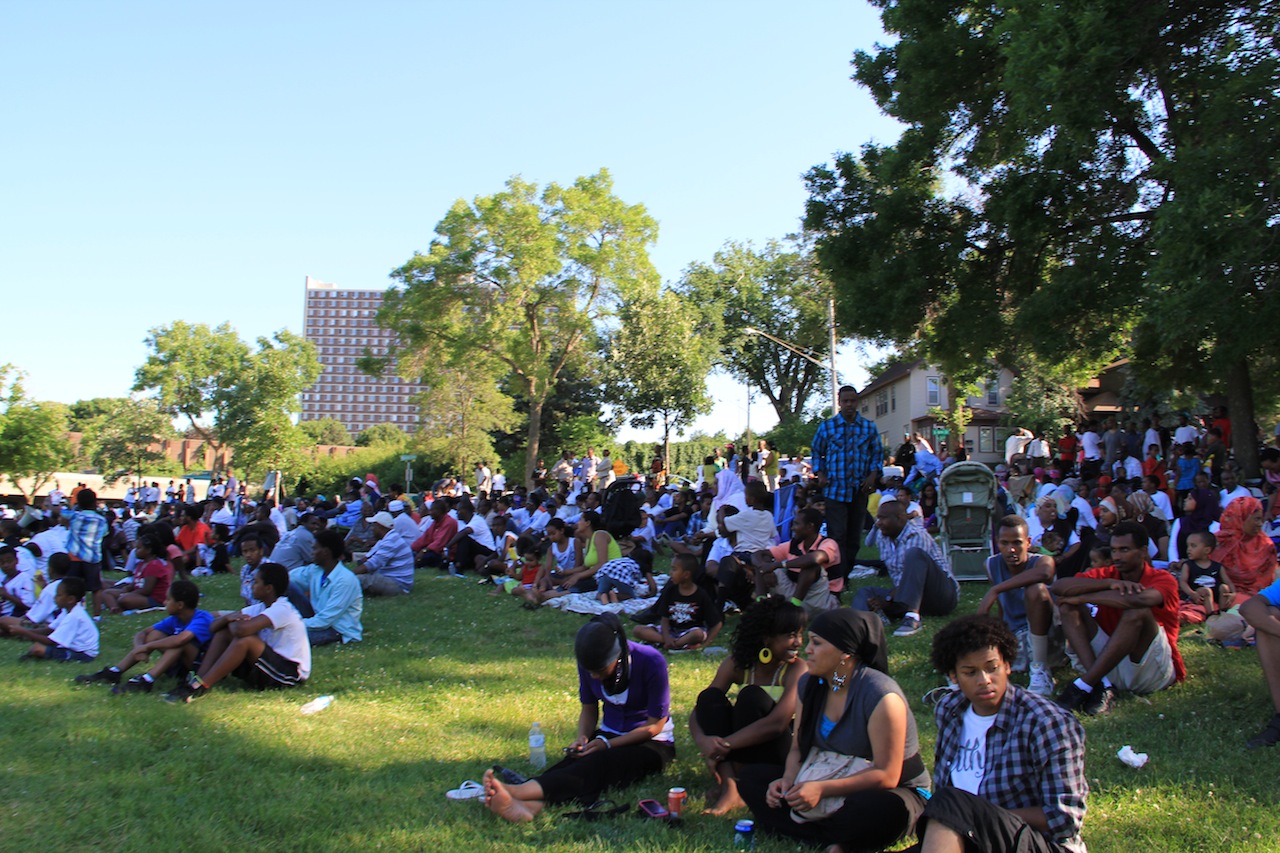
Every year on the Fourth of July, Minneapolis’ Riverside Park turns into party central for the Twin Cities Oromo community. They’ve gathered there for about 18 years, said Hassen Hussein, executive director of the Oromo Community of Minnesota. The St. Paul-based nonprofit provides social services to ease the transition of Oromo refugees from the Horn of Africa, and also works to educate the Twin Cities about the Oromo culture.Because you can’t reserve space at Riverside Park, Hussein and a group of volunteers start setting up tents, grills, and sports equipment at 4 a.m. The party goes on till 10 p.m. “How many people come depends on the weather,” said Hussein. He estimates that there are more than 30,000 Oromo in the Twin Cities, which some say makes it the largest Oromo population outside of Africa, earning the nickname “Little Oromia.” Continue Reading

Ubuntu “straight talk” for Africans and African Americans aims to tackle Twin Cities racism

The energy and sense of community were palpable during an open, “straight talk” session at South High School for African and African American community members last week. Titled “Ubuntu! Storytelling Across the Boundaries of Nation, Culture and Ethnicity,” the panel discussion and community dialog covered much ground.Some of the topics discussed include: racism, migration histories, complex identities, in-group racial tensions, and the struggles of the black diaspora in the Twin Cities and beyond. The purpose of the discussion was to create a space for people of African descent to find creative ways to work together across ethnic, cultural, and national difference. The audience enjoyed food catered from local African restaurants while the panelists tackled complex subjects through storytelling. The diverse panelists represented different generations: Flamingo restaurant owner and women’s advocate Shegitu Kebede, Malanna Fields, artist and policy advocate Andrea Jenkins, local journalist and editor Lolla Mohammed Nur and community elder Dr. Mahmoud El-Kati. The panel and audience were made up of diverse members of the African, African American, and other communities.The Straight Talk session was organized by Zenzele Isoke, University of Minnesota professor of Gender, Women and Sexuality Studies (GWSS), and the Black Feminist Praxis Project Team. Continue Reading

OUR STORIES | Barbara Pierre-Louis: “Ubuntu” and storytelling preserve untold histories

Barbara Pierre-Louis attended the “Ubuntu! Storytelling Across the Boundaries of Nation, Culture and Ethnicity,” a community conversation about migration, nation, identity, and race at South High School. The event was organized by Zenzele Isoke, a professor of Gender, Women and Sexuality Studies, and the Black Feminist Praxis Project Team.Dr. Pierre-Louis, a professor at Metropolitan State University, reflected on the importance of storytelling to her as a Haitian American in Minnesota. Storytelling is a way of preserving the stories and wisdom of her ancestors and black revolutionaries, such as Toussaint L’ouverture, the leader of the Haitian Revolution, she said. She also talked about the importance of libation, a ritual pouring of water as an offering to a spirit, as a way of celebrating those who have passed. Reporting for this article supported in part by Bush Foundation. Continue Reading

OUR STORIES | Willie Walton: “He didn’t deserve to die like a dog”

Terrance Franklin’s uncle spoke to Twin Cities Daily Planet Community Engagement Editor Lolla Mohammed Nur while marching through downtown Minneapolis at the Justice for Terrance rally on May 31. Willie Walton, along with Franklin’s father, other family members and supporters, is demanding that Minneapolis police release details about the May 10 shooting that led to Franklin’s death.”We want those Minneapolis cops that killed Terrance, that slaughtered him in the basement, we want them brought to justice,” he said. “Terrance is unarmed. He’s not known for carrying a gun, so why did they slaughter him? He’s not a known criminal. Continue Reading