
Hotel profitability coming at workers’ expense
|
The hotel industry in the Twin Cities metropolitan region has made a strong recovery out of the Great Recession, but not everyone is benefiting from the industry’s progress.
Twin Cities Daily Planet (https://www.tcdailyplanet.net/category/work-economy/labor/page/11/)
The hotel industry in the Twin Cities metropolitan region has made a strong recovery out of the Great Recession, but not everyone is benefiting from the industry’s progress.
With ballots to be sent out on June 3, the debate on whether or not contingent faculty at Macalester College should unionize is getting heated.SooJin Pate, an American Studies professor, contingent faculty member, and a leader of the organizing committee for unionization at Macalester has an interesting perspective on the recent efforts.While Hamline University and Macalester College contingent faculty members’ efforts to unionize may seem sudden, Pate explained how they represent a growing nationwide movement.“The reason why I got involved was during winter break, I caught up on all of the unionizing efforts that were taking place across the nation with Adjunct Action,” she said.Pate listed off examples from Washington D.C. (Georgetown University, George Washington University, Howard University, and American University) and beyond (Tufts University, Lesley University, and Mills College) where contingent faculty have unionized.“Just today [May 15], Northeastern University voted in a union,” she said.On May 14, Macalester president, Brian Rosenberg, spoke at a town hall meeting that Pate attended with fellow organizing committee members. For about 40 minutes he outlined why contingent faculty should vote no to unionize, Pate said.“The most powerful man on campus is telling us – he has the power to hire and fire – telling contingent faculty, ‘You should vote no,’” said Pate.Pate explained how in the past few weeks, Macalester administrators have become increasingly outspoken against the idea of contingent faculty potentially having the right to collectively bargain with the Service Employees International Union Local 284.On May 2, the administration sent a memo to tenured and tenure-track professors stating, “We remain confident that as your [sic] learn all the facts, you will also realize that a No vote in this election is in your best interest.”The push to unionizePate noted a general trend in the way money is spent at Macalester – fewer dollars going to professors and more going to the administration – as a reason for contingent faculty members to unionize.“Case in point: his salary. The president makes three quarters of a million dollars. He is one of the highest paid college presidents in the nation,” she said.Compare that to the $5,000 many Macalester contingent faculty make per class. While the president’s salary has risen 160 percent in the past ten years, contingent faculty are making the same amount they did ten years ago – roughly 30 percent less valuable because of inflation, Pate added.Another trend Pate noted was the increase of contingent faculty as a percentage of all faculty. Continue Reading
While Minnesota Public Radio touts the conventional talking points about this year’s session in What the 2014 Legislature did for you, Bluestem is finding all sorts of goodies in the supplemental budget bill, and we’ll be posting more about them in the coming week. Continue Reading

A group of fast food workers and activists gathered outside the McDonald’s at the corner of 2nd Avenue and Lake Street in Minneapolis on Thursday, May 15 as part of a nationwide event to raise awareness about low wages and workers’ rights in fast food establishments across the country.The crowd gathered outside as members from the McDonald’s corporate office looked on from inside the restaurant.Several of the activists shared stories of struggling to make ends meet, like Bernenice, a single mother from Minneapolis.“I am a single mother with three kids,” she said in Spanish, translated by Chris Gray, activist with the group 15 Now. “I have only been able to find temporary work. They pay between $7.25 and $8 an hour. It’s not even enough to pay the rent.”Josefina Franco, another activist at the rally, has friends and family members who work at McDonald’s.“It’s urgent that the minimum wage be raised to $15. It’s urgent because it affects us, especially teenage kids. Continue Reading
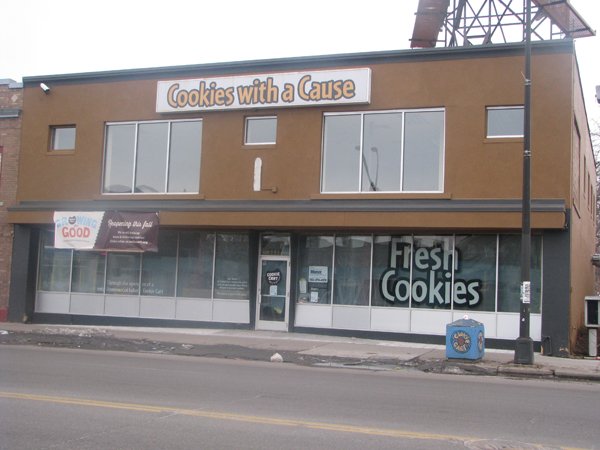
In the late 80’s and early 90’s, the world, the economy, the people and the way of living was vastly different from the way that things are now. Some people and organizations have decided to make the change with the times and improve their relationship to the land.
Minnesota’s anti-poverty programs are intended to incentivize work for those who are able, meaning that earning more money is usually a more lucrative deal than earning less money and remaining on public assistance. However, sometimes the numbers get a little wonky, creating “cliffs” where people lose a lot of assistance for earning just a little bit more money. Continue Reading
Workers at the JBS pork processing facility have voted overwhelmingly to authorize a strike, their union announced.
On April 25, I had the privilege of attending the Minneapolis City Council meeting where the local government body voted unanimously to observe Indigenous People’s Day on the day of the federal holiday known as Columbus Day. It felt important and correct that this change was made — even if, as some pointed out, it didn’t actually get rid of Columbus Day, which is a federal holiday. Instead, it was a local government body doing something they could actually control — the resolution paves the way to use Indigenous People’s Day instead of Columbus Day in various ways they communicate to the public that it’s a holiday, such as press releases that offices are closed, parking meter signs, etc.To me, it was an example of how large changes can start small. At times, the wrong in the world can feel overwhelming, especially when so many of the biggest decisions happen without much input from the average citizen. But when you look at something like the act of saying, “Hey, we know it’s a federal holiday, but we’re just going to go ahead and call it something else,” that can lead to bigger changes. Continue Reading
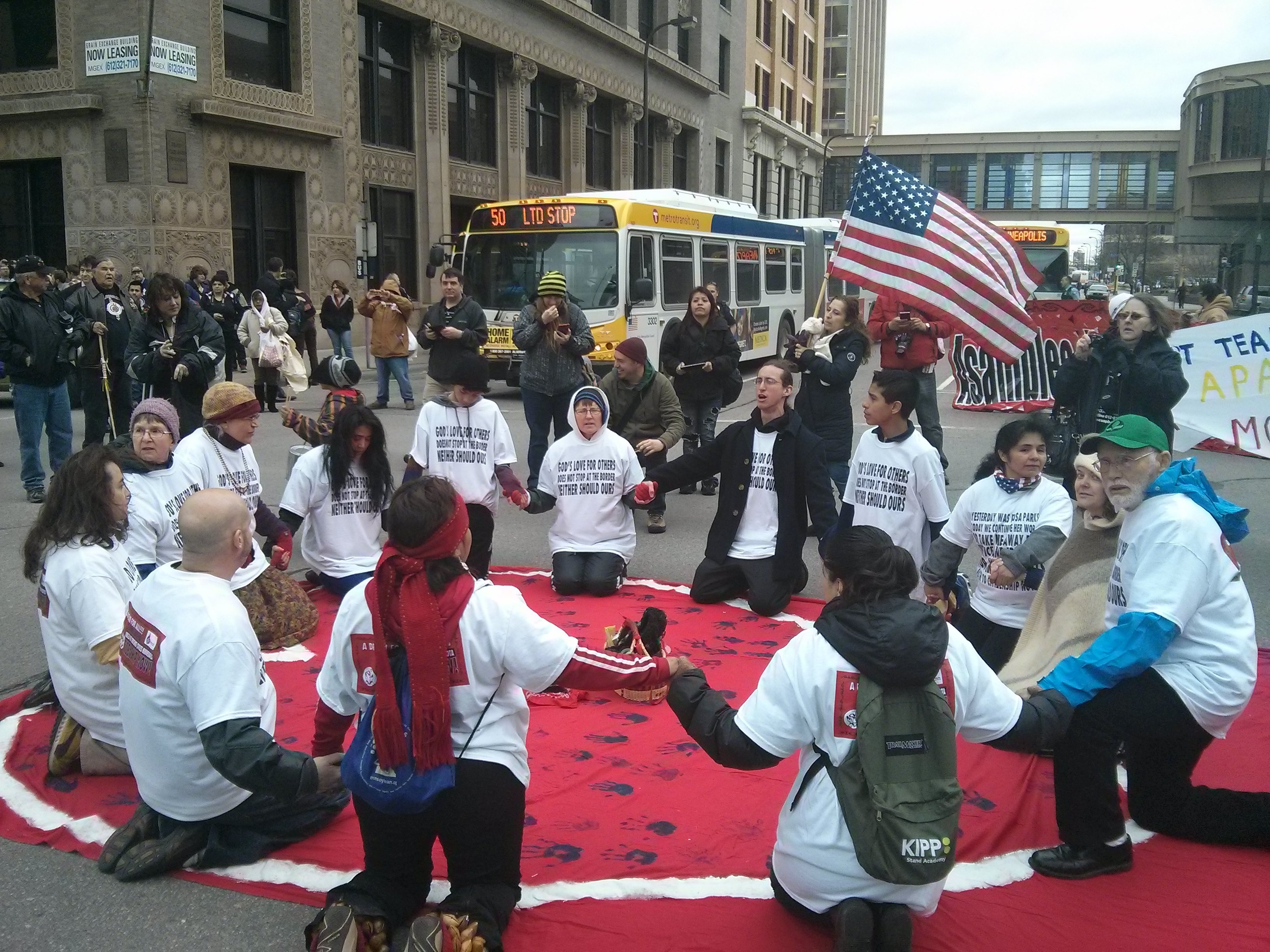
Members of Asamblea de Derechos Civiles (“Assembly for Civil Rights”), faith and labor groups, civil rights activists, including American Indian Movement leader Clyde Bellecourt, and a host of others, gathered at the Hennepin County Government Center in Minneapolis May 1 to call for comprehensive immigration reform and the end of deportations. The event kicked off in the morning with a bus tour of congressional offices aimed at pressuring key U.S. Representatives to sign the discharge petition for immigration reform legislation in order to allow a vote on comprehensive immigration reform. The demonstrators came together at the Hennepin County Government Center in the afternoon. Native American drumming and dance, and singing and chants in Spanish and English, helped warm up the crowd, as banners and flags blew in the biting wind. The size of the rally, roughly 100 people or so, didn’t match the groundswell at the St. Paul rally the same day. But what the marchers lacked in numbers they made up for in determination and grit, evidenced by the event’s dramatic close, an act of civil disobedience.Protesters took to the streets, shutting down the intersection of Fourth Street and Fourth Avenue during rush-hour, to the chagrin of police and commuters. Continue Reading

Volunteer plumbers from Minneapolis/St. Cloud Plumbers Local 15 and St. Paul/Mankato Plumbers Local 34 helped 81 needy homeowners as part of the 20th annual “Water’s Off” day of community service Saturday, April 5.