I love the idea of mashing up visual art, music and dance. Just last month I enjoyed a similar show (Stripe Tease) at the Walker. So I was thrilled to get walk-up tickets to the first of the Final Performances of In Which ____ and Others Discover the End Performance. I brought my favorite 10-year old date.There were things we liked about the show, things we didn’t like as much and things that confused us. But we talked about it the whole way home and I think that’s a win for a gallery that “encourages work that challenges the status quo in contemporary art.”We liked the art. Continue Reading
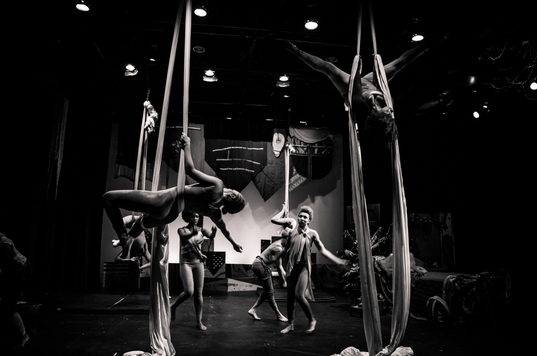
This past weekend, Free Black Dirt presented There Are Other Worlds a play written and directed by Junauda Petrus and produced by Erin Sharkey (these two form the core artistic team of Free Black Dirt). The work premiered as a work in progress at Open Eye Figure Theatre in 2013 and returns in 2015 as a fully realized play at Intermedia Arts in Minneapolis, MN.I have been carrying around this quote by Toni Morrison. “So Ralph Ellison writes ‘Invisible Man’ and as good as that book is, I have to ask, invisible to whom? Certainly not to me.” She is talking so succinctly about gaze, the white gaze, the male gaze and what it means to make art and for whose gaze. Junauda Petrus’s play There Are Other Worlds is the flip side to this question. The play is clearly written with a black female gaze in mind. The entire cast are women of color and the power and beauty present in this play comes from that root and love of Black Women. That the rest of us are invited to witness and imbibe is a gift and we are all stronger for it.I saw the play on the closing night after six sold out, standing room only performances. Such a response speaks to the fact that there is an audience eager and willing for this kind of work. On the political face of it we might merely say how important it is to support an emerging black woman playwright but this is art and what really matters is the actual work. There are Other Worlds is good theater. The play uses movement, aerial arts, more traditional scenes of dialogue and a vast soundtrack that both grounds the play in the late 1990’s with hip-hop of the time and spans time with music from other eras as the two young women, Dreamah and Sarya explore current music and also discover Sun Ra, Ornette Colman and other jazz greats. The original soundtrack created by Sarah White along with the use of aerial arts takes the play outside the day to day and into the universe/spirit realms. Joy Spika and Jordan Hamilton designed the set which is beautiful and layered. Tree branches, paper lanterns and mask like wire sculptures hang from the ceiling. One side of the stage is the bedroom of the teenage daughter Dreamah and is overflowing with rich color and vibrancy. The other side of the stage is stark with a yoga mat and pile of books and serves as the jail cell for Ameri. The stage also holds four location for the long white silks on which the women swing, climb, float, cocoon and spin doing aerial work. The rest of the set design is beautiful, evoking stars and cosmos and quilts and mathematical calculations but was wisely abstract enough to open up the worlds that were being created. The play centers on the frayed relationship between Ameri Akenyemi who has been in prison nine years and her two young daughters, the teenage Dreamah and the young adult Gospel. It also revolves around the transformative relationship between Dreamah and the wildly openhearted, Sarya Rice. Also present are ancestors, a group of talented dancers dressed in purple who appear and disappear; never speaking but evoking, dancing and at times literally holding up characters. Although never on stage fathers are also a strong presence with Ameri’s husband who is trying to hold and protect his daughters and Sarya’s father who she is painfully separated from as he deals with mental illness.The cast is universally strong. Nisreen Dawan as the incarcerated mother Ameri Akenyemi was effortless as both a young revolutionary falling in love with a caring man in college and as a 45 year old woman in prison, taken from her husband and daughters and trying to stay whole as one can in those circumstances. ShaVunda Horsley as Dreamah Akenyemi carried a good deal of the play forward. Her skill was apparent at being able to play Dreamah as young and innocent but not a caricature of youth. The arc of her characters transformation and path back to her mother and new found strength was both believable and moving.Felicia Perry played Gospel Akenyemi the slightly older and angrier sister and had some of the most challenging scenes both in terms of aerial work and drama. She is a riveting presence on stage and held the sense of anger and suffering without over acting it. Alissa Paris played Dreamah’s new found best friend Sarya Rice and had several scene stealing moments. Her kinetic energy and joyfulness were an important part of the play both soothing some of the pain and leading Dreamah forward. All of these strong performances are in service to a beautiful script by Junuada Petrus that is multilayered and complex full of humor and a natural ear for dialogue especially between the two young women Dreamah and Sarya. Without being preachy the script touches on a variety of intense issues around revolution and social change, white supremacy, living in a predominately white place, prison, rape, forgiveness, strength and love. So much love. The love of this mother for her children, the love of these young women for each other, family love, love of and love from ancestors, love of Blackness: as a people, as a source of beauty, creation and resistance. The use of aerial work was a perfect sister to the writing; the long silks were utilized by various characters and served as trees, wombs, and facilitated various journeys both physical and spiritual the characters embark on. Junuada Petrus wrote in the program about wanting to see more women of color involved in aerial performance and also her inspiration to use aerial as a reclaiming of Black and Brown bodies suspended in space from the horror of lynching. All but one of the actors were new to aerial work and the confidence and trust they had in their own bodies to climb essentially a long piece of cloth and wrap themselves in it and then unfurl often to the ground was beautiful to watch.There were two interconnected things I wanted that were not present. More breath and silence and to see Ameri engaged in her yoga practice. Continue Reading
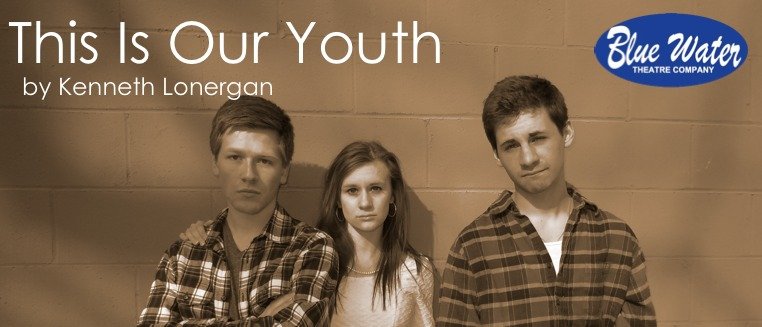
I’m not sure I should be reviewing Blue Water Theatre Company’s production of Kenneth Lonergan’s play This Is Our Youth. On the one hand, it is part of Southern Theater’s ARTshare offerings, and Blue Water is one of the resident companies this year. On the other hand, this could only charitably be called a full production, and I don’t think it helps anybody if I start grading on a curve. If reviewing Defying Gravity felt like kicking a puppy, I’m not sure where to take that metaphor if I start evaluating This Is Our Youth.“My father’s not a criminal, he just does business with criminals.”Part of it isn’t Blue Water’s fault. It’s the script. I will always have a soft spot in my heart for Kenneth Lonergan because of his film You Can Count On Me—early pre-Hulk Mark Ruffalo; beautifully crafted, funny, human story; a soundtrack of songs that still haunts me, I could go on. Continue Reading
I’m fully behind Gadfly Theatre Productions’ mission of creating queer and feminist theater and art. (Heck, I even took part in their original shorts festival last summer.) But Vanda’s Vile Affections isn’t doing them any favors. The script has so many unreliable narrators for this supposedly true but sparsely documented story of nuns under investigation in 17th century Italy that I not only lost the thread of the story, at a certain point I wasn’t even sure what the story was anymore. The case of Sister Benedetta Carlini (Amanda Kay Thomm Bahr) is notable for being one of the earliest documented cases of a lesbian affair. But Benedetta’s sexual relations with Sister Bartolomea Crivelli (Bart, for short) (Emily Weiss) don’t take place until well into the second act. Continue Reading
It’s tough being Jocasta (Laura Leffler-McCabe). Sure, you’re the queen of Thebes, but when your husband Laius (Daniel Ian Joeck) goes to the Oracle at Delphi (Hannah K. Holman) and gets a prophecy, it can seriously muck up your family planning. The Oracle tells Laius that his as yet unborn son will grow up to kill his father (Laius) and marry his mother (Jocasta). What is Laius supposed to do? When a boy is born, you take him from his mother’s arms, hand him off to a shepherd (Foster Johns) and order the man to leave the baby on some far off hillside to die.“Nothing good can come from knowing the future.”The baby instead is left in care of a childless couple who raise him to be a young man named Oedpius (Nick Wolf). But when Oedipus, not knowing he’s adopted, receives the same prophecy that he will kill his father and marry his mother, he runs away from the people he thinks are his parents – and instead runs right into the people who really are his parents, and the whole thing plays out anyway. Oops. That’s Greek tragedy for ya.“It’s as though I’ve been here before. It’s as if I’ve always been here.”Savage Umbrella has turned the whole Oedipus legend on its head with their latest ensemble created production These Are The Men. It might just as aptly be called This Is The Woman because this retelling is focused on the story through Jocasta’s eyes. And a very non-linear sort of retelling it is. Jocasta has become unstuck in time. Her past, present and future are all jumbled up together. One moment she’s dealing with her less than ideal, less than gentle first husband Laius, the next moment she’s tangled up with her more affectionate second husband Oedipus. Nothing wrong with a husband young enough to be your son, unless of course he is your son. Careful there, cougar. One minute she’s having her new baby boy taken from her to be sacrificed to avoid the fallout of an unfortunate prophecy, the next minute she’s navigating the challenges of being a mother of four children – two girls, Antigone (Alana Horton) and Ismene (Heidi Jedlicka Halvarson), and twin boys Polynices (Mason Mahoney) and Iteocles (Russ Dugger). She’s being harangued on one side by the the blind prophet Tiresias (Lisa Brimmer), who also knows her unfortunate future, and outmaneuvered on the other side by her own brother Creon (Michael Ooms), a most adept political animal who still can’t bring himself to like his sister’s second husband Oedipus because, hmmm, something’s not quite right there. Throw in Siddeeqah Shabazz as Oedipus’ adoptive mother Merope, as well as a couple of gossipy servants, Irene and Agatha, and you’ve got quite a broad canvas on which to unfold your crazy, mixed up, disjointed story. No wonder Jocasta drinks a little too much in act one.“No choice. Just is.”By scrambling the narrative aggressively in act one, Savage Umbrella co-writers Blake E. Bolan (also the project’s director) and Laura Leffler-McCabe (the doomed leading lady of the story) get to introduce all the characters at once, providing each of them with an equal chance to capture the audience’s imagination and make an impact. They are all important to Jocasta, for better or worse, so it’s good the audience doesn’t need to feel rushed in getting to know them by a late introduction. Having introduced all the players in the first half, it gives the second half an opportunity to breathe with longer scenes and more meaningful interactions between characters. The broad strokes of the first half get filled in with the finer details in the second. The other nice thing about this strategy is that it gives the Oedipus novices in the audience plenty of opportunity to learn the contours of the story landscape, and the Greek mythology junkies plenty of inside “jokes” tucked inside the nooks and crannies of the tale. Watching the twin brothers slowly grow apart, for instance, has broader implications beyond These Are The Men’s story. Things that seem like throwaway lines such as “Antigone, go dig the grave” or “Is Antigone going to die?” can cast a long shadow depending on the angle from which you see them. This is where the ensemble created theater approach pays off – each character, no matter how “small” or incidental, gets a significant history, past, present and future built for them, because it isn’t just one or two people carrying the whole intellectual load of fleshing out the production. It takes a village (maybe two) to build a tapestry this intricate. Bolan and Leffler-McCabe worked with the current ensemble cast as well as dramaturg Megan Clark, and a whole crew of additional performers who took part in a summer workshop process last year (Neal Beckman, Lisa Marie Brimmer, Megan Clark, Tanner Curl, Joy Dolo Anfinson, Emily Dussault, Eric Elefson, Kathryn Fumie, Joe Halvarson, Theo Langason, Derek Lee Miller, Paul Rutledge, and Gwethalyn Williams) (dang).“Isn’t everything more complicated than history remembers?”How much does a person control their own fate? And if you find yourself in the middle of a horrible situation, is it better to torture yourself about it and wail and moan, or to try to make the best of it? If you don’t know you’re making a mistake, does it still count as a mistake? Is all love a good thing, or is some love wrong? Jocasta transforms into a remarkably good sport about the sick joke the universe is playing on her heart. The audience may find itself in the strange position of rooting for an incestuous couple to find a way to make things work. The reason for Jocasta’s final fateful decision and her instructions to Oedipus make what follows seem almost noble. It also fits neatly into the pre-existing narrative of the legend, allowing them to give all players in the story more depth and humanity without twisting the mythology into something beyond recognition. It’s a neat trick, and not easily done, so my hat’s off to all the collaborators on that score.“Let me take you somewhere. It is not a place you will like, but you will find it useful.”Jumping around in time also gives the play an opportunity to present a happy ending. Because, spoiler alert for beyond the play, this entire family is screwed. But Jocasta allows herself to revisit what was perhaps the happiest day in her life – her wedding day to Oedipus. From a storytelling standpoint, is that cheating? I honestly couldn’t tell you. I’ve been arguing that one both ways in my head ever since the lights came up after the show was over. In the moment, if you’re happy, that still counts, right? No matter what comes after? If you have a loving husband, if you create a family of smart capable children, that’s always a net positive. Right? These Are The Men has no easy answers. It almost demands you continue to juggle both sides of every question. It’s an intriguing way to reinvigorate a centuries old story.4-1/2 stars – Very Highly Recommended Continue Reading
It isn’t often that a piece of theater makes me want to crawl out of my own skin and yell at the characters on stage. And I mean that as a compliment. Theatre Pro Rata’s production of Steven Fechter’s play The Woodsman is that kind of theater. Normally, even when I’m totally engrossed in a play, I’m still scribbling my notes to come back to later, noting telling bits of dialogue and key elements of the design. Not giving anything away, there’s a key scene late in the action of The Woodsman where a former child molester named Walter (Adam Whisner), who has previously struck up a conversation with a pre-teen girl named Robin (Lillie Horton) in the park, crosses paths with her again. In my notes, I started writing the word I couldn’t say out loud, “Leave. Leave. Leave. Leave.” And I was directing that word just as much (or more) at Walter as I was to Robin. That’s the strange alchemy of The Woodsman. With a stellar cast under the sure directing hand of Erik Hoover, this Pro Rata production actually had me concerned for the well-being of a person who I understandably have very mixed feelings about. Just as much as a feared for Robin, I feared for Walter. Because The Woodsman had allowed me to see Walter as human. Not an uncomplicated human. Not a perfect human. But a human nonetheless.“He’s working on it. Maybe he’s fighting it. Same thing.”I struggled with how to define Walter just now when writing about him. Is he, is anyone, ever a former child molester? Can you say, as with addiction, a recovering child molester? Or is it, once a child molester, always a child molester? That last iteration is of course the thinking that I, and I’d wager most audience members, bring into a production like The Woodsman. Fechter’s script has a daunting task to perform, not just to help us to understand the inner workings of the mind and heart of a person like Walter, but to get us to somehow not dismiss him out of hand as irredeemable. Because that’s the question burning in the center of the play – can a person who’s done something horrible ever overcome that, in their own eyes as well as the eyes of others? Does society ever really forgive someone? Can someone who molests a child ever be punished enough? Do some people not deserve a second chance? And what do the answers to those questions say about not just them but the rest of us as a society?“What’s the worst thing you’ve ever done?”Walter has served 12 years in prison for molesting multiple girls between the ages of 10 and 12. Released from prison to try and build a new life for himself, the only apartment that will rent to him that he can afford is, inconveniently, not all that far away from a school. Some of the only people who will talk to Walter are his court appointed therapist Rosen (Ben Tallen), and his brother-in-law Carlos (James Rodriguez). Even Walter’s own sister won’t come to visit him, and doesn’t want him anywhere near her children. Someone itching to talk to Walter who he’d rather see less of is an unforgiving cop named Lucas (William Goblirsch), who is just waiting for Walter to screw up so they have an excuse to throw him back in jail. Despite the odds, Walter somehow manages to stumble upon a woman who is willing to tackle the obstacles of building a relationship with him in his co-worker Nikki (Katherine Kupiecki). One of the unexpected complications of living so close to the school is that Walter spies a young man much like he used to be, loitering around the schoolyard, this one engaging schoolboys in conversation, and trying to lure them to take a ride in his car. And then there’s Walter’s chance meeting with young Robin in the park.“Uncommon beauty is commonly overlooked. Most people only notice the birds with the brightest colors.”Everyone involved here is doing top notch work, particularly Hoover and his cast. Adam Whisner seems to enjoy creeping me out. He started the year unsettling me in Loudmouth Collective’s production of A Bright New Boise, and now here he is again, inhabiting a character I’m not sure I want to spend time with, and yet can’t help feeling compelled to keep watching. It’s a great performance. Also to be lauded is Lillie Horton as Robin. The girl’s scenes with Walter are incredibly complex and layered, and Horton gives a performance to match the quality of the writing and the skill of the acting partner she has in Whisner, moment by moment. Goblirsch, Kupiecki, Rodriguez, and Tallen all contribute their own strange surprises and awkward revelations to the mix, making it plain that no one’s perfect, and maybe all of us aren’t as immune to mistakes as we’d like to think we are.“You know what the worst kind of trouble is? It’s trouble you bring on the people you love most.”Director Hoover has also gathered a design team that reinforces the complicated nature of the story. Matthew Vichlach’s sound design in particular is incredibly evocative and adds a lot to the exploration of the troubled psyche of the central character, backed up by Julia Carlis’ lighting design and Derek Lee Miller’s starkly black and white backdrops that also serve as a forum for some unnerving shadow play throughout the tale. The smooth way this design enables Hoover and his cast to transition straight from one scene into the next without pause, sometimes even overlapping the end of one scene with the beginning of another, keeps the momentum of the story moving as it needs to, not allowing the audience a chance to disengage. One last shout-out to Vichlach, the pre-show music is damn near perfect. If you want to make me a little nervous, put on Bruce Springsteen’s “State Trooper” or The Who’s “Behind Blue Eyes” (“And if I swallow anything evil, put your fingers down my throat” is pretty much the theme song for this show in two lines.)“Why did I take that chance? What did I want to happen?”But here’s where I start to part company, both with the script and the production. I’d like to unequivocally endorse Theatre Pro Rata’s presentation of The Woodsman because in many ways I think it’s an amazing piece of writing and it’s delivered with the appropriate level of intensity and sensitivity. The subject matter could easily be sensationalized and tip over into melodrama, but The Woodsman does the more difficult and interesting job of putting the audience in the position of having to make up its own mind about how they feel about the complicated questions it presents. With one notable exception, the play never stacks the deck or tips its hand.“[The Woodsman] cuts open the wolf’s stomach and one girl steps out alive.”That exception is one of the tactics used to help humanize Walter and put his crimes in some kind of perspective. Fechter’s play seems to be saying at numerous points along the way, “Sure, what Walter did was horrible, but there are worse things.” What worse things, you ask? Why, incest and gay pedophilia, of course. I’m assuming this has to be unintentional, both on the part of the play and the production. At least I hope it is. But the play keeps stepping in it, so I feel like I can’t let it go unremarked. In trying to explain his past crimes to Niiki, Walter says “I never hurt them.” Well, yeah, Walter, you did. You molested them. Do you mean you were gentle, that you never violently raped them? Well, what kind of rape is acceptable? None. Is an underage girl capable of giving consent, or, God forgive me for typing this, “wanting it?” We hold adults to a higher standard. That’s why you went to prison. Yes, the play could just be showing us that Walter is lying to himself as well as others, but since no one calls Walter on his bullsh*t, the play leaves his assertions unchallenged and lets everyone, onstage and in the audience, off the hook just a little.“You once did some bad things but inside you’re a good man.”When Walter finds out someone is being molested by their father, it is repulsive to him. Granted, this also helps Walter wake up to the severity of what he’s done and is tempted to do again. But there’s just this slight veneer over the scene that seems to be saying, “Incest, how horrible. I would never do such a thing to my own child or a child to whom I was related.” No, Walter, you just do it to other people’s children. That’s SO much better. “No parole, no nothing. Just steel bars and death.”The cherry on top of this moral relativist ice cream sundae is Walter’s obsession with watching the guy watching the boys in the schoolyard across the street. This (implied) gay man gives the the boys candy to help initiate contact, so Walter nicknames him Candy. Not Candy-Man, mind you. That gives the guy too much credit for masculinity. Just Candy. A nickname with feminine connotations, because why not throw misogyny on the pile while you’re at it. Candy is a fit good-looking young man (you know the gays, they work out and take care of themselves and their appearance). As Walter narrates Candy’s stalking of his victims, a shadow play of life-size puppets plays out behind screens. I don’t know if this is a suggestion of the script or an added choice of the production, so it’s hard to know who to blame here, but c’mon. Candy is a dark, two-dimensional, slightly less than human silhouette. So is his young target, but the audience is naturally drawn to sympathize with the boy and look upon Candy as the monster in this scenario. In the play’s final moments we also find out that Candy is wanted for raping a boy in another jurisdiction. Because, you know, anal sex is the worst thing ever.“Will I ever be normal?”I’m not saying that child molesters of all stripes aren’t monsters. I’m just saying that the way to make Walter look not so bad is not to try and make other people look worse. The play also, by having one straight child molester, one incestuous child molester, and one gay child molester is creating a false equivalency. Gays have all been painted as child molesters as a public relations tactic in this country’s culture wars for years. Statistics don’t bear this out. The vast majority of child molesters, just like the vast majority of the population, are straight. And the bulk of them aren’t also incestuous. The inadvertent one to one to one correlation set up by the play, however accidental it might be, still isn’t doing anyone any favors. It’s a sloppy, ham-handed move by a script that is otherwise quite deft in handling very tricky subject matter. But the longer this scenario played out in the production, the more I found myself rolling my eyes and thinking, “Oh man, a bunch of straight people picked this play, didn’t they? I bet it never occurred to them, or if it did, they felt it probably wasn’t so bad.” Uh, it’s bad, guys. It’s bad.“So, how are you adjusting?”That said, Theatre Pro Rata’s production of The Woodsman is a smart, skilled piece of theater. I’m still recommending it highly. Just like Walter, if you can forgive the play for its faults, you’ll come away understanding something a little better that you thought was beyond understanding. That’s a pretty fair trade off for an evening of your time, and a lot more than many theaters will deliver.4-1/2 stars – Very Highly Recommended Continue Reading
The Theatre Unbound logo is a corset loosened, suggesting the opening of a woman’s body, heart, soul, social status, and very being. Theatre Unbound is where stories by, for and about women are particularly valued, where everyone is invited, and where one hopes that views and perspectives will be broadened!This year’s Girl Shorts is a festival of short plays, short stories, and a series of short dances produced by Theatre Unbound in collaboration with 20% Theatre Company, Gadfly Theatre Production’s, Table Salt Productions, Erin Sheppard Presents, and Raw Sugar. Audience members can choose to attend one set of three to four presentations for $12 or attend the whole festival for only $ 30, now through March 15th. What a bargain! My comments are based on the order in which I saw each set on Saturday.1. Continue Reading