Since the start of the nuclear age, the State of Minnesota has monitored radiation levels within its borders. In recent decades, that responsibility has fallen to the Minnesota Department of Continue Reading
Sugarbushing begins in February when the snow is still on the ground and the sap in the sugar maple trees begins to rise. At the the Wozupi Tribal Gardens’ grove in Prior Lake, that still means it’s time to get to work. But, it no longer means pulling out the metal taps, the stainless steel buckets and the kettles.“Buckets are for hobbyists,” said Rebecca Yoshino, the director of the Wozupi Tribal Gardens and the maple syrup operation for the Shakopee Mdewakanton Sioux Community. “The bucket system is very labor intensive. You had to put the buckets up and take them down every year. Continue Reading
It’s the sort of post-moronic (and moneyed) politics Bluestem has come to expect from Speaker Daudt’s majority, foreshadowed by the leader’s removal of “Energy” from the Environmental and Natural Resources committee to team it up with “Jobs.”In Tuesday’s floor session, Minnesota House Environment and Natural Resources minority lead Rick Hansen ( DFL-South St. Paul) moved to have HF333 pulled from the House Ways and Means Committee and sent to the Environment Committee.HF333, a bill that would require legislative approval of a state plan to comply with federal regulations regarding emissions from existing power plants, would be paid for by the state’s environmental fund. Implementing the lanuage would be be part of work of the Minnesota Pollution Control Agency (MPCA). The “federal regulations” about air emissions is part of the implementation of the federal Clean Air Act.Hansen also noted that plans for regulating power plant emissions are part of addressing climate change, another concern tasked to the Environment Committee.In short, this bill has everything to do with environmental policy and funding. Bill author, Becker Republican Jim Newberger, opposed Hansen’s motion–prompting a remarkable line of questioning from Rep. Ryan Winkler (DFL-Golden Valley).Newberger: . Continue Reading
Last month, MinnPost’s Ron Meador outlined climate change’s likely impact on Minnesota over the course of the coming century. Meador’s article, and the study to which it referred, adds a sobering close-to-home detail to our collective knowledge about the risks associated with climate change.Meador’s article, and others like it, should spur us to action. To date, governments and others at national and local levels have offered a variety of fix-it plans. These plans include increasing efficiency standards of cars, moving to renewable energy sources, designing carbon capture models, geoengineering, and implementation of new “green” construction standards, among other related suggestions.Markedly absent in mainstream conversations are suggestions that Americans simply consume less. Ideas that do circulate about lifestyle change tend to be either “back to the land” proposals or framed in the language of “giving people options”: bicycle lanes give people the option to get out of their cars; condos provide snazzy options for young people and empty nesters. Continue Reading
A new plan aimed at preserving water resources in the metro area is set to begin next month.A public hearing for the Metropolitan Council’s Water Resources Management Plan, which is part of a larger 30-year plan, called Thrive MSP 2040, was held Tuesday.The council will adopt the new water resources plan in April, and it will address treatment of waste water, as well as prescribe steps to protect surface water and conserve water supply, said Judy Sventek, Metropolitan Council’s manager of the water resources assessment.“It’s all of us working together to get that end goal of sustainable water resources,” Sventek said. “It’s a very high goal, and it’s going to take a while.”The full 2040 plan will also focus on transportation, housing and public parks in the city.The plan will serve as a blueprint to find the best use of infrastructure and resources, and it highlights Twin Cities areas that need funding, Ward 1 Minneapolis City Councilman Kevin Reich said.Patricia Nauman, executive director of Metro Cities, a community group tasked with overseeing the Metropolitan Council, said at the public hearing Tuesday that she is concerned the new water resources plan doesn’t define what the council’s role would be in its implementation.“Making sure that there is clarity around those roles will be very important,” she said at the hearing.City officials recently discussed the plan and prepared comments, which were approved at a Transportation and Public Works Committee meeting last week.Reich said the plan misjudged Minneapolis’ growth in the next 10 years.City researchers think population and development will increase in the Twin Cities in the future, which is contrary to the plan that says growth will occur outside the cities in suburbs, he said.Reich said misallocating resources to the suburbs instead of the city could lead to monetary losses for local governments.Lisa Cerney, director of surface water and sewers for Minneapolis Public Works said the new plan is centered on viewing issues related to the region’s water resources as a whole.This water plan focuses on cooperation between local governments and nonprofit organizations, Sventek said.The full City Council will prepare its feedback to the plan next week and submit it to the Metropolitan Council.[See original article here: http://www.mndaily.com/news/metro-state/2015/03/10/metropolitan-council-water-plan-gets-feedback] Continue Reading
In mid-December the Obama administration announced it would begin to normalize relations with Cuba, opening the door to potentially lucrative new markets. Now, Minnesota farmers want to be among the first to move through it.The House Agriculture Finance Committee heard legislation Tuesday which seeks to help them do just that. HF772, sponsored by Rep. Jack Considine Jr. (DFL-Mankato), would provide $100,000 to identify existing and emerging opportunities in Cuba for Minnesota’s agricultural producers.“I believe there’s an opportunity for the best family farmers in the world, here in Minnesota, to expand the markets in Cuba as the restrictions are being lifted,” Considine said. “I’d like to see us get down there first.”The bill, which was laid over for possible omnibus bill inclusion, would also direct the Department of Agriculture to effectively communicate these opportunities to producers and processors. The companion, SF733, is sponsored by Sen. Dan Sparks(DFL-Austin) and awaits action by the Senate Finance Committee. Continue Reading
My University of Minnesota colleague Elizabeth Wilson lives on the quintessential neighborhood street in St. Anthony Park (St. Paul). While riding her bike to work she was sucking diesel exhaust from four different school buses running down her street; these four buses were taking kids to four different elementary schools. She thought about the transport and environmental implications of such; she corralled Julian Marshall and me (and others) to do a study. Continue Reading
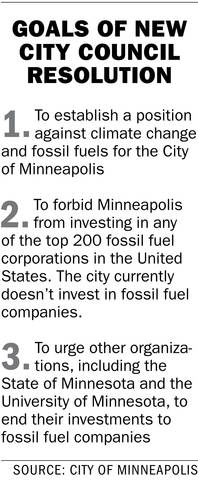
A group of students and other Minneapolis residents gathered at City Hall on Monday in support of the city’s continued divestment from fossil fuels and urged other state agencies to follow.City officials passed a motion at a Health, Environment, and Community Engagement Committee meeting that asks the city to take a clear stance against the use of high-carbon energy and refrain from investing in fossil fuel corporations in the future. It also aims to push other bodies, including the state of Minnesota and the University of Minnesota, to divest.Councilmembers Cam Gordon and Alondra Cano, of Wards 2 and 9 respectively, proposed the resolution, which the full council will vote on March 20. More than 15 students and community members were present for the hearing portion of the meeting, and six speakers were current or former University students.Cano said the turnout at Monday’s public hearing was a sign of support for the resolution. She said she’s proud of the young people who speak out against fossil fuels, and the priority of this resolution was to establish the city’s stance against fossil fuel companies.If the state were to pass legislation and approve divestment, Gordon said, it would be following the precedent set in the 1980s when Minnesota divested from apartheid South Africa.Noah Shavit-Lonstein, an officer of the University student group Fossil Free Minnesota, said it’s important to get people in positions of power to pressure other groups to divest, causing a ripple effect.Shavit-Lonstein said Fossil Free Minnesota started with the help of Minnesota 350, a nonprofit dedicated to divestment from fossil fuels.He said the plan to get the city to support divestment started last year when Minnesota 350 and Fossil Free Minnesota contacted city officials.Patty O’Keefe, divestment coordinator for Minnesota 350, said Fossil Free Minnesota and the proposal are all part of the same movement.Minnesota 350 started in 2010 to combat climate change, O’Keefe said, but the push for divestment from coal, oil and natural gas gained traction in 2012.“Climate change is threatening all life on this planet … including humans, and the fossil fuel industry is … driving us further and further into this crisis,” O’Keefe said.At the committee meeting Monday, O’Keefe said $50 billion is currently dedicated to divestment nationwide. And although the motion by city officials is largely only symbolic, she said it’s a step in the right direction.“The city of Minneapolis, along with its residents and activists and organizers are leaders in this area,” Cano said. “Being a leader isn’t easy … it’s really important that we take this step and show the nation that this can be done.” [See original article here: http://www.mndaily.com/news/metro-state/2015/03/02/city-may-adopt-new-fossil-fuel-stance] Continue Reading
The first of nine public and evidentiary hearings this month on the proposed Minnesota reach of the Sandpiper Pipeline convened on January 5th at St. Paul’s River Center. Ballrooms A and B, combined, are as large as Iowa and more than 200 citizens showed up to listen and/or speak. I was there for about an hour with my video camera; the session went on into the night. The hearings are being conducted by the Minnesota Public Utilities Commission and provide ample time for pro and con opinion and, under oath, experts, scientists, State DNR and MPCA regulators and Enbridge Oil, Inc. officials to present factual and clarifying information. The approximately 600-mile long pipeline would carry Bakken crude oil from North Dakota to Superior, Wisconsin. About 300 miles or more of it would pass through Minnesota. 75% of Enbridge’s proposed Sandpiper alignment in Minnesota would be constructed within existing pipeline corridors. There are alternate pipeline alignments in the discussion, at least one of which would run entirely within existing pipeline corridors. Minnesota Center for Environmental Advocacy (MCEA) attorney Kathryn Hoffman and others say that 25% of the alignment favored by Enbridge goes through sensitive peat and bog lands, forests and lake and stream watersheds. MCEA and citizen groups including Honor the Earth and Friends of the Headwaters oppose the Enbridge plan. It gets complicated being that the review and approval/denial process involves studies, reports and claims being generated by the Minnesota Department of Commerce, the MN DNR, MPCA, Enbridge, organized labor and others. MCEA and Friends of the Headwaters have jointly filed a suit in Ramsey County requesting a full Environmental Impact Statement (EIS) on the thing. Add in just a few of the operating acronyms – EIS, PUC, EPA, FOH – and it gets very complicated for the un-baptized. But on the current edition of Democratic Visions, Kathryn Hoffman, Tim O’Brien and the Dem Vis graphics/editor guy admirably service we non-wonks. The O’Brien and Hoffman discussion is followed by a satirical, animated short film crafted by Vancouver-based editorial cartoonist Dan Murphy. Murphy’s targets are Canada’s oil executives, pipeline politicians and its image, now dripping with tar-sand oil. As grandson and grandmother characters, Brandon Boat and Maggie Sotos from The Theater of Public Policy (T2P2) weigh in on the generation gap among Minnesota Democrats in an improvised sketch and humorist/provocateur Mike Gelfand speaks of the distracted drivers in his St. Louis Park neighborhood. Democratic Visions is an independently produced public access television monthly that can be viewed on flat screen sets in the following cities – SW ‘burbs — Channel 15 in Eden Prairie, Richfield, Minnetonka, Edina and Hopkins – Sundays 9 p.m., Mondays 10 p.m., Wednesdays 5:30 p.m., Saturdays 2 p.m. Bloomington – BCAT Channel 16 – Tuesdays at 2:00 p.m. & 10:00 p.m.; Fridays at 9:30 p.m.; Saturdays at 7:30 a.m. & 2:30 p.m.Minneapolis – MTN Channel 16 – Sundays at 8:30 p.m., Mondays 3:30 a.m., 9:30 a.m., 2:30 p.m. Program is streamed at the MTN website during cablecasts. Continue Reading