
Love it or list it? HGTV challenges for public schools
|
Imagine the public school system as a house, Mary Cecconi said. The house is not working for us. Do we move? Do we tear it down? Do we renovate? Continue Reading
Twin Cities Daily Planet (https://www.tcdailyplanet.net/author/mary-turck/page/18/)

Mary Turck (maryturck@gmail.com) is a freelance writer, editor, teacher, and lifelong activist. She is the former editor of the TC Daily Planet, the Connection to the Americas and AMERICAS.ORG. She is also a recovering attorney and the author of many books for young people (and a few for adults), mostly focusing on historical and social issues. She lives in St. Paul with her husband, two daughters, and two cats.
Imagine the public school system as a house, Mary Cecconi said. The house is not working for us. Do we move? Do we tear it down? Do we renovate? Continue Reading
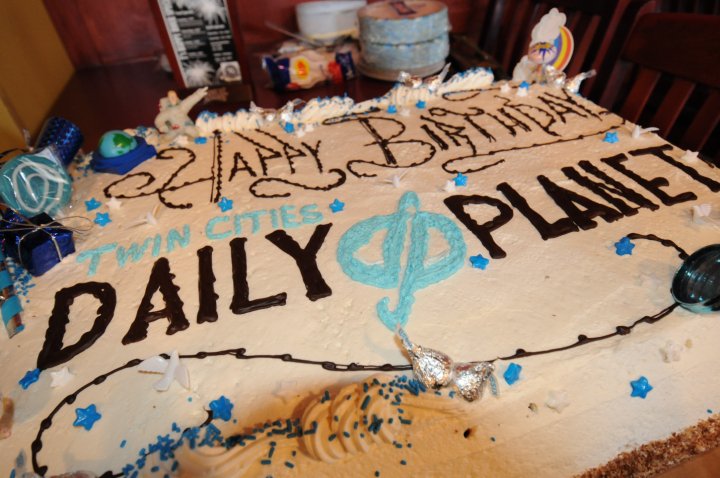
It’s the Twin Cities Daily Planet’s 7th Birthday! Come celebrate with readers, writers, editors, board members, contributors, and partners.
Green Central is implementing a program called Developmental Dual Language, one of four dual language approaches in MPS, along with Two-Way Dual Language Programs, Transitional Dual Language Programs, and Heritage and Culture programs. The program is also in place at Jefferson in grades K-2 and at Andersen United elementary school. A working document from MPS describes the goals of DDL:”Developmental Dual Language Programs are informed by the principle that higher levels of proficiency (both oral and written) in a language are fueled by using the language for meaningful, challenging learning. As such, DDL programs strive to offer equal proportions of core academic coursework in English and in the Home Language.”Goal: Full Bilingualism & Biliteracy. At the heart of DDL is the conviction that full proficiency in two languages is a valuable asset and a powerful resource for learning. Students with a Home Language Other Than English are in a uniquely privileged position to develop such full bilingualism. Continue Reading

I hate throwing away food, but sometimes … I bought the lettuce and strawberries with the best intentions in the world, but we didn’t get a salad made and they migrated to the bottom of the produce drawer and now — YUCK!So I pick through the rest of the produce drawer contents, wash what’s salvageable, and disinfect the drawer. My slimy lettuce and moldy strawberries become part of what Eureka Recycling says is an average of $96 worth of food per household that hits the garbage bin or compost pile every month.This Saturday, May 18, at Minnesota Goes Green, Eureka will present a report on the financial, environmental and social impact of composting.Minnesota Goes Green, 9 a.m. – 6 p.m., The Saint Paul Union DepotIn a phone call today, Eureka spokesperson Dianna Kennedy told me the report is about more than composting — they want to focus on prevention first, helping people like me get better at actually eating the food we buy, rather than letting it end up in the compost pile. Eureka has just launched a website (Make Dirt, Not Waste) with tools and tips to help. According to a press statement:Last year, Eureka Recycling provided the City of Saint Paul with a proposal for a comprehensive composting program—including education for prevention and returning compost to improve Saint Paul soils. The City wanted to conduct a public process to hear directly from residents before making decisions for the 2014 budget. Continue Reading
I remember when Mother’s Day dinner for our very large family meant the A&W drive-in. Mother and Dad piled all of us in the station wagon and we feasted on California burgers and root beer. I know finances had a lot to do with it, but I bet that keeping all of us corralled in a car instead of running loose in a restaurant was also a factor in the dining decision.I’m sure that all of us would have been perfectly well-behaved in a restaurant. (Yes, Mom – really!) We would have been so intimidated that we would have folded our hands in our laps and kept quiet. Not like dinner at home — where one of the our past-times was watching the second hand on the clock over the dining room table, and counting how many people talked in ten seconds. Continue Reading

With Melvin Carter III leaving his First Ward city council seat on July 5, who’s next? While the City Council will probably make an interim appointment, candidates who want to serve out the rest of the two-year term will be running in the November 5 election. Among the earliest to announce:• Noel Nix has been Carter’s aide since September 2011, and before that worked at the Metropolitan Consortium of Community Developers and at Redesign, Inc.• Dai Thao, a Frogtown activist, was described in MinnPost:”Thao works as IT manager for the Greater Minneapolis Crisis Nursery and has been involved with ISAIAH, TakeAction Minnesota and causes in the Hmong American Community.”• Kazoua Kong-Thao, a former St. Paul school board member, sent out a press release saying, in part: “Light rail construction has hurt many businesses, especially our small, diverse stores and restaurants on University Avenue. They need the city’s help, and I will fight for them, because their success is a win for the city as well as the families that they support.”• Johnny Howard ran against Carter in 2011 as a Green Party candidate. Continue Reading

There’s a folk tale, variously attributed to India, China and Africa, about blind men describing an elephant. One feels the trunk and says the animal is like a snake. Another feels the leg, and describes the elephant as like a tree. And so on. The varying emphases of recent articles about for-profit higher education reminded me of that story.MPR reported that For-profit college grads perform as well as public university peers, while the Star Tribune headlined that Graduates of for-profits have more debt. Both articles (and a few others) were about an April 24 report from the Minnesota Office of Higher Education, For-Profit Postsecondary Institutions: A Review of Selected Institutions in Minnesota for Undergraduates. The articles left me with unanswered questions. Continue Reading

Earth Day was kind of a bust, with snow canceling all of the scheduled clean-up activities in both cities, but St. Paul is cleaning up now. The city launched a social media campaign — #CleanupStPaul — with a YouTube video and an invitation on the St. Paul Parks Facebook page. And everybody’s invited, all over the city. The City of St. Continue Reading
Think the end of the drought means no water problems? Think again. In lots of places, we are over-using groundwater, and the situation is getting worse by the year, if not by the month. That means more disappearing lakes and shorelines and, potentially, shortages in drinking water ahead, even in water-rich Minnesota.The Freshwater Society issued a report on Minnesota water last month that should be required reading for every legislator. White Bear Lake may be the first warning sign. Continue Reading