Jay Gabler is a digital producer at Minnesota Public Radio, creating online content for The Current and Classical MPR. He is a co-founder of The Tangential and a contributor to publications including Artforum.com. He was arts editor at the Twin Cities Daily Planet from 2007-2013. He lives in the Lowry Hill East neighborhood of Minneapolis.
A phone call to the Triple Rock Social Club confirms the truth of a policy just announced on the club’s Tumblr: Free Bacon Wednesdays have come to a close. “Yeah, it kind of comes out of nowhere for me too,” said the guy who answered the phone, “but it just came down: no more free bacon.” Per the Tumblr post:”Sorry guys, the free bacon Wednesdays have been cancelled until further notice, it’s nothing personal, no phone calls need to be made, and the cops don’t need to be called for the love of bacon. Bacon will still be an option on the menu for entrees.”Coverage of issues and events affecting Central Corridor communities is funded in part by a grant from the Central Corridor Funders Collaborative. Continue Reading
I wasn’t surprised when lawmakers recently decreed that the State of Minnesota would immediately cease funding out-of-state travel for artists (and, for that matter, travel to our state by non-Minnesotan artists). Any government funding for arts is always scrutinized intensely, and when even governors and presidents are criticized for travel using taxpayer funds, it’s only to be expected that artists would get the same treatment. What was more surprising, and deeply disappointing, was the manner in which the very brief and poorly-informed public discussion about this decision was held. For a state that prides itself on having a strong arts scene, in this instance Minnesotans acted like people who think that making art is a complete waste of time and money.The brouhaha began with an acid Watchdog.org report, written by Tom Steward, that highlighed the fact that a portion of Minnesota state funding for the arts goes to artists who use the money to—God forbid—temporarily leave Minnesota. Though Steward quoted a Minnesota State Arts Board (MSAB) representative who noted that grant applications are reviewed “in a rigorous, competitive manner” and also quoted Minnesota artists who spoke of the invaluable opportunities the state-supported travel gave them, the framing of the article revealed an assumption that the money supporting that travel was wasted. Continue Reading
Planet Earth: Understanding climate change. Act for the Planet is a group blog written by various Minnesotans sharing news and views about the topic of climate change. Continue Reading
We recently received this e-mail from a reader, who has given us permission to republish the e-mail but has asked to remain anonymous.I was really happy to see your article today by Alleen Brown on the recent Supreme Court decisions. It’s so easy to let the “hot” news stories suck all the oxygen out of the room, and then we miss the nuances of these types of shifts.However, I was very unhappy to see that your new format (looks nice by the way) does not include the non-corporate comment opportunity, as it has in the past.Really, this is pretty incomprehensible. What corporate board member or vendor has talked you into this?Facebook—funded by $175 million in Goldman Sachs funds, creating a data farm of half the planet. Google, innocuous, but for how long (?), as it accumulates valuable consumer data. Twitter, who knows what its trajectory is but it’s funded by T. Rowe Price and Morgan Stanley among others—and AOL, proven repeatedly to be a tool of the ruling class.As an activist, I see over and over how corporate groupthink consciously or unconsciously drives us over the edge into abandoning our principles and giving our mission over to the—who knows? Continue Reading
The sun is finally out—and so are cameras. Our readers shared some of their best summer shots. Want to add yours? Sharing your pics with us is easy: just tag them with #tcdpic on Instagram, Tumblr, Flickr, or Twitter—or e-mail them to jay@tcdailyplanet.net. Check back right here to see your photos in our gallery.Previous photo challenge: Fireworks! Continue Reading
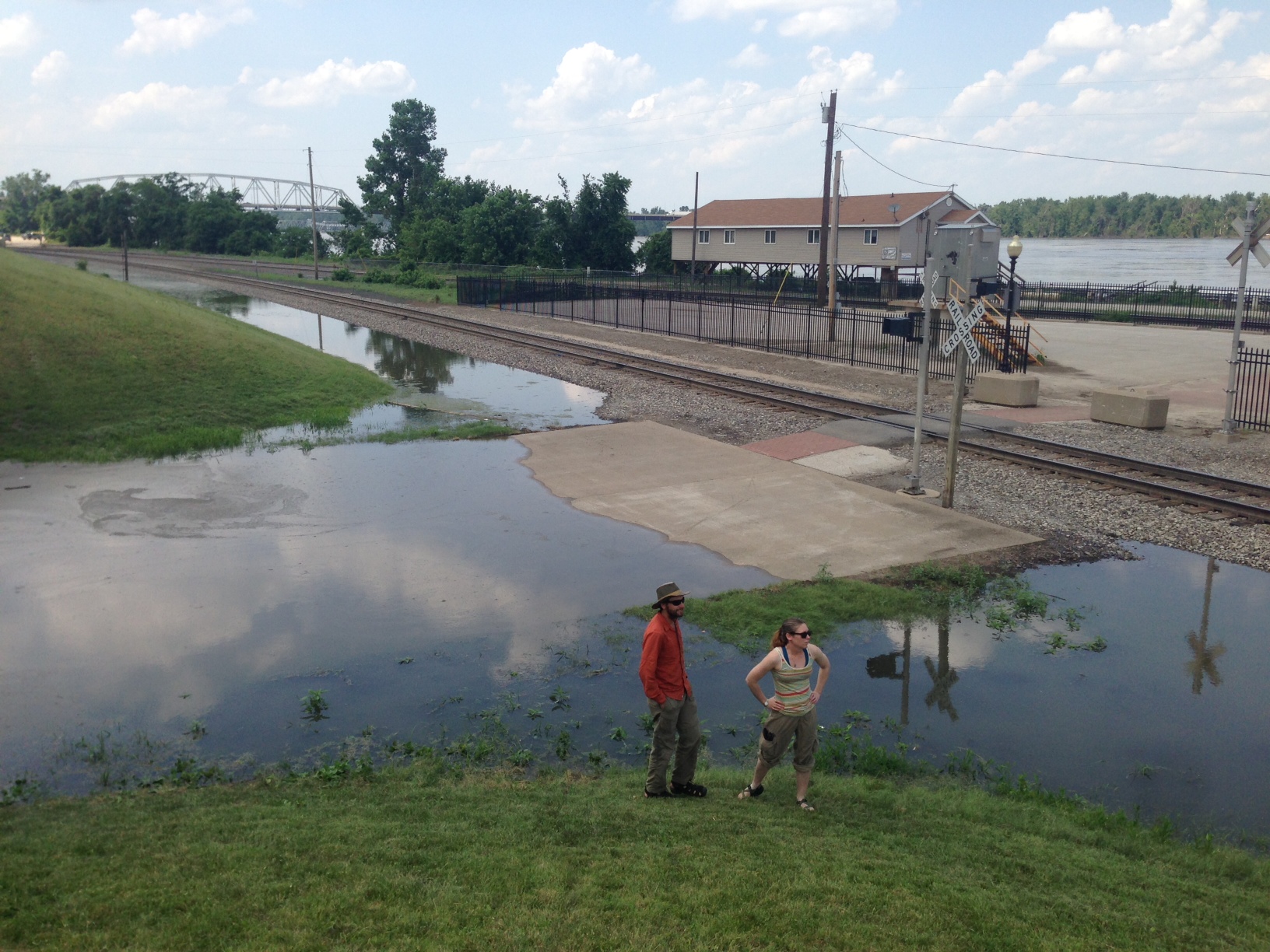
HANNIBAL, MISSOURI—I’m writing from Java Jive, “the first coffee shop west of the Mississippi.” My girlfriend Dana and I are on a rescue mission of sorts, helping our friends Linnea and Dave. They’ve been canoeing down the length of the Mississippi River, starting last month in Itasca. This week they reached the Quad Cities, where the water is high and rising.The rains that made for such a dour spring-into-summer in the Twin Cities have swelled the great river until it’s pushing at its banks from Minnesota to Missouri. Locks are closed, docks are barely above water, and here in Mark Twain’s home town, the flood gates are closed.The high water and quick current have made for easy canoeing—once Linnea and Dave are on the water. The trick is getting on the water, and off of it. Continue Reading
Our readers celebrated the Fourth of July with fireworks—and they shared their best shots with us! Check out the photo gallery above, and submit your pics for our next photo challenge: summer sun. Continue Reading
If the concept of “timely” can possibly apply to a civilization that reached its peak of population and prosperity 1,500 years ago, Maya, the giant exhibit now having its world premiere at the Science Museum of Minnesota, arrives at a good time for the ancient culture. After Mel Gibson’s bloody Apocalypto (2006) and the misreading that made the Mayan calendar a laughingstock when the world failed to end last year, it’s about time to step back and drop some cold hard science regarding this legendary civilization.Maya: Hidden Worlds Revealed does indeed deliver cold hard science, wrapped in a feel-good package that plays up the Mayans’ accomplishments in art, science, and sport while downplaying the bloody side of Mayan life. Nor does the exhibit delve too deeply into the question of the Mayans’ relatively sudden decline, now most commonly attributed to a drought that pushed the giant Mayan cities, which were already putting a severe strain on available natural resources, past the limits of sustainability.For understandable reasons, Maya is also relatively light on authentic artifacts. The most imposing structures in the exhibit are replicas, albeit in some cases made from casts that reveal more detail than could be seen on the decaying, vandalized originals. Still, the exhibit is cleanly designed, with about the right amount of text.The place to begin your Maya exploration is at the Omnitheater, where the film Mystery of the Maya provides, along with images of Mayan structures and artifacts in their original Mesoamerican context, a sense of drama that the exhibit distinctly lacks. Continue Reading