The court-ordered supplemental environmental assessment (EA) of the “Construction-Related Potential Impacts (of the Central Corridor project) on Business Revenues” cites studies of “Twelve highway construction projects in Wyoming in towns ranging in size from 807 to 53,011 people.” Additional studies cited include: “Highway reconstruction near Dubois, Wyoming on the way to Jack Continue Reading
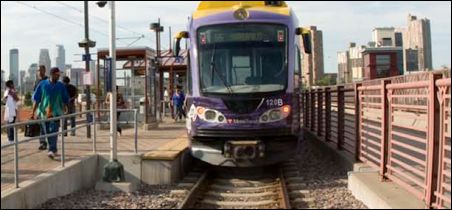
The Central Corridor light rail project survived a near miss in the House Capital Investment Committee. However, the impact of a successful amendment from Rep. Steve Drazkowski (R-Mazeppa) still leaves the project in jeopardy. The bill as amended was passed and sent to the House Ways and Means Committee. It has no Senate companion. A provision to defund a $42.8 million appropriation approved in 2008 for the line between downtown Minneapolis and downtown St. Continue Reading
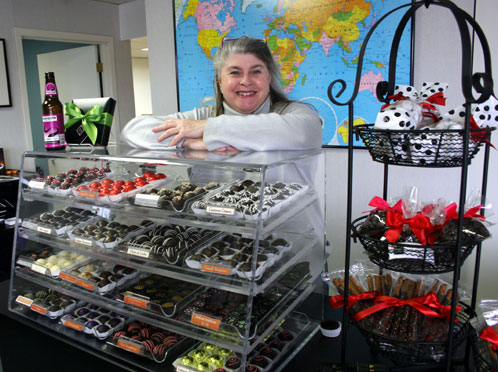
Valentine’s Day wasn’t so sweet this year for Mary Leonard, owner of the Chocolat Celeste. Leonard saw $20,000 in fewer sales, which she attributes to her business’ move from University to Tr
Maybe Jonathan Sage-Martinson says it best: “I think the real story might appear a year from now.”By that Sage-Martinson, coordinator of the Central Corridor Funders Collaborative, means construction of the Central Corridor Light Rail Line will send waves beyond the rail itself into nearby business and residential communities and somebody needs to keep a tab on its effect.To that end the collaborative today releases the Central Corridor Tracker, a set of 13 so-called Central Corridor indicators, baseline data to compare this year with the years ahead.The indexes include residents’ income levels, their access to shopping and services, the health of existing local businesses and appearance of new business and housing, increased employment opportunities, walkability, community involvement in the process and the racial and ethnic makeup of the community.The markers, Sage-Martinson says, will be used to objectively measure the effect of change along the corridor and progress toward four desired outcomes: “ensuring access to affordable housing, building a strong local economy, creating vibrant transit-oriented places, promoting effective coordination and collaboration.” Find details here and an in-depth presentation of the study prepared by Wilder Research.Community Sketchbook focuses on the economic and social challenges facing communities, especially low-income communities and communities of color, and how people are trying to address them. It is made possible by support from the John S. and James L. Knight Foundation, The Minneapolis Foundation, and some Minneapolis Foundation donor advisors.Community Sketchbook articles may be republished or distributed, in print or online, with credit to MinnPost and the foundations. “It’s our perspective that light rail in other communities has brought about great opportunities. It often attracts economic development. It brings access to living wage jobs. Continue Reading
It’s an exciting but scary time to be a University Avenue business owner. From restricted traffic and lane patterns to parking, Central Corridor business owners have plenty of concerns about thriving through light rail transit construction this spring and summer. Minnesota 2020 talked to proprietors who hope the temporary pain brings long-term progress to their doorstep. Continue Reading
If there’s one thing that everybody involved with the Central Corridor light-rail transit line can agree on, it’s that 2011 will not be a year of business-as-usual on west University Avenue.Preliminary utility work has provided a taste of what it will be like when heavy construction begins in a couple of weeks, starting on St. Paul’s western border at Emerald Street and moving steadily eastward, reaching Hamline Avenue by year’s end.The Metropolitan Council, the agency managing the project, said that work will start on the south side of University, with one lane open in each direction on the north side. Vehicle and pedestrian access is promised to all businesses. Nevertheless, it seems inevitable that the elimination of on-street parking and the hubbub associated with such a massive undertaking will complicate the task of moving through the zone and shopping in it.”We’ve told businesses that construction can be disruptive, and that they need to prepare for that disruption,” said Laura Baenen, Central Corridor spokesperson for the Metropolitan Council.Biggest project everThere are still a few hoops to jump through before the federal government commits to paying for the first half of the Central Corridor project, but the light-rail line clearly has momentum going for it. Some $145 million already has been spent on design, property acquisition and construction. Continue Reading
Eve Swan’s roots in the historic Rondo neighborhood of St. Paul run deep. As a child, she ran across the street from her two-story stucco home to the Jimmy Lee Rec Center along North Lexington Parkway to ride her bike and join in after-school craft activities. Now she both lives in and operates her own beauty salon out of that house on Concordia Avenue, maintaining her neighborhood connection for almost five decades and determined to not let the Central Corridor Light Rail Transit line sever it.Swan fears gentrification, the sweeping in of a new, wealthier order and wide displacement of her many working-class neighbors as well as small, independent, minority-owned businesses like hers and those on nearby University Avenue, which she patronizes regularly. “This is how we make our living.””I’m concerned people will be taxed out of their properties because of light rail and new construction,” said Swan, an African-American and one of about a dozen members of the Save Our Homes Coalition. Continue Reading
Central Corridor residents have lower incomes, higher unemployment, and pay a higher proportion of their income for housing costs, according to a set of studies released by the Healthy Corridors for All coalition on Saturday. The studies explored the effect of city plans for rezoning and redevelopment along the Central Corridor route on residents.
Parking and access to businesses along the Central Corridor was the prevailing concern voiced at two open house style town hall meetings on Thursday, February 17. The meetings were hosted by